It’s been over a week, and my issue is still unresolved even after complaining multiple times. When can I expect my internet to be fixed?
@Airtel_Presence@airtelindia@TRAI
@Airtel_Presence@airtelindia
I haven't been able to use my unlimited 5G for a few days now. It was working perfectly fine last week but suddenly stopped. I've already complained via call and multiple times through your useless chatbot, yet there's been no resolution.
Hey @LenovoLegion , I bought a Lenovo Legion 5 pro a few months ago. I requested a warranty upgrade on your website for incorrect warranty. I also sent the requested details by email. Please help me resolve this. Thank you!
@Lenovo_in@Lencare_In@Lenovo
@Deals_Decoder Is this good?
Take a look at this ASUS ROG Strix G16 (2023), Intel Intel Core i5 13th Gen 13450HX - (16 GB/1 TB SSD/Windows 11 Home/6 GB Graphics/NVIDIA GeForce RTX 3050) G614JJ-N3088WS Gaming Laptop on Flipkart
https://t.co/K2hGYgJxQB
Twitter is full of dumb people. Deepinder Goyal tweeted about Pure Veg fleet and uneducated frustrated people who want to direct their hate somewhere else immediately had a meltdown. Come on dude, Vegetarianism and Casteism aren’t related. There is no particular section of the society that is vegetarian.
India has opened its doors to 100% foreign direct investment (FDI) in the manufacture of satellite systems, without the need for official approval.
Here’s what you need to know:
- 100% FDI is allowed for the manufacturing of components and systems/subsystems for satellites, ground segments, and user segments without government approval.
- Up to 74% FDI is allowed under the automatic route for activities like satellite manufacturing, operation, data products, ground segmentation, and user segment. Beyond 74%, government approval is required.
- For launch vehicles, associated systems or subsystems, and for creating spaceports, up to 49% FDI is allowed, with government approval needed for higher investments.
This reform will encourage global players like SpaceX and Blue Origin to invest and give Indian companies access to the latest technological advancements and funds.
With over 150 start-ups already operating in the space sector, this liberalisation is set to propel India’s space industry to new heights. Following the liberalisation of the space sector, India eyes a $40 billion space economy by 2040.
Listed companies like Paras Defence and Space Technologies, MTAR Technologies, Taneja Aerospace and Aviation, HAL, and others, as well as unlisted startups like Agnikul, Skyroot, Erisha, Pixxel, and more, can now attract foreign investment, developed tech and global expertise to propel their growth.
#SpaceTech #FDI #Unioncabinet #investment #MTARTECH #spacesector #Growth
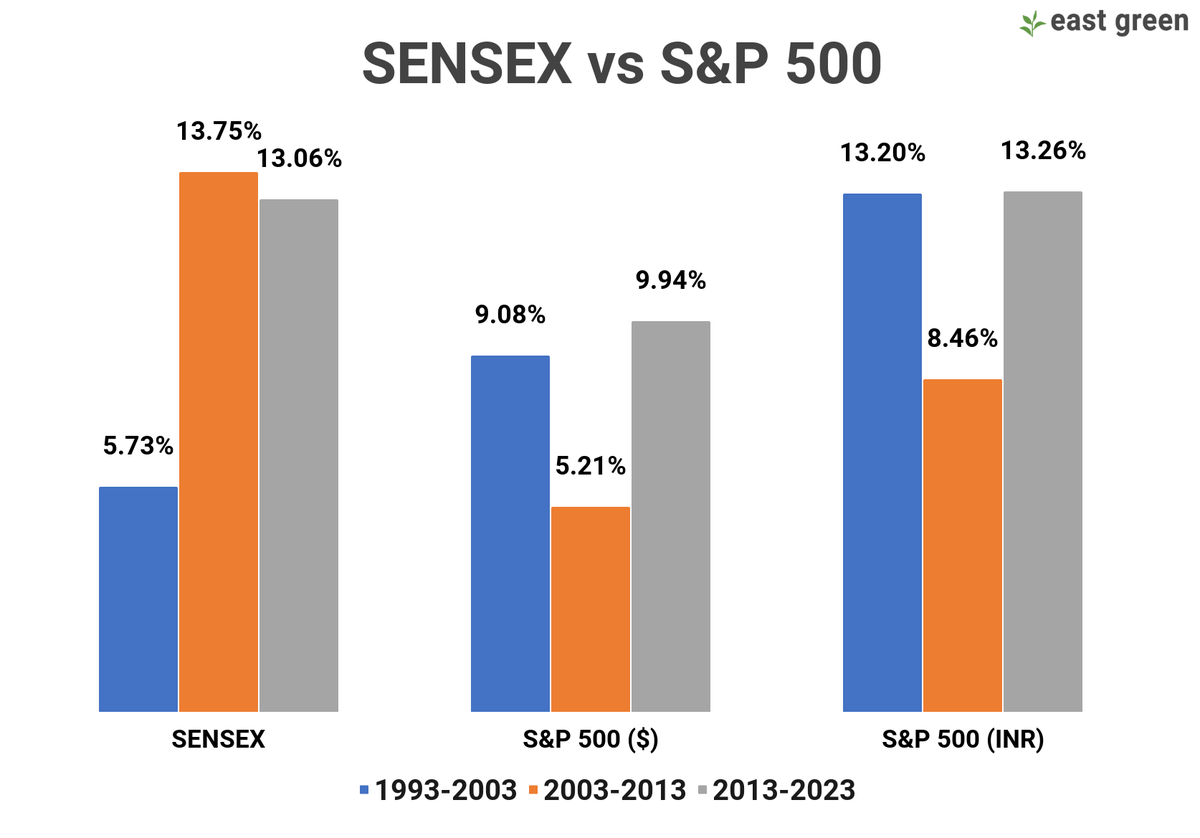
We are often asked about investing in American equities. Considering the size and vibrancy of the US economy, this investor query is not surprising.
The first analysis that an investor will typically do is compare returns between Indian and American markets. If we look at the past 3 decades (coinciding with India’s post liberalisation phase), Sensex has delivered returns at a CAGR of 10.78%, while for S&P 500 the comparable number has been 8.06%.
However, due to Rupee depreciation, the S&P 500 CAGR (in INR) in the same period is 11.62% which is an outperformance of 84 bps over the Sensex. This outperformance is not as high as many would have expected, but due to compounding over decades it isn’t insignificant either.
So would an Indian investor have benefited by investing in US equities over this period? This brings us to the second important factor to consider - transaction costs. To invest outside India, the investor would have to bear forex conversion charges, higher brokerage fees and ever evolving taxes. Adjusted for these, the two markets would have not so dissimilar return profiles.
Despite the stellar growth of the tech sector in the US, the Indian market has been able to hold its own. This is because of strong growth of the overall Indian economy post liberalisation - reflected in businesses across sectors. This growth trajectory is projected to continue for the foreseeable future too.
So what’s the take home message from this? If you are looking simply for better returns, the US market may or may not outperform the Indian market, particularly if the Rupee doesn’t depreciate as much (considering all the noise around de-dollarisation for instance). If you are, however, looking for exposure to specific businesses or to benefit from diversification, it might be worth the time and effort!
#StockmarketIndia #Sensex #economy #equity #NYSE
When we talk about investment options in India, the primary options include the stock market, gold, bonds, and real estate.
Unlike the other options that allow for minimum investments, real estate typically demands a significantly higher initial investment and involves complexities related to government policies.
However, for those interested in real estate without the associated challenges, Real Estate Investment Trusts (REITs) provide a solution, allowing individuals to invest with as little as Rs 300 - Rs 400 and gain exposure to real estate assets.
By opting for REITs, investors can sidestep the burdens of extensive paperwork, property maintenance, tenant searches, and negotiations. Additionally, concerns about local risks such as civic work and squatting are alleviated. This allows individuals to enjoy the benefits of real estate investment without getting entangled in the operational intricacies, as these concerns are outsourced to the trusts.
So, the question remains, what exactly is a REIT?
Imagine a pool where investors contribute their money, kind of like a joint account. This combined sum is then used by a skilled property manager to buy income-producing buildings like offices, hospitals, or IT parks. Investors don't directly own the buildings, but they receive shares or units in the pool, similar to mutual funds. These units represent their claim on the income generated by the properties.
In conclusion, REITs offer a unique and accessible way to invest in real estate. They bridge the gap between the desire for the benefits of real estate investments and the challenges of property management. This was all about what REITs are.
Stay tuned for future posts where we will delve deeper into the landscape of REITs in India, reasons to invest in REITs, how to analyse them, and much more.
(1/5)
#realestateinvesting #MarketInsights #investments #FinancialMarkets