We teach the skills to stay resilient in uncertain times. Courses cover: radio communications, first aid, food security, water purification, shelter, and more.
The world feels more unpredictable than ever — and that’s exactly why NOW is a great time to get into prepping.
Fuel prices are rising again due to instability in the Strait of Hormuz. Supply chains are being disrupted. Cyberattacks are increasing. Severe weather events are becoming more common. Grocery prices continue to climb, and many people are realizing just how fragile modern systems really are.
Prepping isn’t about fear — it’s about being ready.
It’s about having extra food and water, learning useful skills, improving your health, protecting your family, and becoming less dependent on systems that can fail without warning.
The people who prepare early are always in a better position than the people who wait until shelves are empty and panic begins.
Start small. Build a food supply. Improve your physical fitness. Learn first aid. Strengthen your home security. Have backup communications and power options. Every step you take now puts you ahead later.
Preparedness is peace of mind.
Sign up for our course at https://t.co/NHJBYetm8R
#Prepper #Preparedness #Survival #SelfReliance #EmergencyPreparedness #Homesteading #PrepperCommunity #SHTF #FoodStorage #OffGrid #PreparedNotScared #PrepperAcademy
🥵EXTREME FLORIDA HEAT!🥵
UPDATE: Models are continuing to increase the severity of the heat across #Florida, especially on Sunday, with many areas nearing or reaching 100s feels-like temps. NWS have highlighted areas to potentially see EXTREME HEAT IMPACTS! Stay hydrated!
#flwx
National Hurricane Preparedness Week starts on Sunday! Be ready for hurricane season. Take action TODAY to be better prepared for when the worst happens. Understand your risk from hurricanes, and more at https://t.co/I3lPOVTi0P #HurricanePrep#HurricaneStrong
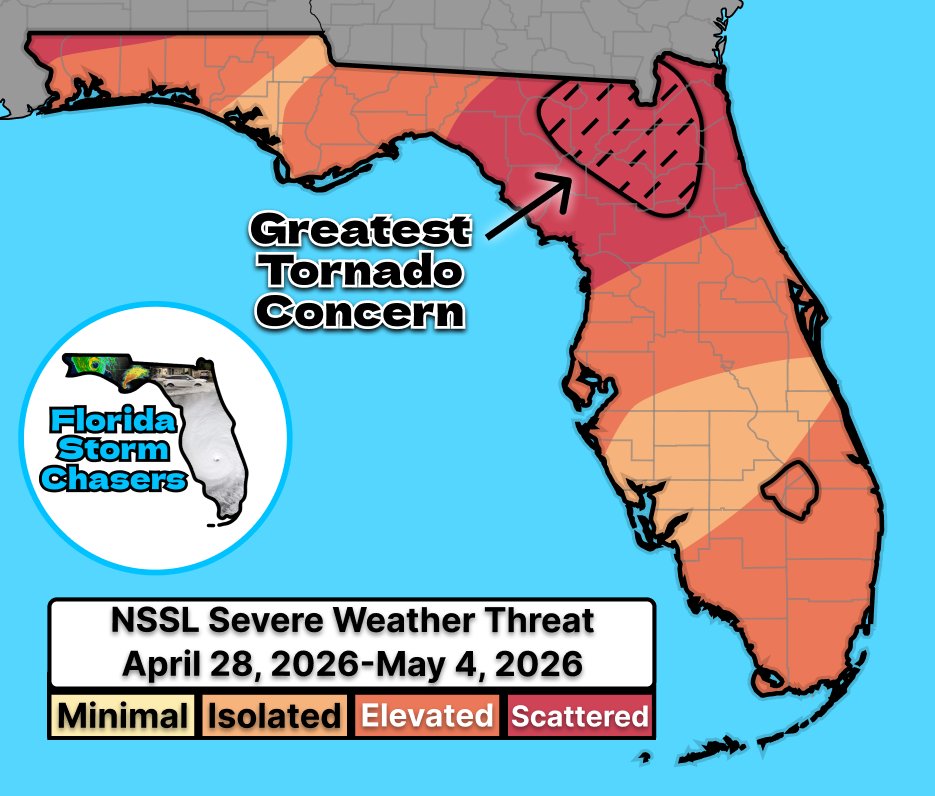
🌪️FLORIDA TORNADOES?🌪️
NEW: Models are beginning to get into agreement that a possible severe weather event will happen across the state this next week, with the main days being Friday-Sunday. The greatest #tornado concern exists near Jacksonville! We'll keep you updated!
#flwx
To be perfectly honest, the average person on here isn't important enough* to be the target of deliberate, organized political violence.
But you could become the target of opportunistic political violence.
If this is a concern of yours, I highly, highly recommend starting off by looking into your area's radical and revolutionary left wing groups.
Those could be political parties like DSA or PSL, anarchist collectives, or local political/social activist organizations. Most of these groups are easily identifiable because they hold meetings, schedule public events, and have social media accounts.
Map these groups and note their tactics, techniques, and procedures (TTPs) on everything from online presence to communication channels (social media, email, SMS, Signal, etc.) to forms of activism/militancy.
Get a sense for their capability and intent based on their online and in-person rhetoric and recent physical activities.
This is very basic threat analysis that will provide dividends for your security in the future. (Simply knowing they're in your backyard opens up a huge range of friendly operations against them, too.)
* Value is always in the eye of the beholder. You may not believe you're "important enough" to be targeted, and that may be true. But it doesn't mean that some unhinged, dysgenic freak agrees that you're unimportant. You may be to zim/zer.
@AHD_from_TX Complacency kills. Very soon, it will be everyday conservatives who will become targets. Be aware of your surroundings at all times and stay strapped.
Radicalization Is a Process, Not a Moment
Some of the brightest minds in the world have been radicalized.
Not because they lacked intelligence, but because intelligence does not protect against influence, identity shifts, or personal vulnerability. Increasingly, those pathways are forming in places people trust, including universities, social advocacy networks, and online communities that appear legitimate but gradually reinforce more extreme worldviews.
Radicalization does not start with violence. It starts with a shift in how someone sees the world. Complex issues become simplified. Nuance disappears. Everything becomes a binary of good versus evil or oppressed versus oppressor. Over time, people begin to reject outside perspectives and rely only on information that reinforces what they already believe.
From there, reinforcement takes over. People do not radicalize in isolation. They find networks that validate their thinking, whether online or in person, and those networks narrow their worldview even further. Disagreement is no longer debate. It becomes proof that others are part of the problem.
What often accelerates this process is personal grievance. Setbacks, isolation, or frustration become reframed as systemic injustice. Extremist narratives do not create those grievances, but they weaponize them. They validate the frustration and slowly shift the logic so that violence is no longer seen as wrong, but as justified or even necessary.
This is the part most people miss. By the time someone is openly supporting a terrorist group or discussing an attack, they are already deep into the process. At that point, you are not preventing terrorism. You are discovering it.
Real prevention happens earlier. It happens when you recognize the pattern. Isolation into echo chambers. Rigid thinking. Justification of violence. Curiosity about vulnerabilities or past attacks. No single behavior defines the threat, but together they form a trajectory.
We recently broke this down on @The_Watch_Floor (link posted below), focusing on how radicalization actually develops and what to look for before it reaches the operational stage. Because if we are only looking for the final step, like what unfolded outside the White House Correspondence Dinner last night, we are already too late.
You have nothing to lose from building strong local networks right now. You could eventually have everything to lose.
We're going to have to become a lot less civilized for what's coming.
Ready to get full access to an entire library and course on prepping and survival? Just a very low one-time payment gets you full and instant access to our library and courses. Our library has over 3,000 documents on all prepping and homesteading topics. https://t.co/NHJBYetm8R #prepping #prepper #survival #survivalist #survivalskills #preparedness #survivaltraining #emergencypreparedness
Your Area Study is a local (tactical) intelligence picture of anything in your area that could affect you before or during an emergency or disaster, either natural or man-made.
You do an Area Study to find out two things, broadly: what you're up against locally (threats, hazards, vulnerabilities) and what you have to work with (assets, resources, opportunities).
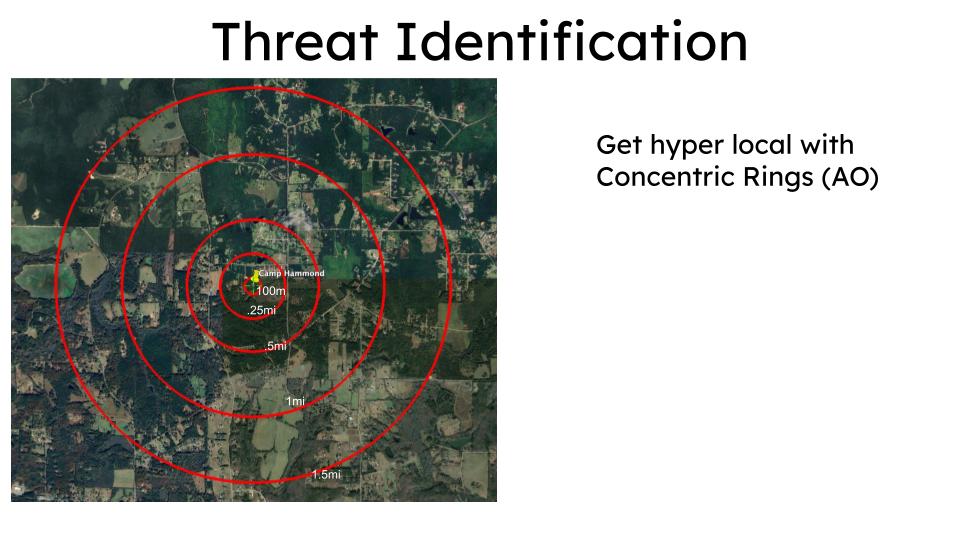
There are two really good ways to begin identifying these things. One is map reconnaissance, or in this case using fresh imagery.
Step 1. Start of by opening up Google Earth, or preferably loading commercially-acquired high-res imagery of your area (literally hours to days old) in any GIS software like QGIS.
Step 2. Use the radius tool to create a 25-meter radius around your home/office/facility/objective, whatever you're looking at. Save it. Zoom in and scan the full perimeter of that 25m ring. What do you see? Anything of interest or of intelligence value? If so, write it down and get eyes on it later. (Record the lat/long / GPS coordinates so you can find it during physical reconnaissance.)
Step 3. Now do a 100m radius and repeat. Continue searching each 100m radius, progressively outward to the boundary of Area of Operations.
This is the concentric ring method of map recon. Drop a pin on anything of interest that you want to check out later. Maybe that's a run down house that looks abandoned. Maybe you see someone's backyard shooting range with steel targets and a berm (true story here). Or a large ham radio antenna on a nearby home.
The possibilities here are endless. And you won't find out unless you look. This is intelligence collection at its most basic level. And it's exactly why we do an Area Study ahead of the upcoming unpleasantness.
So, what are you up against at the local level and what do you have to work with during a crisis?
If you can't give a detailed answer, check out my upcoming release, The Area Intelligence Handbook. Sign up for updates and more here: https://t.co/ZeKdXPfGbX