Prescott Pulse is dedicated to empowering the residents of Prescott, Arizona, with clear, unbiased, & factual information sourced from public resources.
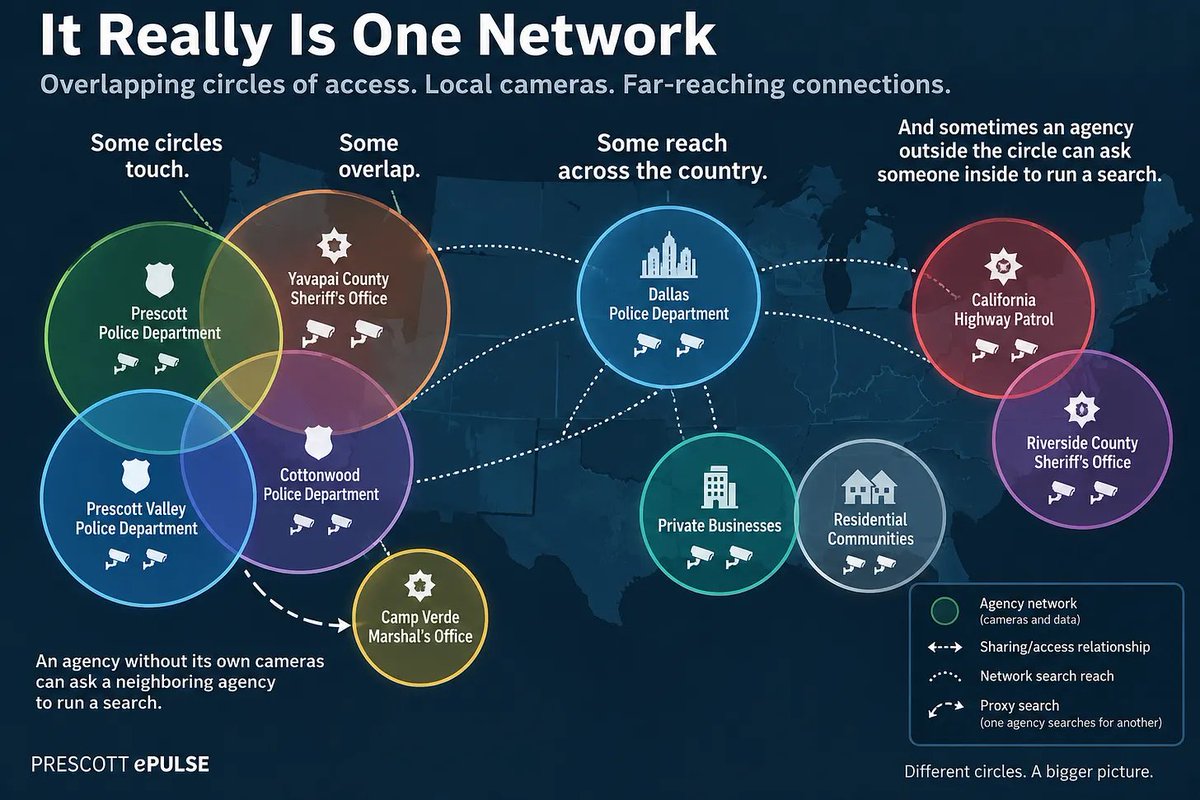
It Really Is One Network
Part 2: The cameras may be local. The network isn’t.
In the first installment of this series, we borrowed a line from 1984: “Big Brother is watching you.”
It was a little tongue-in-cheek. Prescott is not Oceania, Flock cameras are not telescreens, and nobody at City Hall is sitting behind a wall of monitors following your Subaru to Safeway. But after digging into how the system actually works, Orwell may have gotten one thing right.
The interesting part isn’t the camera. It’s the network behind it. And that network is much bigger than Prescott.
3.8 Million Searches? Not Exactly.
Here’s where things get weird. During just six months, Prescott’s Flock audit recorded 3,830,002 network searches involving 594 outside law-enforcement agencies. The biggest numbers came from nowhere near Arizona: Dallas Police Department, California Highway Patrol and Riverside County Sheriff’s Office.
So why would Dallas be searching Prescott hundreds of thousands of times? It probably wasn’t. A Flock network search can sweep across many participating jurisdictions at once. Think of it less like an officer opening Prescott’s filing cabinet and more like casting a very large digital fishing net. Prescott happens to be swimming inside it.
So 3.8 million audit entries do not mean 3.8 million Prescott license plates were handed to outside police departments. But the reality may be more interesting: searches originating from 594 outside agencies reached a network containing Prescott’s locally collected data. Suddenly, those cameras along our roads don’t look quite so local.
You Don’t Even Need Your Own Flock Cameras
Camp Verde provided one of the stranger examples. The Camp Verde Marshal’s Office doesn’t have direct access to Flock. Yet it still shows up in the records.
How? Someone else searched for them.
Larson Newspapers found 20 Cottonwood searches and four Prescott searches of Coconino County’s Flock network that cited Camp Verde. Camp Verde confirmed that when it needs Flock information, it asks an agency with authorized access to search for it.
A department doesn’t necessarily need its own Flock account to benefit from the network. It can ask a neighbor to look. So counting cameras tells us surprisingly little about surveillance reach.
The cameras have city limits. The network has other ideas. Orwell had telescreens. We apparently have networking.
Won’t You Be My Neighbor?
Once we started following the connections, our definition of “neighbor” got considerably broader. Prescott and Prescott Valley show up in Flock networks outside Arizona. Follow the connections farther, and private businesses and residential communities show up too.
Before anyone starts checking the shrubbery for Winston Smith:
We have not established that Prescott can search every private camera connected somewhere else in Flock’s system.
Sharing permissions don’t necessarily pass from one participant through another. But we have established something simpler:
the size of a Flock system cannot be determined by driving around town and counting cameras.
Flock says agencies can share directly, geographically, statewide or nationwide. The result isn’t one giant database through which every officer can freely rummage. It’s overlapping circles of access. Some circles touch. Some overlap. Some reach across the country. And sometimes an agency outside the circle can ask someone inside to run a search. At some point, calling these “Prescott’s cameras” starts missing most of the story.
Now You See It. Now You Don’t.
Last November, Prescott Valley’s Flock Transparency Portal reportedly listed 267 agencies sharing data with PV. Today, that list has vanished from public view. Did the sharing stop? We don’t know, but probably not. Flock records show agencies can choose what appears on their public Transparency Portals.
Here’s the fun part. Prescott Valley residents can’t see PV’s sharing network on PV’s own transparency page. But pieces of it are still visible on Flock portals elsewhere in the country. We’ve asked PV who hid the list, why, and whether anything besides the public display changed.
The network is still watching. We’re just having a harder time watching the network.
Who Controls The Network?
Flock says its customers do. Agencies own their data, decide whether to share it and control who gets access. But there’s a catch.
Prescott can control Prescott officers. It can’t control everybody else’s.
That’s essentially the conclusion another Arizona community reached before pulling the plug. In August, Cave Creek terminated its Flock contract after town officials concluded that local privacy safeguards couldn’t extend beyond town limits because outside law-enforcement agencies could access shared data.
There’s another complication. Flock acknowledged that some California agencies’ camera networks were inadvertently accessible to out-of-state agencies in 2025. In some cases, earlier limitations in Flock’s technical logging meant the company couldn’t determine exactly why.
So yes, there are local controls. But local control has city limits. The network doesn’t.
The Cameras Are Just The Front Door
Flock is no longer simply a system that asks, “Where was plate ABC123?” Its platform is really a broader investigative system capable of connecting searches and information across jurisdictions. We’re now asking Prescott and Prescott Valley which capabilities they actually have enabled. Because there are three very different questions:
What can Flock do?
What can Prescott access?
What does Prescott actually use?
We won’t pretend those answers are the same until the records show us they are. But one conclusion is already hard to avoid. If you want to understand Prescott’s automated surveillance system, don’t count the cameras.
Follow the network.
Safety as a Shield? | How Yavapai County Is Using Another Way to Further Restrict Property Rights
No one in Yavapai County disputes the importance of fire safety. We all understand the risks of living in Arizona, and no reasonable person is arguing for unregulated growth. What many of us are asking for is simple balance, and that balance must include respect for private property rights.
The devastating wildfires at Yarnell Hill, Doce, and elsewhere are painful reminders of what happens when extreme conditions, severe weather, and limited access collide. Emergency access, defensible space, and responsible planning matter. They save lives.
What should concern every property owner, however, is the growing tendency to use fire safety as a legal shield for broad, backdoor land-use restrictions.
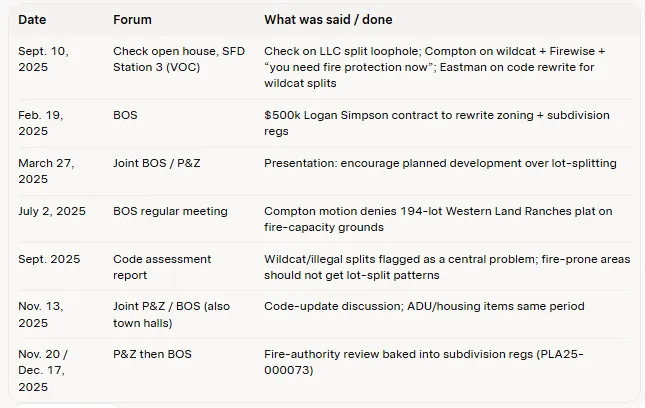
Over the last several years, County leaders, including Supervisor and Board Chair Brooks Compton, have voiced mounting concerns that parcel splits and rural growth create new hazards for firefighters and emergency responders. In case you missed these meetings, you can use these dates as referenced.
Those concerns deserve open discussion. What deserves equal scrutiny is how the County chooses to address them. Where is the public debate when informal concerns turn into county policies, and those policies quietly harden into restrictive codes? In this country, we have choices about the rights to use our land:
● Some of you live in planned communities with HOAs that dictate everything you can do with your property. That was a voluntary choice you made at closing.
● Some of you live on parcel splits carved out fifty years ago, no HOA, operating only under standard county or municipal codes.
● A few of you hold hundreds of acres that have stayed in your family for generations.
Today, all landowners face a growing maze of engineering demands, costly studies, steep fees, and discretionary reviews before they can divide or build on their land. Any single requirement might sound reasonable on its own. The real danger is their cumulative effect: the steady erosion of your constitutional rights.
When the cost of compliance becomes insurmountable, your legal ownership exists only on paper. The County accomplishes indirectly what state law prevents it from doing directly: suffocating private property rights.
The Dilemma: Real Property Rights or Bureaucratic Anti-Growth?
If members of the Board of Supervisors claim to champion property rights while running on growth/anti growth platforms: “controlled,” “planned,” “stopping,” “unbridled,” or “smart.” How do they justify gutting the legal rights tied to your land? With density bonus incentive!
Density bonus incentive: To encourage clustering, the homes are grouped closer together on smaller individual lots or building envelopes. Does the term “Tiny Homes” ring a bell? Ones that can’t accommodate a family comfortably, and most of the time require the homeowner to lease the land it sits on? How about 15 minute cities?
We wrote about this in an April 6, 2026 article titled “Yavapai County Board of Supervisors Joint Meeting - Development Services and Subdivision Regulations Update” when Consultant Roger Eastman of Logan Simpson presented a high-level administrative draft of the updated subdivision rules. You can read that article by Clicking Here.
Understanding How the Game is Played
Significant portions of Yavapai County carry two-acre minimum zoning. Under Arizona state law, that means large parcels can legally be divided over time into two-acre parcels through lawful lot splits (often disparaged as “wildcat” development). A 100-acre ranch, for instance, can initially be split into five 20-acre parcels. Those buyers can divide their lots into four-acre parcels, which are eventually divided once more into two-acre home sites. This process is fully legal, and it happens every day across Arizona.
According to public statements and county documentation, key county officials are pursuing strategies that threaten this process:
● Targeting “Wildcat” Subdivisions: Pushing policies to restrict or eliminate split-lot divisions that bypass standard subdivision reviews—a move directly impacting upwards of 28,000+- privately owned parcels in Yavapai County.
● Downzoning and Density Reductions: Amending the zoning code to mandate larger minimum lot sizes, reducing the overall number of permitted homes.
Here is the problem the County faces: Arizona voters severely tied local government’s hands when it comes to arbitrary zoning changes.
The Prop 207 Barrier and the Public Safety Loophole
In 2006, Arizona voters overwhelmingly passed Proposition 207, the Private Property Rights Protection Act (A.R.S. § 12-1134).
Under federal law, proving a regulatory “taking” requires an owner to lose nearly 100% of their land’s economic value. Prop 207 threw that standard out the window. In Arizona:
If a local government passes a land-use regulation that diminishes the fair market value of your property, the government must pay you cash for that loss.
To avoid massive financial payouts, cities and counties routinely exempt existing owners or allow their land-use rights to remain grandfathered in.
The County cannot broadly downzone 28,000 parcels without exposing local taxpayers to staggering financial liability.
Except for one critical escape hatch.
Under Prop 207, downzoning is completely exempt from compensation if the government enacts the rule for public health and safety, specifically, wait for it…….. fire protection.
Connect the dots. If the County cannot afford to downzone your land outright, what is the alternative? Layer on crushing fire codes, subjective access mandates, and engineering obstacles under the banner of public safety.
The Double Standard
This regulatory double-standard creates an impossible landscape:
Master-Planned Communities Face a Brick Wall: When commercial developers propose planned and engineered communities with dual access roads, on-site fire improvements, advanced drainage, and infrastructure improvements, officials often reject them to appease anti-growth politics. When developers get denied for a legal project, they sue costing taxpayers millions. Look at the broken promises lawsuit as seen in the $150 million dispute between Arizona Eco Development and the City of Prescott.
Rural Landowners Bear the Brunt: When master plans are rejected, owners turn to state-protected minor land splits. But small landowners do not have armies of lawyers to fight the County. When the County slaps an individual with arbitrary road-improvement demands or fire-access mandates, the landowner is simply forced to walk away.
Which is it? Does the County want engineered, master-planned developments, or does it want individual parcel splits? Our opinion: our government is choosing to do whatever they can to stop it all. We certainly hope you don’t own any land that you want to sell now or in the future.
County leadership often cites a mission to protect Yavapai County from “unplanned and unbridled growth.” But using fire safety as a pretext for zoning freezes is disingenuous. What began as legitimate concern has drifted into an unofficial anti-growth weapon.
The Red Rock News published the “Fire Fear Porn (our words)” coming out like a firehose at a September 10, 2025 Town Hall hosted by County Supervisor Nikki Check in Oak Creek. Click Here for the full article.
A Constructive Way Forward
Fire preparedness and private property rights are not mutually exclusive.
Yavapai County can protect its residents without gutting their land rights. We can expand voluntary Firewise programs, build dedicated secondary emergency routes, and partner directly with rural communities and Fire Departments/Districts. Work with developments to find improvements that can benefit the region and enhance the benefits to all.
If County leaders believe rural growth needs to stop, they should make that case openly to the voters, not just words during elections, but each time they erode your property rights and bury it. Every decision is a precedent, and will eventually come home to roost.
Pay attention. Attend Board of Supervisors meetings. Ask hard questions about the legal and financial motives behind new fire ordinances. Demand transparency. County decisions alter your property’s value, utility, and legacy far more than anything decided in Washington.
In the next article, we will examine how disagreements among rural fire districts are shaping local development mandates, and how certain officials are attempting to force urban-style utility codes onto rural Arizona land.
The Central Yavapai Hospital District | What It Is, Why It Exists, and Why Voters Will Decide Its Future on March 9, 2027
For more than 65 years, the Central Yavapai Hospital District (CYHD) has been the public landlord and steward of key healthcare infrastructure in western Yavapai County. It owns the land and buildings of the YRMC West Campus in Prescott and leases them to a nonprofit operator. It does not run daily hospital operations. Its job is targeted oversight: protect the community’s interest in the public asset and enforce the lease.
The District’s elected board has now asked that voters decide whether the CYHD should continue. After receiving the District’s application, the Yavapai County Board of Supervisors placed the dissolution question on a special election ballot for March 9, 2027.
How and why the District started
Prescott’s modern hospital story began in 1943, when volunteers and donors opened Prescott Community Hospital in a converted elementary school. The facility quickly outgrew that space.
By the late 1950s the community needed a larger, modern hospital. Rather than relying on general county taxes, voters chose a special-purpose hospital district under Arizona law, a dedicated public entity to finance and own hospital infrastructure.
In 1960, Yavapai County voters approved creation of the Central Yavapai Hospital District. A 1962 vote authorized bonds to build a new hospital on Willow Creek Road. The facility opened in 1964 as Yavapai Community Hospital, later renamed Yavapai Regional Medical Center (YRMC).
The reasons for forming the District were straightforward:
Dedicated financing and public ownership of hospital land and buildings, without broad county tax reliance.
A partnership with a nonprofit operator (originally the Yavapai Community Hospital Association, now operating YRMC under Dignity Health / CommonSpirit) while the community kept control of the core assets.
Local jobs, economic development, and reliable healthcare closer to home.
That public-ownership plus nonprofit-operation model was unusual for Arizona at the time. The community built the facility; the operator focused on clinical care.
What the board is for today
CYHD is the landlord of the YRMC West Campus at 1003 Willow Creek Road in Prescott. It owns the land and buildings. YRMC (through the Yavapai Community Hospital Association) leases and operates the facility.
The East Campus in Prescott Valley is owned directly by YRMC and is not part of the CYHD lease.
The District’s statutory purpose under Arizona law is to promote the public health, comfort, convenience, and welfare of its residents primarily through ownership of the facilities and oversight and enforcement of the lease. It does not deliver patient care.
The official county description of the District’s mission is lease oversight and enforcement, “acting with respect, accountability, and transparency.” Yavapai County collects an annual report from the District. The current five-member board includes Lauren Newington, Steven Woods, and Matthew Cordua (terms expiring 2026) and Harry Oberg and Jill Martin (terms expiring 2028).
Historically, the arrangement delivered value with a light tax footprint. The District has very limited taxing authority and generally has not imposed ongoing property taxes for operations. Lease-related support payments from the operator have largely covered its modest expenses. Facilities remain a community asset rather than private property. Patient care continues under the operator.
Why the current board asked for dissolution
The request is not about shutting the hospital. It is about whether the District can still do the job it was created to do.
Until October 2020, the Yavapai Community Hospital Association operated as an independent local nonprofit. In 2020 it entered an Affiliation Agreement with Dignity Community Care (“Dignity”), an affiliate of CommonSpirit Health, a large national system headquartered in Chicago.
After that affiliation, the Association and a previous District board executed the Sixth Amendment to the lease (amending the 1997 lease and prior amendments). The current District board describes that amendment as transferring effective long-term control of the Medical Center to Dignity. Its principal terms, as the board has stated them, include:
Term extension. The guaranteed lease term was extended from 2038 to 2043.
Long-term renewal options. Dignity received the unilateral right — but not the obligation — to extend the lease for five additional 10-year renewal terms, giving it the ability to control the facility substantially rent-free until as late as 2093.
Expense cap. Support payments Dignity must make to the District, previously uncapped, were limited to $50,000 per year, subject to CPI adjustment. The current adjusted ceiling is about $61,948 and is intended to cover District expenses, including legal counsel.
Non-disturbance for encumbrances. The District must agree to non-disturbance agreements for encumbrances placed on the Medical Center, whether or not those encumbrances secure debt incurred for the benefit of the facility.
The current board’s position is that the District received nothing of value in exchange for those concessions. Dignity made no new commitments on rent, services, capital investment, or other obligations beyond those already in the pre-existing lease. In the board’s words, a prior board granted Dignity long-term control and the option to “put” the Medical Center back to the public after 2043, without additional consideration.
The board also raises Gift Clause concerns under Article 9, § 7 of the Arizona Constitution, which prohibits the state and its subdivisions from giving or loaning credit, or making a donation or grant, to any individual, association, or corporation. Arizona courts require that public expenditures serve a public purpose and be supported by adequate consideration. The current board’s assessment is that valuable ownership and control rights were transferred without corresponding consideration.
Attempts by the current board to obtain the underlying Affiliation Agreement to see whether any hidden consideration existed, have been refused. Dignity’s counsel has said that “all issues by and between the District and [Dignity] are fully contained in the Lease.” Dignity has also made clear it will not fund a District legal challenge over the lease or access to the Affiliation Agreement. Combined with the hard annual expense cap, the board says the District has no practical ability to compel disclosure or seek a judicial ruling on the Gift Clause issue. Outreach to the Arizona Attorney General’s Office produced no action.
After the Sixth Amendment, the board concludes the District’s statutory purpose can no longer be meaningfully achieved:
Effective control of the West Campus has shifted to Dignity through the long-term lease and renewal options.
The District lacks the money to enforce even remaining lease covenants if they were breached, or to litigate the validity of the Sixth Amendment.
The District therefore exists as a governmental body that can no longer perform the oversight role for which it was created.
Dissolution, in the board’s view, would remove that inactive layer of government and transfer the remaining public assets to an entity better positioned to act as landlord.
The board’s formal request and the March ballot
On May 26, 2026, the CYHD board held a special public meeting at the Prescott Public Library. After discussion and executive session on the lease, the board voted to submit an application to the Yavapai County Board of Supervisors under A.R.S. § 48-1918 asking that a special election be called on whether the District should be dissolved. The application requested March 9, 2027. The estimated cost of the election, according to information from County Elections included in the application, was about $156,492. The District asked YRMC / the Association to pay those costs and stated it was prepared to reimburse the County to the extent of its limited resources. Those resources are tight: the District has no current taxing power, and its sole revenue is the capped lease support payment.
The statute is clear. A hospital district may be dissolved by majority vote of the real property taxpaying electors of the District who vote on the question. The election is called by the Board of Supervisors upon application of the District board (or upon a petition signed by 25 percent of the electors). If the District is dissolved, all property, buildings, equipment, and other items owned by the District become the property of Yavapai County.
The Board of Supervisors took up the application in 2026, including legal advice in executive session on August 19, 2026, and then action on the call of election. The dissolution question is now slated for a special election on March 9, 2027. Local reporting has confirmed that date for voters who live within District boundaries.
What happens if voters approve dissolution
If a majority of the real-property taxpaying electors who vote on the question say yes:
Title transfers by operation of law. All CYHD property, buildings, equipment, and other assets, including the West Campus real property and buildings, plus any small cash balance, become property of Yavapai County.
The County becomes the landlord. The Board of Supervisors would assume the landlord role under the existing lease with the Association / Dignity. Day-to-day hospital operations would continue. The lease itself would continue, subject to any updates needed during the transition.
The five-member District board ends. Dedicated District oversight would end. County-level governance would take over responsibility for the public asset and lease enforcement.
Oversight capacity changes. Unlike the District, the County is not constrained by the $50,000-per-year (CPI-adjusted) support cap. The District board has argued that gives the County greater practical ability to monitor lease compliance and protect the public interest in the facility.
Dissolution is not designed to remove Dignity or interrupt patient care. The West Campus would still be operated under the existing lease. The East Campus, which YRMC already owns, would be unaffected.
What voters should keep in view
The original mission was public ownership of hospital infrastructure with local accountability and a nonprofit operator. The 2020 affiliation and the Sixth Amendment are what the current board says changed that bargain: long-term control concentrated with a national system, and the District stripped of leverage and resources.
Whether that outcome should stand is now a question for the District’s real-property taxpaying electors on March 9, 2027. Until then, the District continues under the current lease, and YRMC continues to deliver care on both campuses.
This summary is for informational purposes and is based on the District’s published history, its May 26, 2026 application and motion, A.R.S. § 48-1918, Yavapai County special-district records, and subsequent public reporting on the March 9, 2027 election. For official documents, election notices, and meeting materials, use the Yavapai County website, https://t.co/Pa7Bck1J3v, the CYHD meeting archive, or contact the District or County directly.
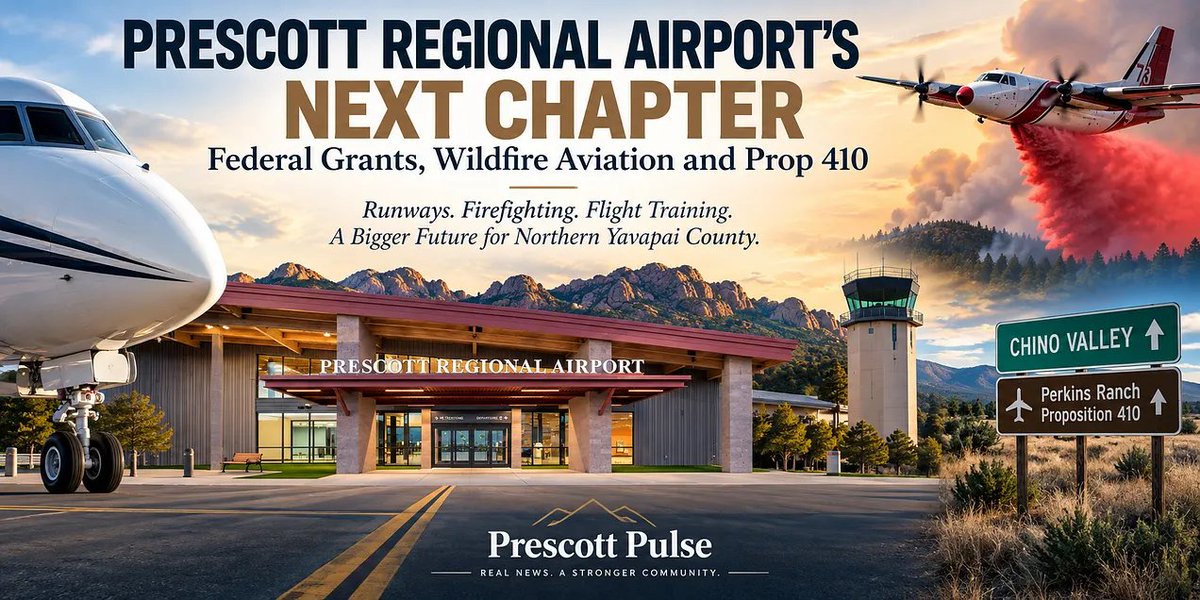
Prescott Regional Airport’s Next Chapter | Federal Grants, Wildfire Aviation and Prop 410
A year after Prescott Pulse examined what federal aviation spending could mean for Ernest A. Love Field, projects once discussed as future improvements are moving toward design and construction, while a proposed Embry-Riddle training airfield in Chino Valley could reshape aviation across the region.When Prescott Pulse examined the impact of the One Big Beautiful Bill Act on Prescott Regional Airport in August 2025, we made an important distinction: Congress approved billions for aviation and air-traffic-control modernization, but it did not hand Prescott a dedicated pot of OBBBA money.A year later, Prescott and the FAA reshape Prescott Regional Airport (PRC) through major runway, taxiway, hangar, land and control-tower projects. At the same time, wildland firefighting plays a larger role in the city’s long-term plans for the airport.And roughly 15 miles north, Chino Valley voters will decide the fate of a proposed private airfield intended to serve Embry-Riddle Aeronautical University’s flight-training operation.
Runways, Ramps and Hangars: Federal Money Starts Reshaping PRCOur previous reporting identified an estimated $146 million in long-term airport projects, including runway improvements, a new control tower and an Aircraft Rescue and Fire Fighting facility. The city’s federal contracting documents lay out a substantial 2025-2027 capital program, including environmental work for the Runway 3R/21L extension, Runway 12/30 electrical improvements and a future ARFF/Snow Removal Equipment/Operations and Maintenance building.On August 11, the Prescott City Council approved the acceptance of seven FAA grants and seven related Arizona Department of Transportation grant applications for PRC. The projects include Hangar Development Phase 2, a wash rack, Southwest Ramp reconstruction, a vehicle service road, an environmental assessment for the proposed Runway 3R/21L extension, Taxiway F realignment and vehicle transmitters. Together, the grants direct nearly $3 million in FAA funding to the airport, before applicable state matching funds.
The Runway Project AdvancesOne of PRC’s most consequential proposals would shift and extend Runway 3R/21L. Wildfire operations add urgency to that proposal. The city’s 2026 Strategic Plan calls for runway infrastructure improvements that would support unconstrained operations by wildland firefighting aircraft, commercial airlines and other airport users. Prescott’s 2026 legislative platform sought $4 million to design the runway shift and extension to allow PRC to accommodate fully loaded air tankers and other large https://t.co/zLIq6soZJu August, the city council authorized additional engineering work for an advanced runway-length analysis to complete environmental reviews, technical studies and benefit-cost calculations before construction can begin. Meanwhile, the city continues hangar development and advances the first phase of the Taxiway F realignment, turning portions of PRC’s capital plan into active projects.
Wildland Aviation Expands PRC’s MissionWildland aviation now shapes more of Prescott’s airport planning. The U.S. Forest Service’s Henry Y.H. Kim Aviation Facility, or Prescott Fire Center, operates on airport property and serves as an important Northern Arizona wildfire-response hub. The city provides airport access and infrastructure that support federal firefighting aircraft and personnel. That relationship drives additional capital https://t.co/fcK787LQav June, the city announced plans to pursue additional airport-adjacent property, partly to support infrastructure for seasonal U.S. Forest Service aerial firefighting aircraft. The State of Arizona also allocated FY2026 money for firefighting-related infrastructure at PRC. As we previously reported while discussing property rights and eminent domain around the airport, the city council authorized eminent domain if necessary for a 4.18-acre parcel intended for a public aircraft ramp adjacent to the fire https://t.co/D3FdHwZ8EK City Council’s September 8th voting session, they approved two agenda items related to the airport. The approvals amount to this: the city is officially folding some land it already owns next to Prescott Regional Airport into the airport’s official property map, and it is buying two more small vacant parcels next door, about 4.18 acres from Crosswind Leasing LLC and about 1.61 acres from Air & Land Company LLC. It’s roughly 5.8 acres in all and putting those purchases on the same airport https://t.co/ZYK8w1vGqg plain terms, that designation as “Airport Lands” is not just a label; it treats the ground as part of the airport for planning, operations, and federal/state grant purposes. Staff have described this kind of adjacent land as needed to support airport operations and public-safety uses, including space for seasonal U.S. Forest Service aerial firefighting aircraft that stage out of PRC. These particular votes are purchase agreements with two private owners (plus the paper trail to add both the old city parcels and the newly bought ones to airport property), closing the eminent-domain fight with an agreement.That broader mission changes how the community should measure PRC’s value. Passenger counts tell only part of the story. PRC serves commercial aviation, general aviation, one of the nation’s largest collegiate flight-training operations and a growing regional wildfire-response mission.
A New FAA Control Tower Brings New TechnologyThe FAA plans to replace PRC’s existing air traffic control tower with a modern facility while controllers continue to manage one of the nation’s busiest flight-training environments. Federal permitting records show the FAA conducting the project’s environmental review.The new tower coincides with the federal government’s broader overhaul of the nation’s air traffic control system. Transportation Secretary Sean Duffy’s Brand New Air Traffic Control System calls for hundreds of new radars, high-speed network connections, digital voice switches, electronic information displays and expanded surface surveillance. In January, DOT announced new radar contracts funded through the One Big Beautiful Bill.Prescott also appears on an FAA deployment schedule for the Surface Awareness Initiative, technology that gives controllers real-time displays of aircraft and vehicles on airport surfaces. The technology could prove particularly useful at PRC, where the FAA identifies flight-training traffic, multiple runways and complex taxiway geometry as factors that increase the risk of wrong-surface operations. The FAA has also begun introducing more advanced automation nationally. In June, DOT selected Air Space Intelligence to provide new traffic-management software that analyzes air traffic and aircraft trajectories to improve traffic flow.The unanswered question is how much of this technology the FAA will install at Prescott. Federal records do not yet establish that PRC’s new tower will receive new radar, AI-assisted systems or the entire national modernization package. But the tower replacement puts Prescott in position to benefit as the FAA replaces the technology that controllers use to manage the nation’s airspace.
Then There Is Chino ValleyIn March, Prescott Pulse took readers inside the Perkins Ranch Airfield proposal and its long history with Embry-Riddle. The approximately 390-acre project would create a private training airfield east of Chino Valley intended to give Embry-Riddle students another location for repetitive flight training, shifting some training operations away from PRC and reducing congestion.After the Town Council approved the rezoning, Chino Valley citizens organized a referendum effort and gathered enough petition signatures to send the decision to voters. Prop 410 will put that question before Chino Valley voters on November 3.
One Regional Aviation StoryTaken together, these developments tell a larger story than any single airport project.Prescott reshapes PRC through new infrastructure and land acquisitions. The FAA replaces the control tower. Federal and state grants fund airport projects. Embry-Riddle expands its Prescott facilities. Wildland firefighting creates new demand for runways, ramps and land. And Chino Valley voters will decide whether Perkins Ranch adds another aviation facility north of Prescott.Together, those projects link Prescott, Chino Valley, Embry-Riddle, the FAA, state government and federal firefighting operations. Northern Yavapai County now supports an interconnected aviation economy that spans higher education, commercial service, general aviation, wildfire response and private aviation development.A regional aviation hub could extend those benefits throughout the Quad Cities. It could attract aerospace and aviation businesses, create skilled jobs, strengthen commercial air service, support Embry-Riddle’s talent pipeline and give companies greater reason to invest locally. Prescott, Prescott Valley, Chino Valley and Dewey-Humboldt could capture the economic benefits through new employers, supporting businesses, tourism and a larger skilled workforce, while the region gains greater capacity for wildfire response and other aviation services.
Part 1 Prescott Water: Is the Aquifer Really Running Dry? | New Pulse Water Series, Part 1: Very slowly declining groundwater, overdraft and the difference between a water-management problem and running out of water.
Mark Twain supposedly said, “Whiskey’s for drinkin’, water’s for fightin’.” Prescott has certainly embraced the second half.
In our original Whiskey’s for Drinkin’, Water’s for Fightin’ series, Prescott Pulse dug into the Prescott Active Management Area (PrAMA), groundwater, conservation, safe-yield and the Big Chino Water Ranch.
Now we’re going back underground.
Our recent WIS update covered Prescott’s new Long-Term Water Management Plan (LTWMP) modeling—including declining groundwater levels and 50-year projections.
But those numbers raise a more basic question: Is Prescott actually running out of groundwater? So far, the evidence says no. That doesn’t mean we don’t have water availability issues. It means we should define the issues correctly before Chicken Little orders bottled water by the pallet.
First: What Does “Safe-Yield” Mean?
Arizona law established a “safe-yield” goal for the Prescott AMA (PrAMA), which ADWR determined was no longer being met in 1999. Safe-yield means groundwater withdrawals do not exceed annual replacement. But the calculation relies on measured and estimated water-budget components—an educated “guess” useful for long-term planning, not a direct measurement of how much water remains underground. Since 1999, ADWR management plans have sought to reduce withdrawals and move the PrAMA back toward balance. ADWR’s Prescott AMA information
But here’s the important distinction: Being out of “safe-yield” does not mean an aquifer is running out of water. It means we may be withdrawing more groundwater than the amount being replaced under ADWR’s water-budget calculations. Those are two very different measurements.
Think household budget. If you earn $5,000 this month and spend $5,500, you ran a $500 deficit. That tells us something important about your spending. It does not tell us whether you have $50 or $500,000 in savings—or how long those savings will last without knowing what happens to both income and spending in the future.
So How Much Water Is Down There?
That’s considerably harder to answer. As discussed in our previous update, Prescott’s preliminary LTWMP modeling estimates approximately 450 feet of saturated aquifer thickness beneath the City’s Chino and Airport wellfields under baseline conditions.
That doesn’t mean Prescott has 450 feet of drawdown (pumpable water). Aquifers aren’t underground swimming pools. Different layers transmit water differently. Well depth and construction matter. Geology matters. Water quality matters. Pumping costs matter.
That’s why the more useful question isn’t: “When will the aquifer be ‘empty’ ?” Although aquifers are never completely empty.
It’s: “How far can groundwater levels decline before Prescott’s wells lose production capacity?”
The LTWMP should help answer that. Follow Prescott’s Long-Term Water Management Plan here.
And Groundwater Does Get Recharged
Another misconception worth examining is the idea that groundwater simply gets pumped out and never comes back. It does recharge. Recharge comes from natural sources (rain and snow) and from human efforts: Prescott deliberately puts water underground through recharge facilities.
Recharge isn't limited to city facilities, either. Rain and snowmelt infiltrate through natural ground, washes and drainage areas, while hardscape choices such as pavers, gravel surfaces, rain gardens, retention basins and directing roof runoff onto permeable ground can keep more stormwater on-site rather than sending it immediately downstream.
The City’s own recent monitoring illustrates the point: while deeper airport-area monitoring wells show declines, some shallow monitoring wells have rising groundwater levels, which consultants associate with Prescott’s underground storage facility, and reduction in agricultural pumping.
Prescott also uses reclaimed water and conservation programs as part of its overall supply-management strategy. See Prescott’s current water supplies and conservation programs.
Hydrogeologist and Prescott Daily Courier columnist Kelly Kading raised another important point during his recent Eye on Prescott interview: both rainfall and snowmelt contribute to groundwater recharge. Exactly how much recharge occurs—and where—is much harder to calculate. Which brings us back to overdraft.
Overdraft Is an Estimate
You can’t install a meter on an aquifer and watch the needle move.
ADWR builds its water budget from measured and estimated components: groundwater withdrawals, recharge, surface-water supplies, reclaimed water and other inputs. That makes overdraft a paper number that can be used in long range planning.
It doesn’t make it a dipstick.
ADWR has devoted considerable work to developing methods for measuring and communicating “safe-yield” and overdraft. Its own framework looks at several measures, including annual overdraft, long-term status and long-term direction. That distinction matters whenever someone turns an annual overdraft figure into a prediction that Prescott has only X years of groundwater remaining.
One number doesn’t tell us that.
The Trend Still Matters
None of this gives Prescott permission to throw caution to the wind and start filling Olympic swimming pools. Groundwater levels are declining in important portions of the Little Chino aquifer (at a rate of approximately one foot per year, a very slow decline rate). That’s precisely why we should:
track groundwater levels;
conserve where conservation produces meaningful savings;
maintain and improve recharge;
manage new water allocations;
improve infrastructure;
evaluate additional well capacity;
understand future growth;
plan additional supplies before they’re urgently needed,
and pray for rain, snow, a few dying Pacific hurricanes.
That’s water management. It isn’t evidence of an approaching apocalypse.
The City’s LTWMP says its purpose is to evaluate existing supplies, future demand, conservation, infrastructure and additional water strategies over 10-, 25- and 50-year horizons. That’s what responsible communities in the desert should do.
Then Comes the $262 Million Question
Eventually almost every Prescott water conversation arrives at the same place: the Big Chino Water Ranch (BCWR). Prescott and Prescott Valley jointly own the Big Chino Water Ranch and associated groundwater rights, and have spent decades planning for groundwater importation from outside the Prescott AMA.
But here’s where our new Water Series takes a turn. We’ve spent years hearing that Big Chino is part of Prescott’s future water supply. That statement is technically true. It’s also nowhere near the whole story. There’s a difference between:
having a legal right to groundwater;
having that water recognized within an Assured Water Supply designation;
having groundwater physically available;
having wells capable of producing it;
having a pipeline capable of transporting it;
and having roughly $262 million—or whatever the eventual number becomes—to build the infrastructure necessary to deliver it (keeping in mind we will receive some amount of federal and/or state funding, and that Prescott Valley must fund their portion).
And while researching what’s currently happening at the BWCR, we discovered another layer.
The Nature Conservancy is working with Prescott on restoration of the City-owned property while pursuing its own conservation, groundwater and Verde River objectives throughout the Big Chino watershed.
That opens an entirely new set of questions about money, land, groundwater, conservation easements, federal grants and who gets a say in Big Chino’s future. We’ll follow those streams. But first we need to answer the question underneath all of them:
Is Big Chino really part of Prescott’s water supply—and if so, how much water can Prescott actually count on?
That’s next. Until then, keep conserving. Just don’t start building the ark. Chicken Little can wait another week, and have a whiskey.
Reminding Conservatives: Be Present, Be Respectful, Be Heard | Tuesday, September 8th Items to watch: Hospital vs Water, Threatened Eminent Domain Settled
It’s that time again, your friendly reminder from Prescott residents Linda Nichols and Cathy Messinger’s in their email campaign to help keep Prescott residents informed and motivated in their local governance. These timely reminders to fellow conservatives about upcoming City Council meetings and what is on the agenda is amazing, thank you ladies!
Hello Prescott City Council: Concerned Conservative Watch Party (CCWP) group,
This is a reminder that the next Prescott City Council meeting is Tuesday, September 8th. Mark your calendars and plan to have an in-person presence if at all possible so the council can see and hear from all the viewpoints and parties in our city!
Viewing & Participation Options:
The Study and Voting sessions may be viewed on Channel 64, Facebook Live, YouTube, or the city’s website: City of Prescott Live Meeting Feed, etc.
Public comments for both general comments and specific to a topic are allowed in the Voting Session and may be submitted in person at the meeting or through the city website, using the Public Comment Form. Go to ‘contact the City Clerk,’ here is the link: Contact City Clerk - City of Prescott AZ
Here is the schedule:
Executive Session: 9:00 AM I will no longer include the Executive Session, or it’s attached agenda since the public is not allowed to attend, and the agenda does not contain insight to the meetings content.
Study Session: 1:00 PM, open to the public. To view the Agenda and Agenda Packet, Click Here.
Voting Session: 3:00 PM, open to the public. To view the Agenda and Agenda Packet, Click Here.
The agenda includes but is not limited to:
Call to Order, Roll Call, Announcements, Invocation, Pledge.
Presentation(s)
Proclamations (if any)
Open Call to the Public: Fill out a speaker’s card and give to Sarah Thornhill if you wish to speak
Open call to the Consent Agenda
Consent Ordinance
Regular Agenda:
Adjournment
For questions or getting on their email list, contact: Linda K. Nichols - [email protected] or Cathy Messinger - [email protected]
Study Session Notable:
Tuesday’s City Council study session is about a federally funded plan to give Prescott wider sidewalks, more bike paint, extra crossing time, and maybe legal sidewalk cycling. Huh?
Good news if you’re the small minority of younger folk in town, but for the rest of Prescott’s aging, it’s a very expensive way to stripe lanes we would have used 40 years ago. No vote, no new local tax tomorrow. Just a grant-backed wish list they can bolt onto green projects already in the pipeline.
Voting Session Notables:
Here is a breakdown of the measurable dollar impacts from the agenda items that involve spending, grants, or property acquisition. All figures come directly from the official agenda packet memos.
Hospital Water Appeal:
Tuesday Council is asked to approve WSA26-031 for a YRMC / Yavapai Community Hospital Association medical plaza of about 149,000 square feet on roughly 16 acres at Willow Creek Road and Jenna Lane, inside the Deep Well Ranch master plan. Staff put the demand at 18.02 acre-feet a year, 10.82 for the buildings and 7.2 for landscaping, which is over the city’s own rule that no single water-service application may take more than half of the remaining semi-annual water budget.
The hospital is appealing that cap based on providing jobs, generating tax revenue, and improving medical access. The Water Issues Subcommittee already recommended yes, with two conditions: maximize xeriscape and put the site on the airport overlay. Watch whether Council holds the 50% rule or treats a hospital as a special case. Once the water is granted, it is in the annual accounting. Will they choose water scarcity or heathcare?
Airport ordinance. The other vote assembles land for a northeast aircraft parking ramp for regional wildfire and public-safety capacity, paid from a $3.5 million state warrant already in hand. Council would buy 4.18 acres from Crosswind Leasing for $849,000, after it authorized eminent domain in June and then settled, and 1.61 acres from Air & Land Company for $290,000.
A companion resolution folds a slice of the old “W” parcel into Airport Lands and moves $1.34 million of that warrant back to the General Fund. The “W” ground was bought in 2021 for $9.877 million; a piece later went to FedEx. What to watch is not only the price. Designating the parcels as Airport Lands puts them under FAA grant assurances, which is hard to unwind, and it continues a pattern of assembling airport property first and locking the use later.
The full 471-page packet (Click Here) contains the detailed memos, contracts, appraisals, and exhibits. The biggest future financial exposure remains the eventual full construction cost of the effluent/wastewater pipelines + SR89 project once the CMAR process produces a Guaranteed Maximum Price.
City of Prescott Water Issues Subcommittee July, August, September 2026 Meetings Report | The Sky Isn’t Falling—But There’s Plenty to Dig Into
What is our Water Issues Subcommittee talking about and approving? The members of the subcommittee are: Mayor Cathey Rusing, and council members Lois Fruhwirth and Jim Garing. To see upcoming agendas for Water Issues subcommittee meetings, go to this City of Prescott webpage, and click on the date you want. Here you will find the agenda, meeting ”packet” and minutes if you go to a past meeting. Meeting packets include all slides shown by presenters at the meeting.
New water allocations, long-range aquifer modeling and activity at Big Chino
Just when you thought it was safe to escape Prescott’s groundwater conversations, they suck you back in. The short version? The sky isn’t falling!
The longer version is considerably more interesting—and it has uncovered enough new questions about groundwater, growth, Big Chino Water Ranch and outside conservation organizations that Prescott Pulse is launching a new Water Series.
Water Budget: What Prescott Allocated
The July 7 WIS report closed out Prescott’s January–June Water Budget. The City started the period with 25 acre-feet (AF) available for residential development and another 25 AF for non-residential development.
Residential approvals used 11.93 AF, leaving 13.07 AF.
Smaller non-residential projects used 8.39 AF, leaving 16.61 AF.
Another 14.62 AF serving 86 residential units moved forward under existing contracts or entitlements and was tracked separately from the regular Water Budget.
Deep Well Commercial Development — Jenna Lane/Hwy. 89: 27.9 AF. The City’s tracking sheet specifically says that 27.9 AF does not come out of the regular Water Budget.
The July 1–December 31 budget started the clock again with another 25 AF residential and 25 AF non-residential.
According to the September 1 WIS documents: No residential allocations had been approved as of August 20. Five smaller commercial projects had used only 2.15 AF, leaving 22.85 AF available.
Willow Creek Road and Haas Boulevard: a proposed 50-acre mixed-use development with retail, senior living, hotel, medical uses and residential development. City staff estimated total water demand at 120.29 AF per year. The property has an existing agreement for 60 AF, but City legal counsel said the proposed change in use could eliminate that entitlement. WIS tabled the application for additional work rather than recommending approval.
Dignity Health/YRMC Deep Well Ranch Campus: a phased healthcare development on approximately 16.25 acres that could eventually reach 150,000 square feet. City staff estimated total water demand at 18.02 AF per year, enough to require an appeal of the Water Budget’s 50% rule. WIS recommended the project move forward to Council.
Neither application provided in the WIS materials states a final requested AF allocation.
Long Term Water Management Plan (LTWMP): Declining Doesn’t Mean Disappearing
On August 11, City Council got its first substantial look at groundwater modeling being developed for Prescott’s Long-Term Water Management Plan.
Near the Little Chino Wellfield, monitoring shows the deeper aquifer used by City production wells declining about 0.9 feet per year. Consultants described the broader Little Chino decline as roughly one foot annually (a very small amount), with somewhat larger drawdowns nearer Prescott Valley’s wellfields.
But groundwater doesn’t behave uniformly across the basin.
Near the Airport Wellfield, deeper monitoring wells are declining while some shallow wells have actually risen, which consultants attribute to recharge at Prescott’s underground storage facility.
Now for the number that puts the Chicken Little version of Prescott’s water story into perspective.
The model estimates roughly 450 feet of saturated aquifer thickness beneath both City wellfields under baseline conditions. Over the next 50 years, preliminary modeling projects approximately:
• 80 feet of decline at the Chino Wellfield
• 40 feet of decline at the Airport Wellfield
Those numbers matter. They demand management and planning. But they do not describe an aquifer about to run dry.
And the projections aren’t fortune telling. Consultants caution that modeled water levels can differ from measured conditions by as much as 100 feet at some locations. Future studies will address the much more practical issue: how declining water levels could eventually affect the City’s ability to produce water from its wells.
The model also assumes growth. It increases pumping from existing Chino Valley and Prescott Valley municipal wells 2% annually and assumes approximately 6,900 exempt wells use half an acre-foot each per year, with that demand also growing 2% annually.
Change the assumptions and the future changes. The LTWMP will evaluate conservation, infrastructure, additional Airport wells, septic-to-sewer projects, stormwater, the City’s lakes and other options over 10-, 25- and 50-year planning horizons. The City’s stated purpose is to maintain a stable supply for current and future needs—not sound an alarm bell.
And Then There’s Big Chino
Prescott continues to identify the Big Chino Project as part of its long-term water picture. But while researching the LTWMP and September WIS meeting documents, another story emerged.
The City is working with The Nature Conservancy (TNC) on watershed-restoration projects at the City-owned Big Chino Water Ranch. The September 1 presentation discussed channel reconnection, baffles and low-tech restoration intended to change how water moves across portions of the ranch. One proposed channel-reconnection design came with an estimated price tag of more than $3.2 million, prompting TNC and City staff to consider a less expensive hybrid approach combining limited channel reconnection with baffles and other lower-tech restoration methods.
On its face, slowing erosion and keeping water on the landscape sound a lot like traditional good land stewardship.
But TNC isn’t simply an engineering contractor. It is a major environmental organization (which has 100% bought into “Climate Change” narratives) with broader policy goals. TNC Arizona says its projects contribute to organizational United Nations Agenda 2030 Goals (SDG 6.4, 6.5, 6.6) involving freshwater, lands, people and climate adaptation, while its Verde River work seeks to sustain streamflow and replenish aquifers.
That raises questions worth asking, not conclusions worth jumping to.
What exactly is TNC’s role at Prescott’s Water Ranch?
Who pays?
What does Prescott receive?
Could restoration agreements affect future use of the property?
And how do TNC’s broader goals for Big Chino and the Verde intersect with Prescott’s legal right to eventually pump and transport Big Chino groundwater?
Those questions don’t fit neatly into a WIS meeting recap. They deserve their own reporting.
A New Prescott Pulse Water Series
So we’re heading back down the water rabbit hole (you know, Whiskey’s for Drinking, Water’s for Fighting!).
Upcoming installments will dig deeper into what Prescott’s aquifer numbers really mean, what’s actually available at the Big Chino Water Ranch, the agreements governing the Water Ranch, The Nature Conservancy’s growing role in the Big Chino watershed, conservation easements and groundwater restrictions, federal and private funding, and the decades-old relationship among Prescott, Prescott Valley and SRP over the Upper Verde.
Some findings may reassure readers. Others may raise uncomfortable questions. Either way, we’ll follow the documents.
For now, Prescott’s latest groundwater modeling offers a useful starting point: our aquifers require management, but the data don’t show the sky falling.
Chicken Little can stand down. Prescott Pulse, however, is diving deeper!
The next Water Issues subcommittee meeting is scheduled for October 6, 2026.
BREAKING: A Flock salesman tried to sell the city of Sheboygan 5 years' worth of data on traffic speeds and movement captured by the city's Flock cameras, which the city was never told about.
This proves Flock controls and stores data without the city's knowledge and for periods well over 30 days, in contrast to all public statements and promises about how they handle data.
Your pet’s rabies shot can now be SELF-AMPLIFYING RNA and many vets WON’T EVEN TELL YOU.
The USDA quietly approved Merck’s experimental gene shots (NOBIVAC NXT) for rabies, flu and FeLV.
FOIA data now shows DEATHS, CARDIAC ARRESTS, and NEUROLOGICAL DAMAGE within HOURS of injection.
Injected pets are likely shedding self-amplifying RNA onto humans across the country.
Merck’s Nobivac NXT Self-Amplifying mRNA “Vaccines” Are Quietly Rolling Out to EVERY Vet Clinic in America RIGHT NOW.
The SAME experimental self-replicating RNA tech that was rushed into human arms during COVID is now being injected into your dogs and cats.
Merck calls it “Nobivac NXT.” It is really a biological time bomb.
These shots don’t just “train” the immune system — they hijack your pet’s cells and turn them into rabies, leukemia, or flu protein factories that replicate inside the body, spread through organs, and can shed from saliva, scratches, or kisses.
The three shots already in clinics:
• Nobivac NXT Rabies (dogs & cats) — symptoms in trials: aggression, biting, drooling, seizures, paralysis, death. Looks exactly like actual rabies.
• Nobivac NXT FeLV (cats) — turns healthy cats into leukemia-virus factories.
• Nobivac NXT Canine Influenza H3N2 (dogs) — self-spreading flu RNA through saliva.
Merck’s own “safety” data:
• Only 14 days of monitoring.
• 38 animals tested → 35 euthanized.
• No long-term studies.
• No shedding studies.
• No human transmission data.
• No reversal method if it goes wrong.
Your indoor cat doesn’t need this. Your dog doesn’t need this.
But Merck needs the billions.
This is not protection — it’s an uncontrolled biological experiment on the animals we love most. One happy lick or playful scratch could now be the vector that exposes your entire family.
ACTION STEPS RIGHT NOW:
1. Ask your vet: “Is this Nobivac NXT or any self-amplifying mRNA product?” Say NO and refuse.
2. Find a holistic vet who respects informed consent.
We already watched this movie with humans. Don’t let them run the sequel on our pets.
What’s in the Water? Arizona’s real contamination problem isn’t in the aquifer. It’s coming through the screen. | Words are not water. They are pipes. They carry whatever you pour into them.
Prescott Pulse has already spent more words on water than a four-hour wasteful City Council work session. Big Chino. The Verde. Who owns what, who promised what, and who is waving climate change like a club. That series was about the non-lack of it. Click Here to read it. And we have more coming.
This one is about the other water. The stuff that seems to have seeped into the American bloodstream and left people crazy, hateful, rude, and….let’s be neighborly about it…not operating on all cylinders.
If the problem were about water main breaks, the city would send a crew. If the problem were drought, we’d argue about wells until the cows came home and then argue about the cows. But you can stand in line at Sprouts and watch a grown adult treat a cashier like a war criminal over a paper bag, then go home and watch the same person post a sermon about kindness. That is not a water-table issue. That is a soul-table issue.
So, we ran a satirical lab test on the cultural tap. We did not find lithium. We found oxymorons. The kind that would never survive a kitchen-table conversation in Prescott, but thrive under studio lights and in comment sections on the scourge of humanity….NextDoor and FaceBook.
Lab Result No. 1: Mercy, Rebranded
On The View, actress Anne Hathaway told the country that “abortion can be another word for mercy.” Mercy used to mean a blanket, a meal, a second chance, a hand on a shoulder. Now, in certain zip codes of the culture, mercy is the word you reach for when you do not want to say what the procedure actually does…stop a beating heart. For the episode, Click Here.
You can believe abortion should be legal and still notice the language is doing gymnastics. You can believe it should be rare and still notice that television has a gift for sanding the edges off hard things “until they rebrand as “healthcare.” The point is that millions of people heard a polished phrase, felt the moral weight lift, and never picked it back up.
Words are not water. They are pipes. They carry whatever you pour into them.
Lab Result No. 2: Twenty-One for Beer, Ten for Forever
Here is an oxymoron so large you could park a 747 in it.
A fifteen-year-old in Arizona cannot buy a beer. Good. The law assumes the teenage brain is still under construction, which every parent who has handed over car keys knows. That same culture will turn around, with a straight face, and tell you a child of ten or twelve is wise enough to decide irreversible medical decisions about their sex organs, the kind of decisions adults later describe with the quiet sentence, “I was sure then.”
If a kid is too young for a Coors Light, the kid is too young to be treated like a finished adult by an institution that profits from their physical and emotional trauma. That is not hate. That is the same common sense that keeps whiskey behind the bar and matches away from toddlers. We used to call it protecting children. Then the phrase got captured by people who meant “protect them from ideas I dislike,” and the original meaning wandered off towards Thumb Butte looking for a ride home.
Lab Result No. 3: My Body, My Choice — Until the Child Needs a School
Arizona has another slogan that only works in one direction.
“My body, my choice.” Fine. That is the hill a large slice of the culture will die on when the subject is stopping a beating heart. The same voices will then turn around and tell you that once the baby arrives, after the teething, the diaper rash, the whooping cough, the 2 a.m. floor-pacing, the years you spent soothing a human being into the world… your choice expires at the schoolhouse door.
You may choose not to have the child, but you may not choose how to educate the child you did have. That is the quiet rule behind the loud attack posts on Arizona’s Empowerment Scholarship Account (ESA) program.
Watch the pattern. A parent uses ESA account to buy a curriculum, hire a tutor, or get a kid out of a classroom that was failing that kid. The news package arrives with a scandal font. Social media piles on. The comments treat a mother who wants phonics as if she robbed a bank. A few ugly receipts get waved like a flag (as if no public school district has ever wasted a dime) and suddenly 100,000 Arizona families are framed as grifters for wanting a say in the one job schools are supposed to do, and failing at: educating their children.
Oversight is not the enemy. Fraud is not a personality trait of homeschool moms. But the temperature of the coverage gives the game away. The outrage is not mainly about receipts. It is about control. The unborn child is framed as a choice. The born child is framed as state inventory.
If “choice” only applies before the first breath, it was never about the parent. It was about the institution that wants the child when the funding formula shows up.
Lab Result No. 4: A Sampler of Modern Nonsense
The tap keeps pouring.
“Follow the science,” until the science shows up with two chromosomes and a middle-school biology book.
“Love is love,” until you love the wrong opinion, at which point love puts on boots.
“Diversity,” which now often means a room that looks like a catalog and thinks like a memo.
“Safe spaces,” which are frequently the least safe places for our children.
“Protect the children” from peanuts, secondhand smoke, and a warm six-pack, then hand them a phone that never sleeps and a curriculum that treats their confusion as a costume change.
“Words are violence,” declared by people whose timelines look like a bar fight on Whiskey Row at last call.
“Be kind,” stamped across a profile that hunts strangers for clicks.
None of these contradictions were born fully formed. They were produced, packaged, and delivered. Sitcoms taught the sneer. News panels taught the pile-on. Movies taught that the small-town skeptic is always the punch line. Social media taught that the fastest way to feel tall is to make someone else look small.
The Water Didn’t Raise You. The Feed Did.
Here is the part that is supposed to sting, and also the part that is supposed to free you.
Human beings are not issued “hateful personalities” at the hospital with the birth certificate. They are not issued a “dumb card” because they grew up helping on the family farm instead of going off to university. Meanness is an acquired taste. Stupidity, in the civic sense, is often just unexamined slogans repeated until they feel like reality.
Newsrooms, studios, streaming queues, and the little slot machine in your pocket will rent you an identity by the hour. They will tell you who the villain is before breakfast and who the hero is by lunch. They will reward the hottest take and bury the person who said, “I don’t know enough yet.” They will train you to confuse contempt with intelligence. That training works. Look around.
Prescott still has an antidote most cities find ridiculous. People wave in parking lots. They hold doors. They talk about weather like it matters because out here it does. That ordinary decency is not nostalgia. It is discipline. It is what a town looked like when people remember they might see each other at Safeway tomorrow. And it’s disappearing, and it’s dying… if we let it.
Think Before You Type
You have a choice the aquifer does not. Water goes where gravity sends it.
You can be kind or you can be hateful. That is not a branding exercise. It is a decision you make with your mouth, your keyboard, and your face when somebody across the aisle says something you disagree with, prays differently, or asks an unfashionable question. Kindness is not a surrender. It is the refusal to become the thing you claim to oppose. Be better.
Before you hit send, run a quicker test than any city lab…
Would I say this to a neighbor’s face on the Courthouse Plaza?
Am I trying to understand, or am I trying to win a crowd that will forget me in twelve minutes?
Did I learn this sentence from a person I love, or from a show that needs me angry so the ads pay better?
If the answer makes you wince, delete it. The republic will survive the loss of your post. Your name might even look better without it.
Arizona’s water fights will go on. They should. Water is life out here, and life is worth an argument conducted like adults. But the craziness, the rudeness, the sudden collapse of common decency…we need to shut off the tap that is running like a firehose in Prescott/Yavapai County.
What is coming out of the culture we keep inviting into the living room and then act shocked when it rearranges the furniture, has to stop.
Shut the faucet off. Talk to a human being who is not a comment. Choose a decent word when the cheap one is easier.
Water was never the problem. We are. And unlike the aquifer, we can change course without a court order. Do it!








![prescottpulse's tweet photo. The Central Yavapai Hospital District | What It Is, Why It Exists, and Why Voters Will Decide Its Future on March 9, 2027
For more than 65 years, the Central Yavapai Hospital District (CYHD) has been the public landlord and steward of key healthcare infrastructure in western Yavapai County. It owns the land and buildings of the YRMC West Campus in Prescott and leases them to a nonprofit operator. It does not run daily hospital operations. Its job is targeted oversight: protect the community’s interest in the public asset and enforce the lease.
The District’s elected board has now asked that voters decide whether the CYHD should continue. After receiving the District’s application, the Yavapai County Board of Supervisors placed the dissolution question on a special election ballot for March 9, 2027.
How and why the District started
Prescott’s modern hospital story began in 1943, when volunteers and donors opened Prescott Community Hospital in a converted elementary school. The facility quickly outgrew that space.
By the late 1950s the community needed a larger, modern hospital. Rather than relying on general county taxes, voters chose a special-purpose hospital district under Arizona law, a dedicated public entity to finance and own hospital infrastructure.
In 1960, Yavapai County voters approved creation of the Central Yavapai Hospital District. A 1962 vote authorized bonds to build a new hospital on Willow Creek Road. The facility opened in 1964 as Yavapai Community Hospital, later renamed Yavapai Regional Medical Center (YRMC).
The reasons for forming the District were straightforward:
Dedicated financing and public ownership of hospital land and buildings, without broad county tax reliance.
A partnership with a nonprofit operator (originally the Yavapai Community Hospital Association, now operating YRMC under Dignity Health / CommonSpirit) while the community kept control of the core assets.
Local jobs, economic development, and reliable healthcare closer to home.
That public-ownership plus nonprofit-operation model was unusual for Arizona at the time. The community built the facility; the operator focused on clinical care.
What the board is for today
CYHD is the landlord of the YRMC West Campus at 1003 Willow Creek Road in Prescott. It owns the land and buildings. YRMC (through the Yavapai Community Hospital Association) leases and operates the facility.
The East Campus in Prescott Valley is owned directly by YRMC and is not part of the CYHD lease.
The District’s statutory purpose under Arizona law is to promote the public health, comfort, convenience, and welfare of its residents primarily through ownership of the facilities and oversight and enforcement of the lease. It does not deliver patient care.
The official county description of the District’s mission is lease oversight and enforcement, “acting with respect, accountability, and transparency.” Yavapai County collects an annual report from the District. The current five-member board includes Lauren Newington, Steven Woods, and Matthew Cordua (terms expiring 2026) and Harry Oberg and Jill Martin (terms expiring 2028).
Historically, the arrangement delivered value with a light tax footprint. The District has very limited taxing authority and generally has not imposed ongoing property taxes for operations. Lease-related support payments from the operator have largely covered its modest expenses. Facilities remain a community asset rather than private property. Patient care continues under the operator.
Why the current board asked for dissolution
The request is not about shutting the hospital. It is about whether the District can still do the job it was created to do.
Until October 2020, the Yavapai Community Hospital Association operated as an independent local nonprofit. In 2020 it entered an Affiliation Agreement with Dignity Community Care (“Dignity”), an affiliate of CommonSpirit Health, a large national system headquartered in Chicago.
After that affiliation, the Association and a previous District board executed the Sixth Amendment to the lease (amending the 1997 lease and prior amendments). The current District board describes that amendment as transferring effective long-term control of the Medical Center to Dignity. Its principal terms, as the board has stated them, include:
Term extension. The guaranteed lease term was extended from 2038 to 2043.
Long-term renewal options. Dignity received the unilateral right — but not the obligation — to extend the lease for five additional 10-year renewal terms, giving it the ability to control the facility substantially rent-free until as late as 2093.
Expense cap. Support payments Dignity must make to the District, previously uncapped, were limited to $50,000 per year, subject to CPI adjustment. The current adjusted ceiling is about $61,948 and is intended to cover District expenses, including legal counsel.
Non-disturbance for encumbrances. The District must agree to non-disturbance agreements for encumbrances placed on the Medical Center, whether or not those encumbrances secure debt incurred for the benefit of the facility.
The current board’s position is that the District received nothing of value in exchange for those concessions. Dignity made no new commitments on rent, services, capital investment, or other obligations beyond those already in the pre-existing lease. In the board’s words, a prior board granted Dignity long-term control and the option to “put” the Medical Center back to the public after 2043, without additional consideration.
The board also raises Gift Clause concerns under Article 9, § 7 of the Arizona Constitution, which prohibits the state and its subdivisions from giving or loaning credit, or making a donation or grant, to any individual, association, or corporation. Arizona courts require that public expenditures serve a public purpose and be supported by adequate consideration. The current board’s assessment is that valuable ownership and control rights were transferred without corresponding consideration.
Attempts by the current board to obtain the underlying Affiliation Agreement to see whether any hidden consideration existed, have been refused. Dignity’s counsel has said that “all issues by and between the District and [Dignity] are fully contained in the Lease.” Dignity has also made clear it will not fund a District legal challenge over the lease or access to the Affiliation Agreement. Combined with the hard annual expense cap, the board says the District has no practical ability to compel disclosure or seek a judicial ruling on the Gift Clause issue. Outreach to the Arizona Attorney General’s Office produced no action.
After the Sixth Amendment, the board concludes the District’s statutory purpose can no longer be meaningfully achieved:
Effective control of the West Campus has shifted to Dignity through the long-term lease and renewal options.
The District lacks the money to enforce even remaining lease covenants if they were breached, or to litigate the validity of the Sixth Amendment.
The District therefore exists as a governmental body that can no longer perform the oversight role for which it was created.
Dissolution, in the board’s view, would remove that inactive layer of government and transfer the remaining public assets to an entity better positioned to act as landlord.
The board’s formal request and the March ballot
On May 26, 2026, the CYHD board held a special public meeting at the Prescott Public Library. After discussion and executive session on the lease, the board voted to submit an application to the Yavapai County Board of Supervisors under A.R.S. § 48-1918 asking that a special election be called on whether the District should be dissolved. The application requested March 9, 2027. The estimated cost of the election, according to information from County Elections included in the application, was about $156,492. The District asked YRMC / the Association to pay those costs and stated it was prepared to reimburse the County to the extent of its limited resources. Those resources are tight: the District has no current taxing power, and its sole revenue is the capped lease support payment.
The statute is clear. A hospital district may be dissolved by majority vote of the real property taxpaying electors of the District who vote on the question. The election is called by the Board of Supervisors upon application of the District board (or upon a petition signed by 25 percent of the electors). If the District is dissolved, all property, buildings, equipment, and other items owned by the District become the property of Yavapai County.
The Board of Supervisors took up the application in 2026, including legal advice in executive session on August 19, 2026, and then action on the call of election. The dissolution question is now slated for a special election on March 9, 2027. Local reporting has confirmed that date for voters who live within District boundaries.
What happens if voters approve dissolution
If a majority of the real-property taxpaying electors who vote on the question say yes:
Title transfers by operation of law. All CYHD property, buildings, equipment, and other assets, including the West Campus real property and buildings, plus any small cash balance, become property of Yavapai County.
The County becomes the landlord. The Board of Supervisors would assume the landlord role under the existing lease with the Association / Dignity. Day-to-day hospital operations would continue. The lease itself would continue, subject to any updates needed during the transition.
The five-member District board ends. Dedicated District oversight would end. County-level governance would take over responsibility for the public asset and lease enforcement.
Oversight capacity changes. Unlike the District, the County is not constrained by the $50,000-per-year (CPI-adjusted) support cap. The District board has argued that gives the County greater practical ability to monitor lease compliance and protect the public interest in the facility.
Dissolution is not designed to remove Dignity or interrupt patient care. The West Campus would still be operated under the existing lease. The East Campus, which YRMC already owns, would be unaffected.
What voters should keep in view
The original mission was public ownership of hospital infrastructure with local accountability and a nonprofit operator. The 2020 affiliation and the Sixth Amendment are what the current board says changed that bargain: long-term control concentrated with a national system, and the District stripped of leverage and resources.
Whether that outcome should stand is now a question for the District’s real-property taxpaying electors on March 9, 2027. Until then, the District continues under the current lease, and YRMC continues to deliver care on both campuses.
This summary is for informational purposes and is based on the District’s published history, its May 26, 2026 application and motion, A.R.S. § 48-1918, Yavapai County special-district records, and subsequent public reporting on the March 9, 2027 election. For official documents, election notices, and meeting materials, use the Yavapai County website, https://t.co/Pa7Bck1J3v, the CYHD meeting archive, or contact the District or County directly.](https://pbs.twimg.com/media/HR9nwJOa4AAWh43.jpg)