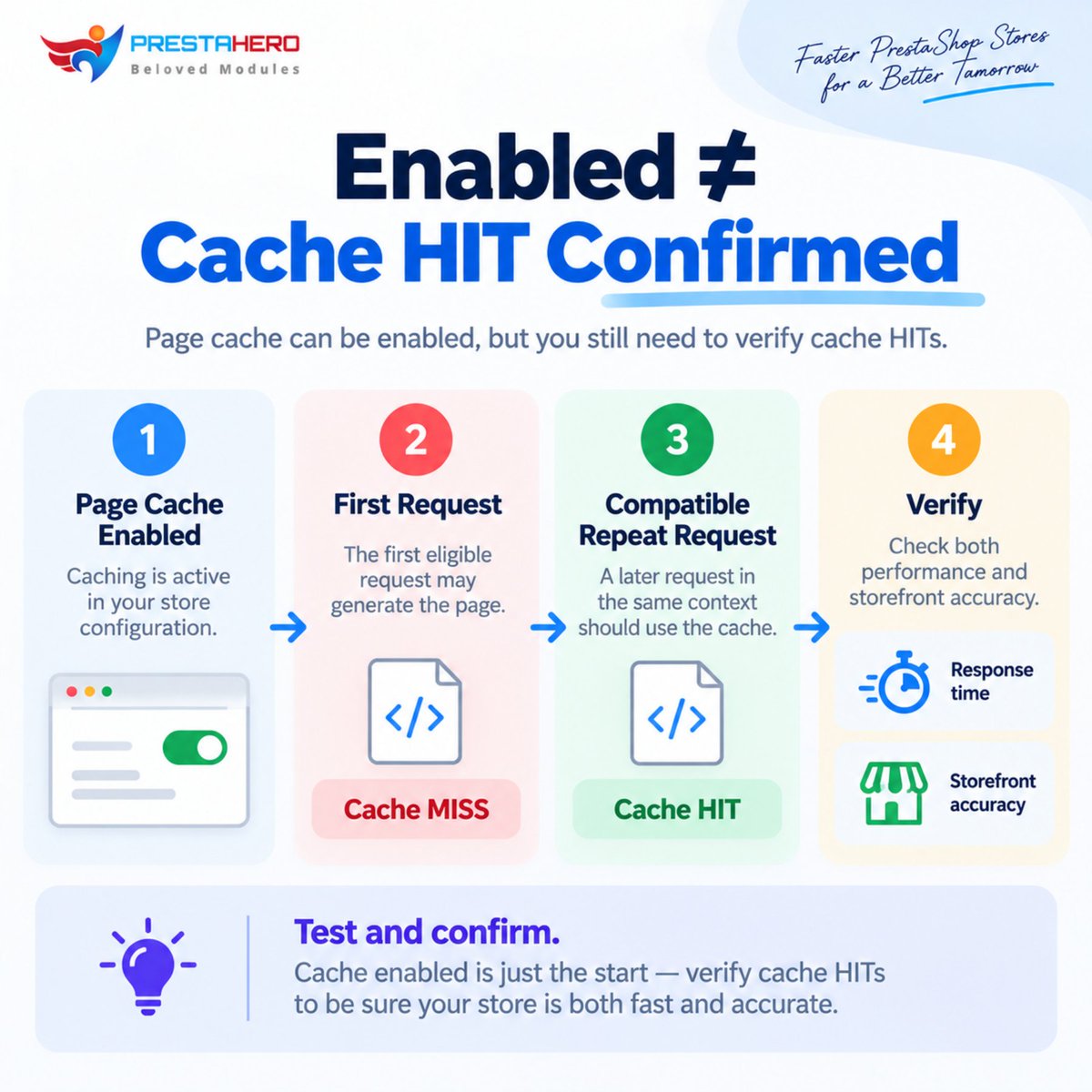
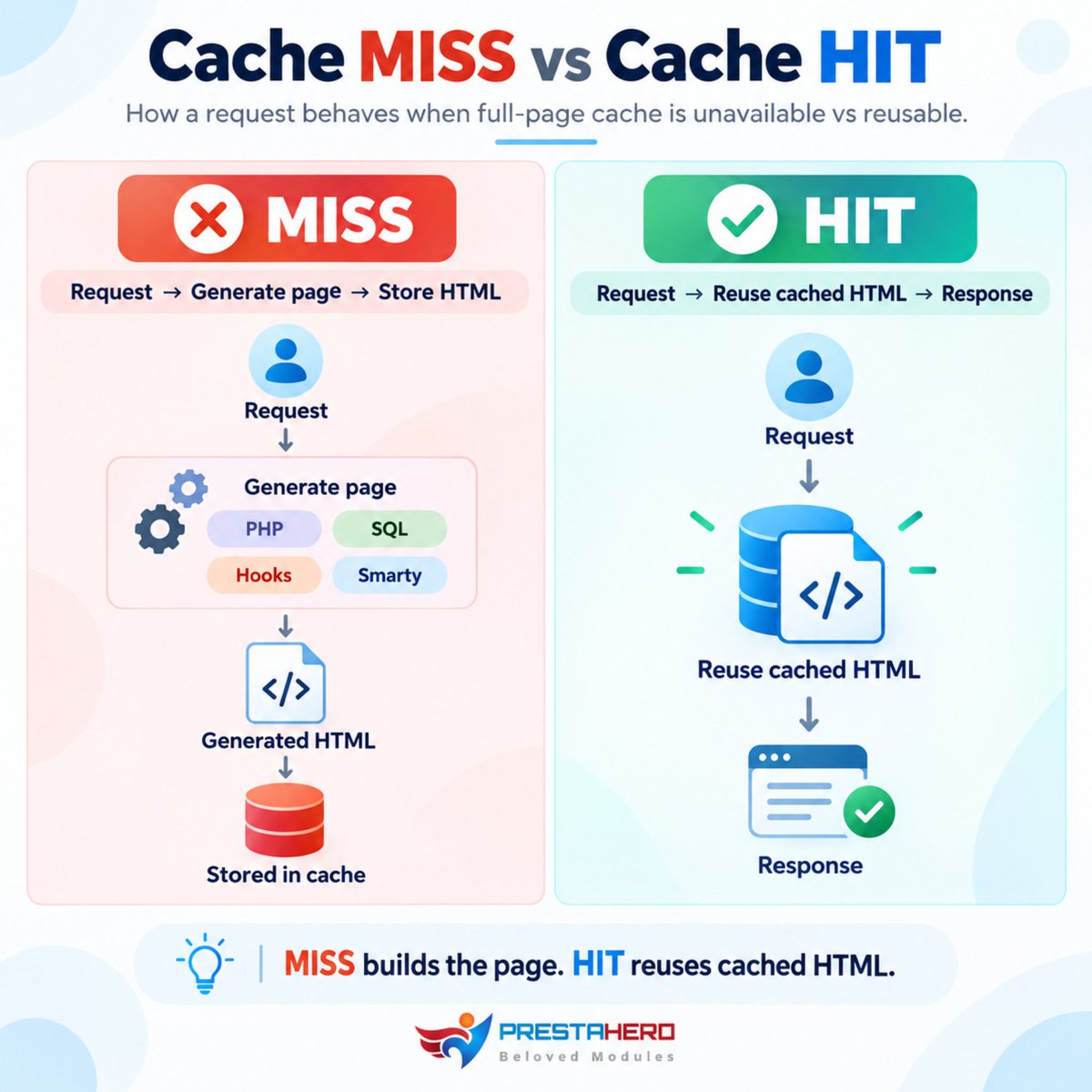
🔍 “Page cache enabled” does not prove visitors are getting cache HITs.
Test the same eligible page in the same context. The first request may MISS; a later compatible request should HIT.
Then check response time and storefront accuracy.
Guide:
https://t.co/zHd4E4VziF
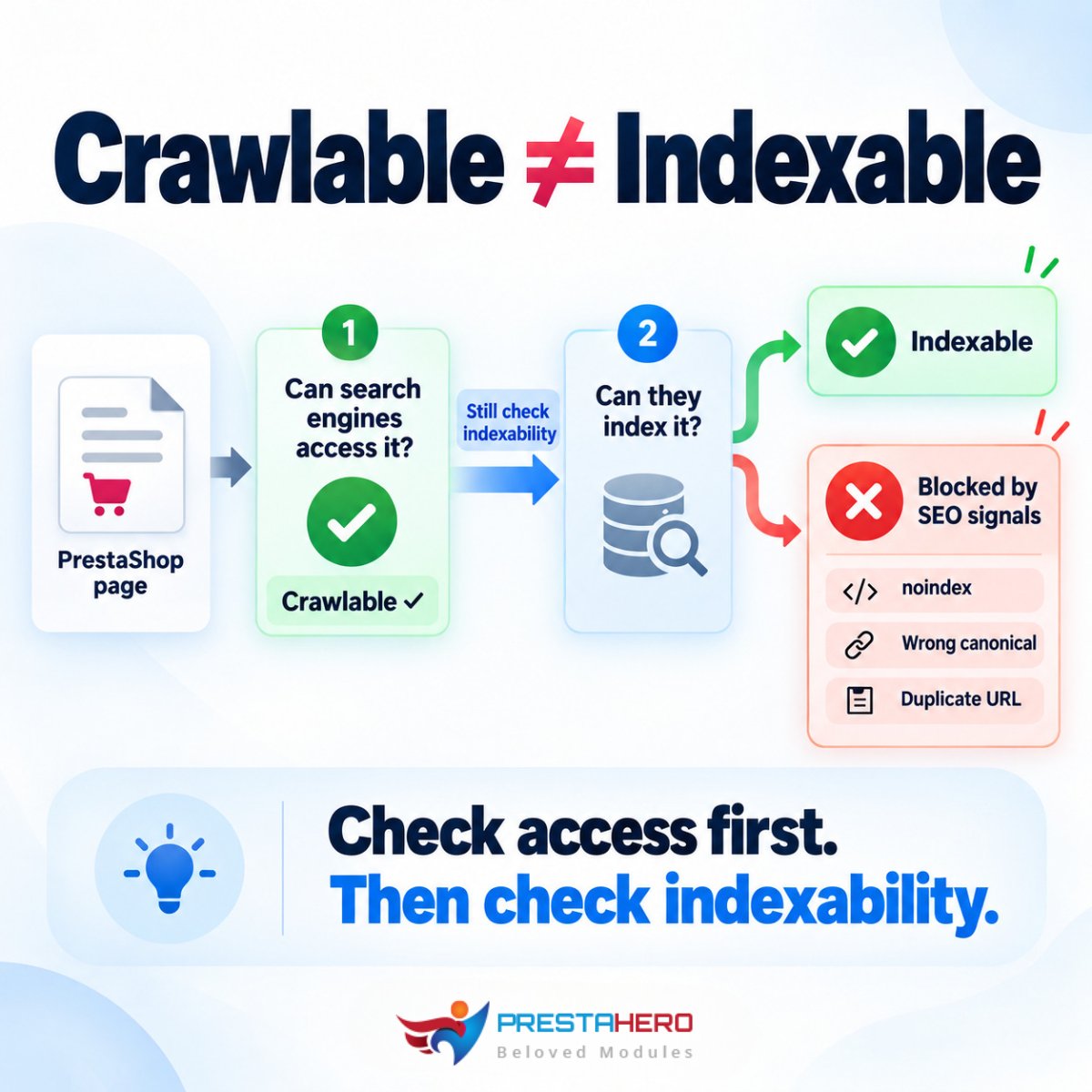
⚠️ A crawlable PrestaShop page is not automatically indexable.
Check crawler access first. Then review robots meta, canonicals and duplicate versions to confirm whether the page should be indexed.
SEO Audit supports these controls.
Guide:
https://t.co/apIZbvZkZv
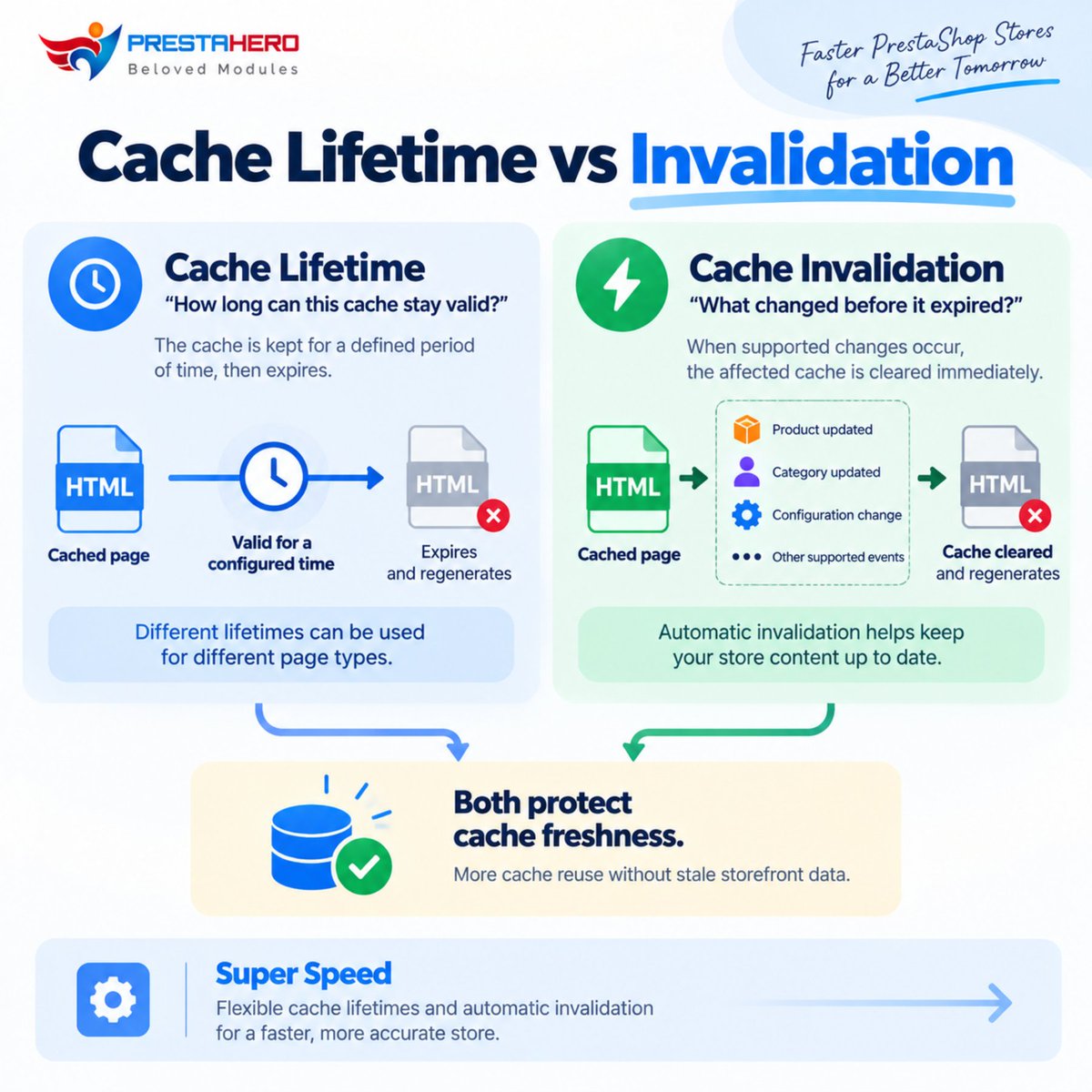
⏳ Cache lifetime and invalidation solve different freshness problems.
Super Speed supports different lifetimes by page type and automatic cache clearing after supported changes.
Goal: more cache reuse without stale storefront data.
Framework:
https://t.co/zHd4E4W78d
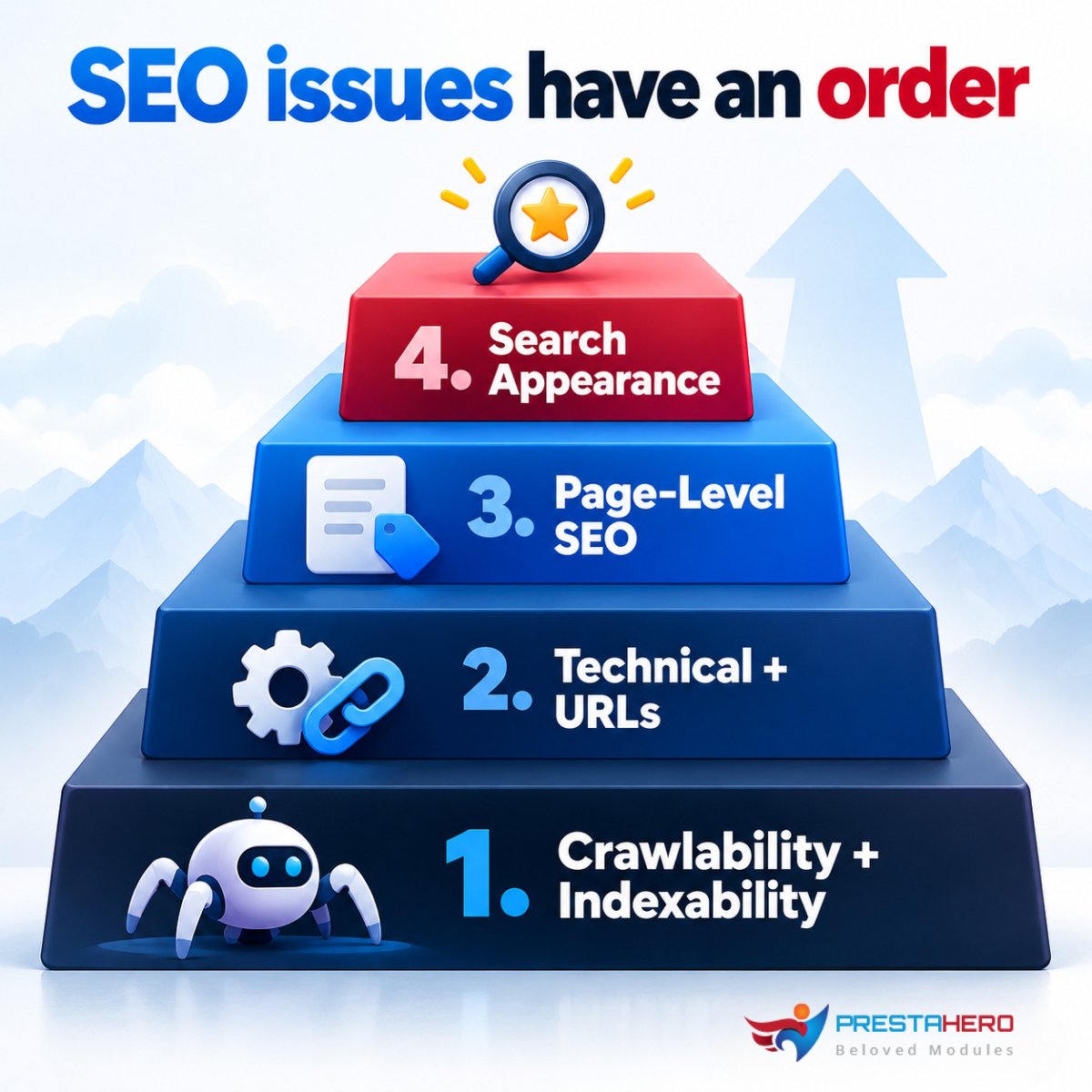
🔍 Don’t fix every SEO warning equally.
For a PrestaShop store, crawlability and indexability come first. If an important page cannot be discovered or indexed, polishing its metadata or structured data is secondary.
Priority framework:
https://t.co/apIZbvYN9X
🛒 Full-page cache does not need to make every PrestaShop block static.
Super Speed can keep reusable HTML cached while selected hooks, cart/customer data or prices reload dynamically when needed.
That helps preserve speed and accuracy.
Guide:
https://t.co/zHd4E4W78d
🧩 Structured data helps search engines understand products, ratings, and breadcrumbs—but it cannot guarantee rich results.
SEO Audit can generate supported schema. Check it matches the page and does not conflict with other markup.
Guide:
https://t.co/VEMaIsDZkz
🌐 One PrestaShop URL does not always mean one safe cached response.
Language, currency, country, customer group or cart state can change what visitors should see.
Super Speed can create separate cache variants for these contexts.
Guide:
https://t.co/zHd4E4W78d
🚧 A 404 is not automatically an SEO emergency.
Ask why the URL disappeared and whether a relevant replacement exists. Don't send every old URL to the homepage or an unrelated category.
SEO Audit includes 404 monitoring and redirects.
Guide:
https://t.co/VEMaIsDrv1
⚠️ Full-page cache is not a universal speed fix.
If the main bottleneck is heavy images, expensive JavaScript, hosting or a slow module, caching HTML will not remove that problem.
Diagnose the bottleneck first.
Guide:
https://t.co/zHd4E4W78d
📝 SEO Audit meta templates scale across PrestaShop catalogs, but generic patterns can create duplicate metadata.
Use sensible placeholders for routine pages. Write custom titles and descriptions where search intent needs precision.
Full guide:
https://t.co/VEMaIsDZkz
⏱️ Full-page cache helps most when server-side HTML generation is a real bottleneck.
A cache HIT can skip repeated PHP, database, hook and template work, reducing TTFB and server workload on frequently requested pages.
Read more:
https://t.co/zHd4E4W78d
🎯 Treat SEO scores as guidance—not Google ranking scores.
PrestaHero SEO Audit checks supported PrestaShop pages for issues with keyphrases, content, links, image ALT, metadata, and readability.
Use those findings to prioritize fixes.
Guide:
https://t.co/VEMaIsDrv1
🔄 First eligible request: cache MISS. PrestaShop generates the page and stores the HTML.
Later compatible request: cache HIT. The server can return that stored HTML instead of rebuilding the page.
How it works:
https://t.co/zHd4E4W78d
🗺️ A sitemap helps discovery; it does not guarantee indexing.
PrestaShop URLs still need to be crawlable, indexable, useful, and internally connected.
SEO Audit generates dynamic sitemaps; Google Search Console submission is manual.
Guide:
https://t.co/VEMaIsDrv1
⚡ Full-page cache stores generated HTML, not images, CSS or JavaScript.
On a compatible request, PrestaShop can reuse that HTML instead of rebuilding the page through PHP, SQL, hooks and Smarty.
Guide:
https://t.co/zHd4E4VziF
↪️ Canonicals and redirects are not interchangeable.
A canonical leaves the current URL accessible while signaling a preferred version. A redirect sends users and crawlers elsewhere.
Use each according to the URL behavior you want.
Guide:
https://t.co/VEMaIsDZkz
🎯 Don't change many performance settings at once.
Diagnose one bottleneck, make one targeted change, then retest the same PrestaShop pages.
This shows what improved and makes regressions easier to spot.
🔍 Measure → change → retest.
Full framework:
https://t.co/qEkAzKDVNS
🔗 A cleaner PrestaShop URL is not always worth changing.
If an established URL has traffic, backlinks, or search history, changing it creates migration work. Change it only when the benefit justifies redirects and validation.
Framework:
https://t.co/VEMaIsDrv1
🗄️ A large PrestaShop database is not automatically a slow database.
Old logs may need cleanup. Slow SQL needs query/index investigation.
Super Speed can export cleanup data before cleaning, but cleanup does not fix inefficient SQL.
🔎 Guide:
https://t.co/qEkAzKEtDq
⚙️ Page Cache, Browser Cache and GZIP solve different problems.
🚀 Page Cache cuts page generation.
🌐 Browser Cache cuts repeat downloads.
📦 GZIP cuts text transfer size.
Super Speed provides all three. Use each for the bottleneck it addresses.
Guide:
https://t.co/qEkAzKDVNS