I “joke” that I’m the dumbest guy in the company. I’m surrounded by math Olympiad winners, engineers who’ve been building and shipping AI for over a decade, a Fields Medalist, a Turing Award winner, and a boss who worked at CERN as a teenager, has a PhD in algebraic topology (I still don’t know what that means), and was early at Google’s Quantum AI lab.
Most explanations of AI either get buried in jargon or get simplified to the point where they’re misleading. So I’m going to try something different. I’m going to explain it the way I understand it, in plain English, using whatever analogies actually stick, even if they’re a little rough.
And when I get things wrong or cut a corner or two too many, Dr. Boris Hanin from Princeton, who advises us, will jump in and mark it up in the margins just like he does my internal memos.
The goal is simple. Help the rest of us non-quantum PhDs understand the systems that are starting to shape how the world actually works…
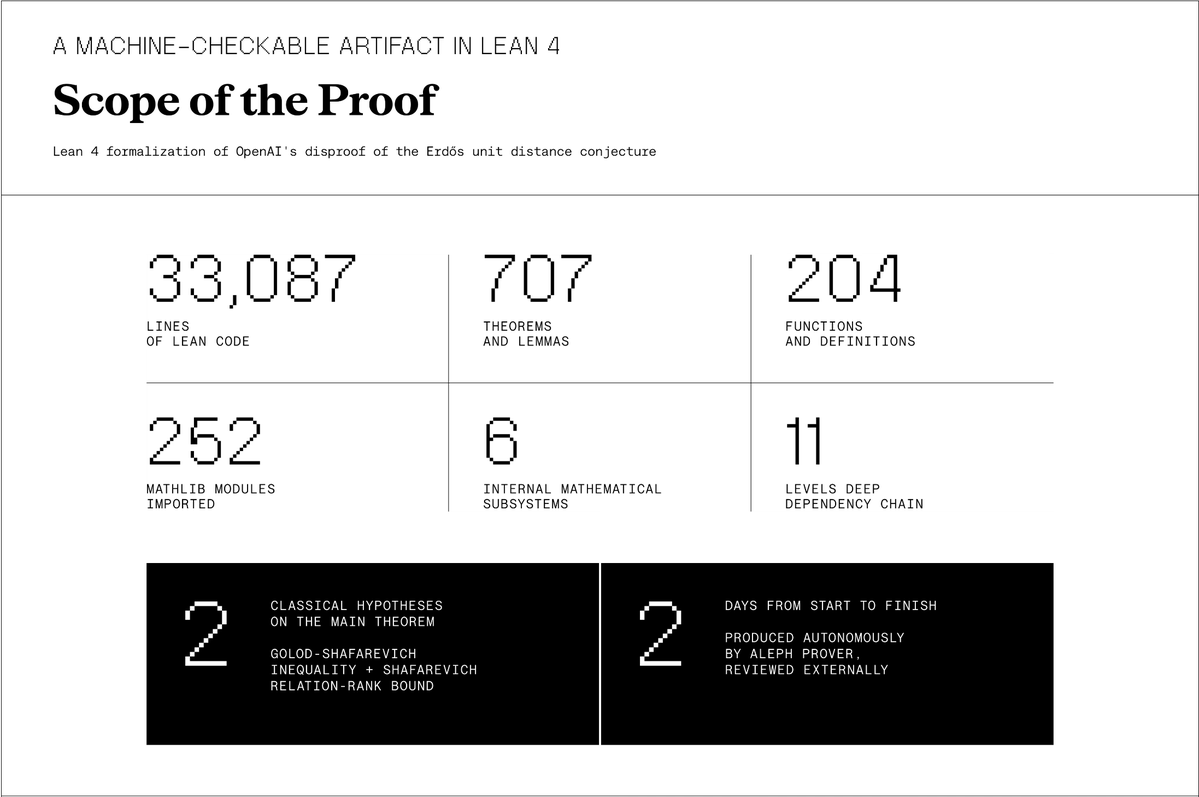
Last week, OpenAI showed that AI can help discover new mathematics. We took their result and formalized it into a machine-checkable proof in Lean 4.
This is more than academics. It's a step toward putting AI into critical systems where accuracy matters.
https://t.co/I0ElLegyWs
Last week, OpenAI demonstrated that AI systems can help discover new mathematics approaches in its recent counterexample to a conjecture of Paul Erdős announcement. We at Logical Intelligence took that as a challenge as well and formally verified the result in Lean 4 using the latest version of our Aleph Prover agentic system. The result is now a machine-checkable artifact in Lean 4.
This was a real hurdle for our new improved version of Aleph Prover to overcome to demonstrate that it can solve more complicated problems for extended periods of time.
We are happy to see more top companies working in that direction. We firmly believe that verifiable AI is the future and we’re excited to be part of that.
NEW: Aleph Prover has formalized OpenAI’s disproof of Paul Erdős’ planar unit problem.
We are releasing the formalization as open source so that other researchers can inspect, extend, and independently validate the result.
See it here: https://t.co/JR7M0tWQVN
Buggy slop code is burning capital faster than ever. I believe our recent formalization advancements will lead to AI producing code that’s formally verified *upon generation*.
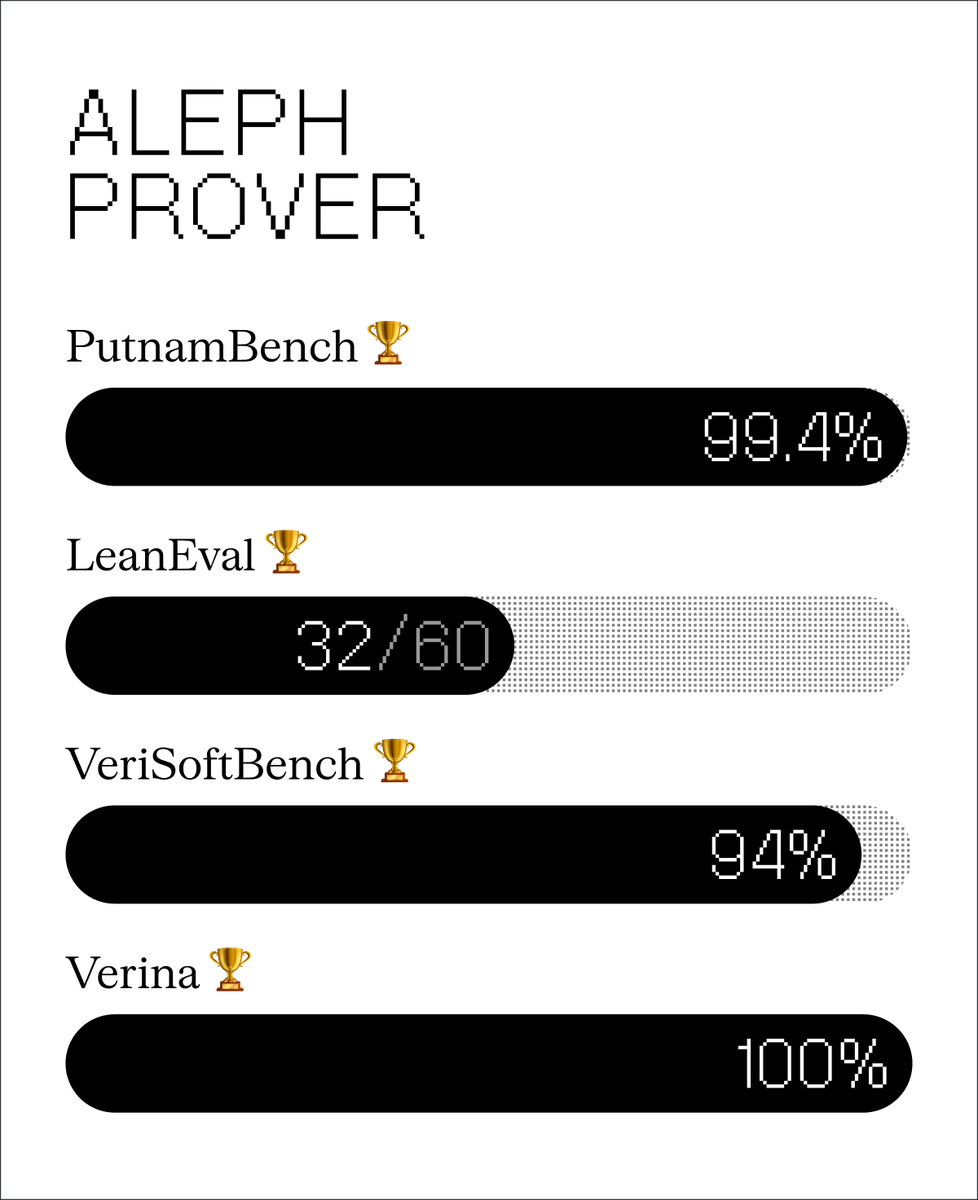
Aleph Prover reached the top position across several key formal reasoning benchmarks, marking another step toward scalable formal verification for mathematics, software, and hardware systems.
Our CTO @AlexFLogic explains why this is becoming one of the most strategically important frontiers in AI
@mertunsal2020 All good, friend. Not being snipey.
Regarding certain “others,” I’m a big believer in karma. Not sure Twitter hot takes is a good look for the CEO of a company. Reminds me of when SBF used to be on here acting holier than thou.
Aleph, our fully autonomous AI agent system for formal verification, aced all major theorem proving benchmarks including PutnamBench, VeriSoftBench, and Verina
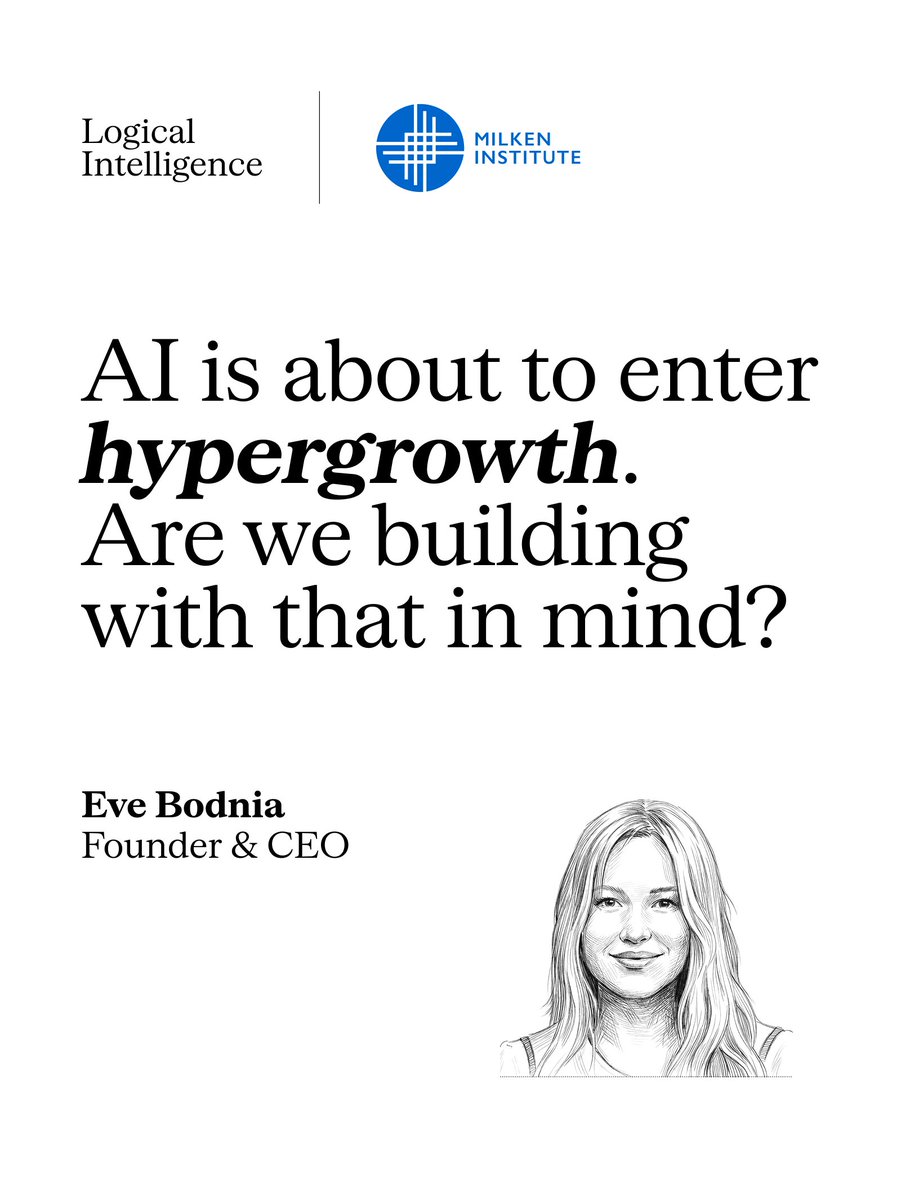
Our Founder and CEO, Eve Bodnia will be on stage at the Milken Institute Global Conference to discuss what it takes to build faster, smarter, and more sustainably, without compromising security in today’s era of AI hypergrowth
Livestream:
May 5 2:30 - 3:30 PM PDT
https://t.co/KxVqkGrHU4
Panel:
https://t.co/FPZV3J1uXu
If AI only predicts words, is it really thinking? 🤔
In this episode of The Neuron, we sit down with @evelovesolive, Founder and CEO of @logic_int, to explore energy-based models — a fundamentally different way to build AI systems that reason, plan, and evaluate multiple possibilities at once.
📺 YouTube: https://t.co/dCtI3J0TPj
🎧 Spotify: https://t.co/sa7Z3JBltg
🎙️ Apple Podcasts: https://t.co/QSF1mKiEXi
#TheNeuron #TechPodcast #EnergyBasedModels #LogicalIntelligence #LLMAlternatives
As the world’s largest companies pour hundreds of billions of dollars into large language models, San Francisco-based Logical Intelligence is trying something different in pursuit of AI that can mimic the human brain. https://t.co/3jZzhWVclO
As the world’s largest companies pour hundreds of billions of dollars into large language models, San Francisco-based Logical Intelligence is trying something different in pursuit of AI that can mimic the human brain. https://t.co/3jZzhWVclO
Logical Intelligence introduces first energy-based reasoning AI Model, and brings Yann LeCun to leadership as founding chair of their Technical Research Board
The 6-month-old Silicon Valley start-up, unveiled an “energy based” model called Kona and says it is more accurate and uses less power than large language models like OpenAI’s GPT-5 and Google’s Gemini.
It is also starting a funding round that targets a $1bn-$2bn valuation and has named LeCun chair of its technical research board.
Most large language models answer by predicting the next token, which can sound fluent while still drifting into confident mistakes.
Kona is an "energy-based reasoning model" (EBRM) that verifies and optimizes solutions by scoring against constraints, finding the lowest "energy" (most consistent) outcome. It's non-autoregressive, producing complete traces without sequential generation, reducing hallucinations.
Focuses on trustworthy, math-grounded reasoning for high-stakes applications where LLMs fail, emphasizing safety, efficiency, and constraint enforcement in logic-heavy tasks like puzzles or proofs.
How Kona operates
Its a non-autoregressive "energy-based reasoning model" (EBRM) model, meaning it doesn't generate outputs sequentially (like LLMs do token-by-token) but instead produces complete reasoning traces simultaneously. Here's how it works step-by-step:
- Input Conditioning: It takes a problem, constraints, and optional targets (e.g., a desired outcome like a proof goal or spec) as inputs. These condition the model directly, unlike LLMs which rely on probabilistic sampling.
- Energy Function Scoring: Kona learns an energy function that assigns a scalar "energy" score to entire reasoning traces (partial or complete). Low energy indicates high consistency with constraints and objectives; high energy flags inconsistencies, violations, or errors. This global scoring evaluates end-to-end quality, allowing the model to assess long-horizon coherence without degrading over extended traces.
- Optimization as Reasoning: Reasoning is reframed as an optimization problem. The model searches for the lowest-energy solution by minimizing the energy function, often through iterative refinement. It can revise any part of a trace mid-process, using dense feedback to localize failures (e.g., "this step violates constraint X") and guide corrections.
- Continuous Latent Space: Unlike discrete token-based LLMs, Kona works in a continuous space with dense vector representations. This enables precise, gradient-based edits and efficient local refinements without regenerating entire sequences.
- Output: The final low-energy trace represents a valid, constraint-satisfying solution. For example, in Sudoku, it maps allowable moves and finds a puzzle completion that minimizes energy (i.e., maximizes rule adherence).
This mechanism draws from physics-inspired principles, where energy minimization finds stable states, similar to how natural systems settle into low-energy configurations.
Overall, Logical Intelligence views EBMs as a path beyond LLM limitations, enabling AI that "knows" rather than guesses, with applications in verifiable, efficient reasoning.
This aligns with LeCun's long-standing advocacy for objective-driven AI via energy minimization, as opposed to autoregressive prediction.
Excited to finally be able to announce that I joined the @logic_int team as their chief strategy officer under @evelovesolive. Make sure you check our new AI system, Kona. It's wild stuff and just the tip of the iceberg for what we'll be releasing in the months ahead.