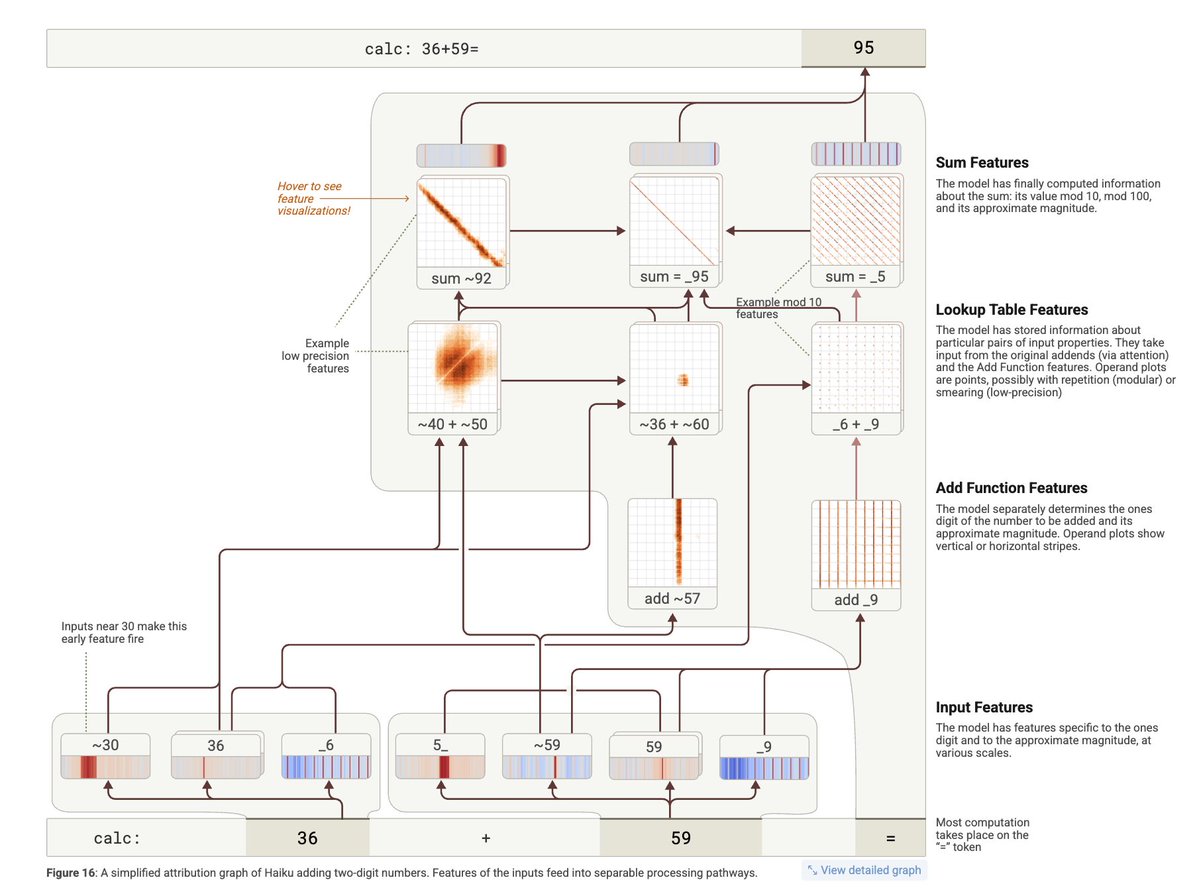
Transformer-based neural networks achieve impressive performance on coding, math & reasoning tasks that require keeping track of variables and their values. But how can they do that without explicit memory?
📄 Our new ICML paper investigates this in a synthetic setting! 🧵 1/13
Great work! See also https://t.co/mtWDpIqiEa from @LedermanHarvey & @kmahowald
This is a nice cautionary tale about Morgan's canon in interpretability: "introspection" here is closer to anomaly detection with confabulation than to direct/privileged access to injected content.
1/ Can LLMs introspect, i.e., reason about their internal states? Recent work claims LLMs notice when their "thoughts" get tampered with, and can report their content. We looked closely and we think it's too early to say that. Work led by @shashwat_s19 , with @tallinzen and me.
I redid the multi-digit multiplication experiment, now with gpt-5.5. With medium reasoning and 7 samples each cell, it pretty much aced the test with 99.46% accuracy. The model had no tools to call and had to rely on its reasoning. Can it go further? (1/4)
New opinion piece on the interface between research on concepts and categories in minds vs. in neural network LMs! I take the position that there is much to be learned from this interface (e.g., learning about concepts from language alone) and outline some directions for future.
all mech interp people are bought into causality, this criticism is very lazy as of ~2 years ago.
since this is a subtweet of NLAs, it is worth pointing out that their steering experiments on the poetry and eval awareness tasks *do* test for (in those cases) causality!
pov: you are a natural language autoencoder and you are aware you are being subject to evals by Redwood Research. do you fake writing out a coherent cot or truthfully say "the math problem is giving me 92ish vibes"?
@jatin_n0 Mostly a joke, it's a cool paper! yes the planning result is causal but only looking at total effect (i.e. an NLA-derived resid stream edit changes the output). I was referring to causal effect on the model's downstream computations, not anything inside/after the autoencoder. 1/2
New Anthropic research: Natural Language Autoencoders.
Models like Claude talk in words but think in numbers. The numbers—called activations—encode Claude’s thoughts, but not in a language we can read.
Here, we train Claude to translate its activations into human-readable text.
@jatin_n0 An additive AR-difference vector can change the output while acting as a broad steering perturbation without showing that the described content actually maps onto the operative feature in the model's putative "rhyme-planning" circuit 3/3
@jatin_n0 It's missing is evidecne about causal mediation: whether the NLA-described "rabbit plan" is the variable later components read, whether the edit produces a coherent "mouse plan" in later layers/tokens, whether ablating/patching intermediate states blocks or restores the effect 2/