We remember Sony's brilliantly brutal "This is how you share your games on PS4" video, as PlayStation kills discs 13 years later: https://t.co/Rv7qi8aPj3
@PlayStation Bad choice. You stood on a podium once, although it might have been a stunt in hindsight, and lended a ps game on a cd to a friend. You mocked a competitor for pushing people to be connected to the internet to play. Now you do the same. Shame.
“THE DAY I STOPPED ARGUING… EVERYTHING CHANGED.”
It didn’t happen in a church & it didn’t happen during prayer.
It happened… in the middle of a comment section.
A Protestant man had been arguing with me for days.
Every answer I gave… he rejected.
Every verse I explained… he twisted.
Every truth about Mother Mary… he mocked.
But that wasn’t the strange part.
The strange part was this…
He never responded to what I said.
It was like… he was fighting something else.
I tested it.
I stopped explaining theology.
Instead, I wrote one simple line:
“I will pray for you tonight.”
For the first time…
He paused.
Then came the reply:
“Don’t.”
Just one word.
“Don’t.”
That word hit me harder than all his arguments.
Why would someone be angry… about being prayed for?
Why fear a prayer… if this is just a debate?
That night, I couldn’t sleep.
Something didn’t feel right.
So I did exactly what he didn’t want…
I prayed.
Not loudly.
Not dramatically.
Just quietly:
“Jesus… go where I cannot.”
The next morning…
There was a message waiting.
Not an argument.
Not a debate.
Just this:
“I don’t know what happened last night…
but I felt restless… I couldn’t sleep…
something was bothering me…”
I didn’t celebrate.
I didn’t argue.
I just understood something deeper…
This was never just about knowledge.
Because if it was about knowledge…
answers would have been enough.
But some battles…
Don’t happen in the mind.
They happen in the soul.
Listen…
Not everyone who disagrees is against you.
But sometimes…
When truth is resisted violently…
when love is rejected aggressively there may be a deeper struggle inside that person.
And your arguments…
cannot reach that place.
But your prayer can.
From that day…
I still answer questions.
But I never forget this:
The strongest weapon is not my words…
It is what I whisper to God
when no one is watching.🕊️
Because some people don’t need another argument.
They need someone
who will fight for them on their knees.
She's kissing His feet.
The prostitute is kissing the rabbi's feet.
With her mouth. Her hair. Her tears.
And every man at this table knows exactly who she is.
Some of them have paid her.
She knew Jesus.
Simon the Pharisee just knew ABOUT Him.
And there's a blood-soaked difference.
Simon invited Jesus to dinner.
Not to honor Him. To evaluate Him.
Simon was a Pharisee. Didn't touch unclean things. Kept every law where people could see it.
Jesus walked through his door.
No kiss. No water for His feet. No oil for His head.
Just the minimum hospitality the law required.
Safe belief. The kind that doesn't cost anything.
Then she walked in.
That woman. The one they whispered about.
She brought her alabaster jar. The expensive perfume.
Some of them had smelled it before. Up close. In the dark.
Tonight it meant something different.
She didn't come to work. She came to worship.
She fell at His feet.
Then she did something that stopped every conversation:
She let down her hair.
First-century Jewish culture: A woman never let down her hair in public.
Never.
Grounds for divorce. Proof of adultery.
Bound hair = respectability.
Loose hair = available.
Every man in that room knew the language.
She let it fall. In front of the rabbi. In front of the men who'd paid her.
Not seduction. Surrender.
When you truly KNOW Jesus, you stop performing for Pharisees.
Her tears fell on His feet.
Sobbing. Ugly crying. Years of shame cracking open.
She wiped His feet with her hair.
The hair that marked her as "that woman."
The hair men had touched in transactions.
She used it to serve Jesus.
Kissed His feet. Over and over.
Poured the perfume over them.
The whole house filled with her smell. Her past. Her trade.
And Jesus let her.
Simon thought: "If this man were a prophet, He would know what kind of woman is touching Him."
Here's the bomb:
Jesus DID know.
Her profession. Her shame. Every client. Every transaction.
He knew.
And He let her touch Him anyway.
Because God doesn't keep His distance from unclean things.
He gets close enough to be contaminated by our shame so we can be cleansed by His love.
Jesus turned to Simon.
Told a story about two debtors. One owed 500 denarii. One owed 50.
Neither could pay. Both forgiven.
"Which one will love more?"
"The one forgiven more."
"Correct."
Then Jesus destroyed Simon:
"I entered your house. You gave Me no water. She washed My feet with tears.
You gave Me no kiss. She hasn't stopped kissing My feet.
You gave no oil. She anointed My feet with perfume.
Her many sins are forgiven—as her great love has shown."
Simon knew ABOUT Jesus. Kept all the laws. Maintained distance.
The prostitute knew JESUS. Brought shame. Tears. Hair. Everything.
Simon calculated. She surrendered.
Jesus said: She understands the Kingdom.
Believing in Jesus doesn't make you a Christian.
The demons believe. Know theology. Quote Scripture. Recognize His authority.
James 2:19 — "Even the demons believe—and shudder."
And they're going to hell.
Because belief without surrender is just information.
It's Simon at the table. Safe. Clean. Unchanged.
Knowing ABOUT Jesus while never getting close enough to be changed.
The woman's love WAS the evidence of forgiveness.
Not the cause. The proof.
Simon looked at her and saw sin.
Jesus looked at her and saw faith.
Simon kept distance to stay clean.
She broke every rule to get close.
Jesus said to HER: "Your faith has saved you. Go in peace."
Not your belief. Your faith.
Not your knowledge. Your reckless proximity.
Not your reputation. Your messy surrender.
Simon went home still clean. Still correct.
Still distant.
Still unchanged.
The prostitute went home forgiven.
Transformed.
Not because she was better.
Because she came closer.
Which one are you?
—TBM
The application of one term, “Reformation,” to a hodge-podge of conflicting sects with no common faith, worship, or government, is a masterstroke of deception. It gives an appearance of solidity and unity that Protestantism has never had.
I know this because I was one for 31 years.
I loved and read the Bible since the earliest days I could read. I read, read, and read (much like today). I had many great Protestant heroes, such as Luther, Calvin, Edwards, Wesley, Spurgeon, Sproul, Piper, MacArthur, etc.
But as a Protestant, I couldn’t even get a consistent answer on something as basic as baptism—the very thing Our Lord commanded be done in the Great Commission. The furthest I could get was Good/Educated Person A teaching Doctrine X, and Good/Educated Person B teaching Doctrine Y, with no way to obtain an ultimate verdict on which of the two (if either) was actually CHRIST’S TEACHING. And since Christ said “If you love me, you will obey my commandments,” and He commanded the Apostles to teach the nations “to observe ALL that I have commanded you,” this inability to get beyond a good guess meant I could never really know whether I was loving Him in the way He actually commanded us to love Him, or if I was even following the correct set of “commandments.” No one claimed the authority to teach what Scripture actually meant. Therefore, the “commandments” they believed Jesus gave were really just their opinions about what He commanded.
But is that what Jesus intended? I didn’t see anything like that in Scripture, and when I later began reading the Church Fathers, there was nothing like that in Church history either—except among heretics and schismatics (virtually all of whom believed doctrines different than modern Protestants, but arrived at them by the same means—reading Scripture apart from the Church).
That is why, even before considering the Catholic Church in any way, I came to believe the “Reformation” label was somewhat disingenuous.
“The Reformation” refers to a singular WHAT, which is often claimed to be a recovery of “the Gospel.”
But the WHAT in this case wasn’t a WHAT, but a bunch of WHATS—an ever-increasing number of conflicting sects, all claiming to teach Christ’s “Gospel,” but not agreeing on what that is.
But how can you claim to recover the “Gospel” while not even agreeing on what it means, what it teaches, and what it requires? Where are simple people supposed to go? Who are they supposed to trust? Did Christ not provide an assured means through which the true Faith could be publicly known and declared to the whole world, especially in the midst of conflicting opinions? It’s a sham claim.
So, I thought to myself, what exactly was “reformed” (literal sense of the word, not Calvinism)? I can’t get a straight answer on baptism; on divorce; on worship; on Church structure and government; on basic moral questions; whether I can lose my salvation; etc. etc. etc., from those celebrating this singular thing they called “The Reformation.” How was that an IMPROVEMENT on anything?
I thought then—as I know many thoughtful Protestants also believed, and continue to believe now—that this couldn’t possibly be what Christ intended.
Indeed, it is not.
“Every man did what was right in his own eyes” (Judges 21:25).
“If Protestants knew thoroughly how their religion was formed; with how many variations and with what inconstancy their confessions of faith were drawn up; how they first separated themselves from us, and afterwards from one another; by how many subtleties, evasions, and equivocations they labored to repair their divisions, and to re-unite the scattered members of their disjointed reformation; this reformation of which they boast would afford them but little satisfaction, or rather, to speak my mind more freely, it would excite in them only feelings of contempt.”
Bishop Jacques Bossuet, “The History of the Variations of the Protestant Churches” (1688) (Volume I, Preface)
In Dallas, Texas, an Islamic imam got very angry when he saw a fellow Muslim talking to a Christian preacher.
He then called the police and threatened to get him arrested and ban the man from his mosque if he keeps ‘talking to Christians.’
This is what a cult looks like.
🚨 BREAKING: Erika Kirk forgives the killer of Charlie Kirk, Tyler Robinson.
"Father, forgive them, for they not know what they do."
"That young man. I forgive him."
If this doesn't give somebody chills, I don't know what will.
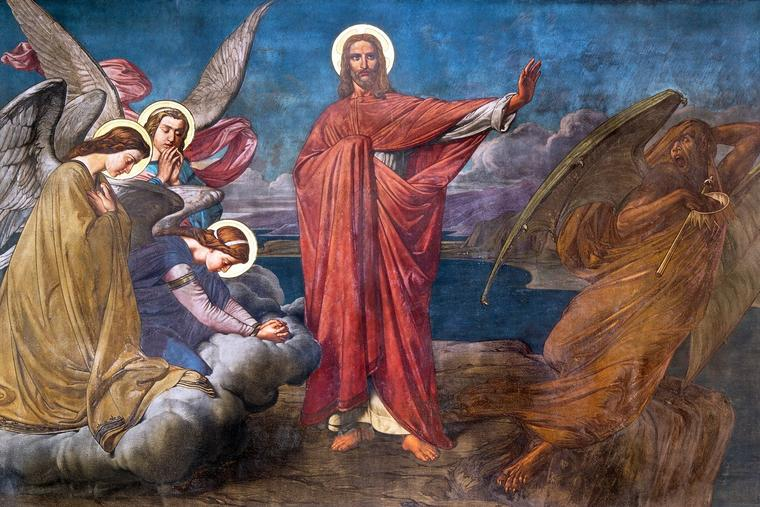
The greatest trick the devil ever played was convincing the world he does not exist
Demons are real. The Church has always taught this.
And if you are not aware of their existence & playbook you already lost the war for your soul
What the Church teaches about demons - a 🧵✝️