Congrats @MLB, you've managed to make watching a pitch feel like a glitchy video game. Those behind-the-batter digital ads jitter and flicker like they're haunted. Just leave the local ads. I promise we can handle seeing a car dealership in Omaha.
And immediately after we get something good, this shit happens.
Because the tech lords truly want our works for free and want us to be glad when we hand it over. Insanity.
https://t.co/o7AWdB3ohb
🚨 BREAKING: The U.S. Copyright Office SIDES WITH CONTENT CREATORS, concluding in its latest report that the fair use exception likely does not apply to commercial AI training. From the report's conclusion:
"Various uses of copyrighted works in AI training are likely to be transformative. The extent to which they are fair, however, will depend on what works were used, from what source, for what purpose, and with what controls on the outputs—all of which can affect the market. When a model is deployed for purposes such as analysis or research—the types of uses that are critical to international competitiveness—the outputs are unlikely to substitute for expressive works used in training. But making commercial use of vast troves of copyrighted works to produce expressive content that competes with them in existing markets, especially where this is accomplished through illegal access, goes beyond established fair use boundaries.
For those uses that may not qualify as fair, practical solutions are critical to support ongoing innovation. Licensing agreements for AI training, both individual and collective, are fast emerging in certain sectors, although their availability so far is inconsistent. Given the robust growth of voluntary licensing, as well as the lack of stakeholder support for any statutory change, the Office believes government intervention would be premature at this time. Rather, licensing markets should continue to develop, extending early successes into more contexts as soon as possible. In those areas where remaining gaps are unlikely to be filled, alternative approaches such as extended collective licensing should be considered to address any market failure.
In our view, American leadership in the AI space would best be furthered by supporting both of these world-class industries that contribute so much to our economic and cultural advancement. Effective licensing options can ensure that innovation continues to advance without undermining intellectual property rights. These groundbreaking technologies should benefit both the innovators who design them and the creators whose content fuels them, as well as the general public."
-
My comments:
Although this is a pre-publication version, the report states: "The Office is releasing this pre-publication version of Part 3 in response to congressional inquiries and expressions of interest from stakeholders. A final version will be published in the near future, without any substantive changes expected in the analysis or conclusions."
It's GREAT NEWS for content creators/copyright holders, especially as the U.S. Copyright Office's opinion will likely influence present and future AI copyright lawsuits in the U.S.
As I've written before, licensing deals seem to be the future of AI training.
👉 Read the full report in the link below.
👉 NEVER MISS my updates and analyses: join my newsletter's 61,000+ subscribers using the link below.
AI boosters claim creators object to changing copyright law because they don’t understand AI or the nuance behind the debate.
I’ve spoken to 100s of artists about this. They understand just fine.
They object because it’s hideously unfair.
GenAi companies know where all the court cases are headed, and how badly it’s going to go for them.
Their only resort? Entirely destroy legal systems that are in our constitution in order to get away with their theft of creative works.
But they wont succeed. We wont let them.
"Aside from it being bigoted and unconstitutional, it’s ludicrous to think that laws need to be created to help protect the language of Shakespeare." ––Joey Lucas, The West Wing
Remember in The West Wing, Joey Lucas says the Repubs won't put English as the national language on the table—they would never risk losing Latino voters.
Charging your personal phone on campus is basically stealing from the university. Electricity cost money! Also, you’ll need to use your personal phone number for two factor authentication on all university apps.
Yes, we want you working over the break. No, we don’t want you on campus. That why we turned the heat off. Work from home and, if you have to come to the office, don’t bring a space heater.
Any electricity used in your office will be subtracted from your January pay check.
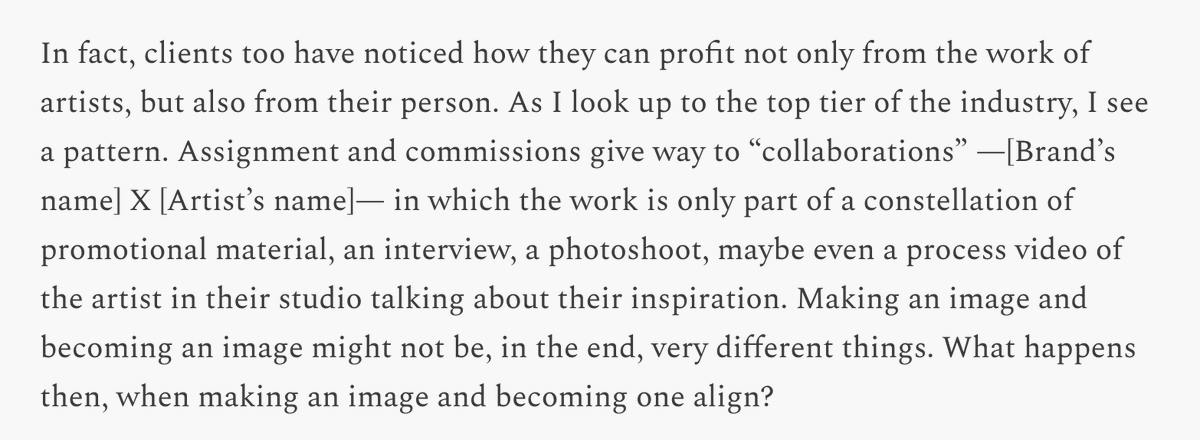
I loved @JulienPosture’s recent newsletter about hot men making shitty art. I was particularly struck by this aside about the push towards artist-as-influencer & content producer. Definitely something I've been thinking about in the design industry, too... https://t.co/0v55U0pvkA