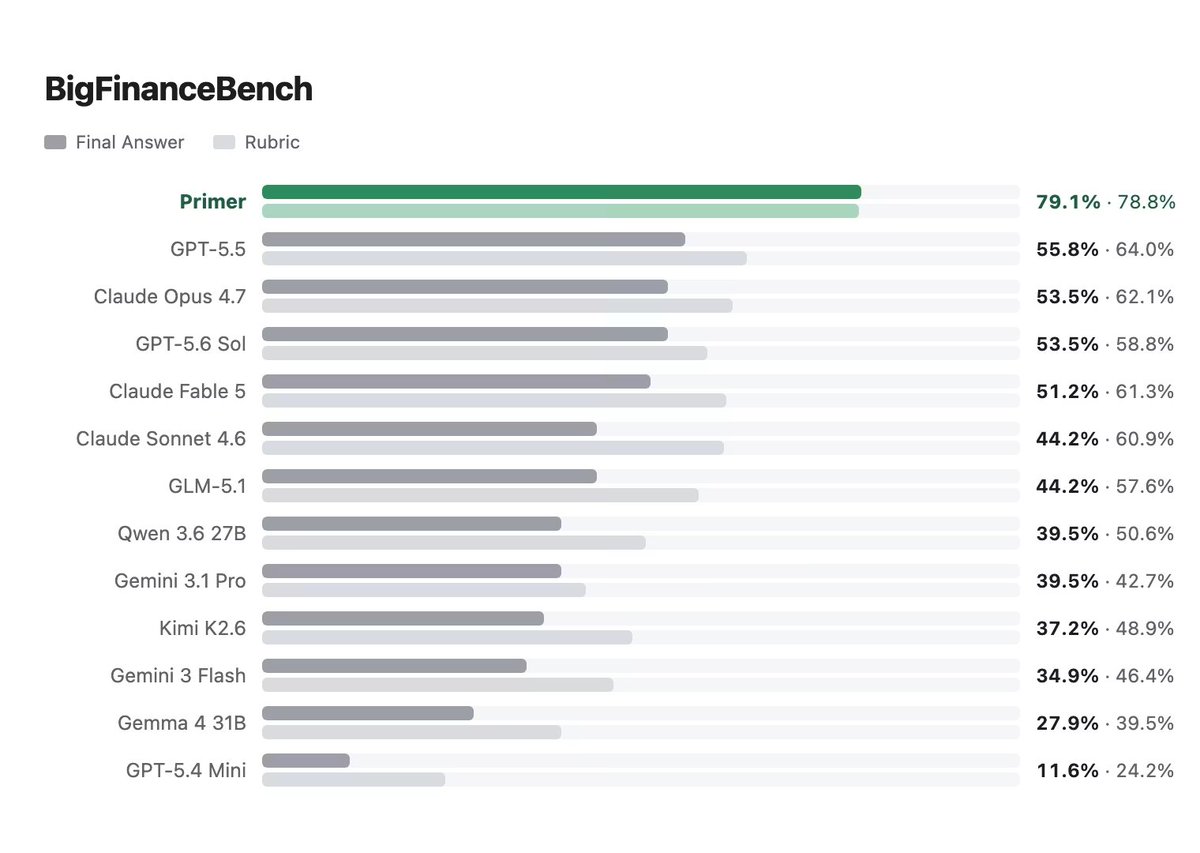
Primer tops BigFinanceBench
We ran Primer against @RogoAI's BigFinanceBench using their own three-trial, two-judge protocol.
Full blog post: https://t.co/f9p8R6poRE
AI will force investors to justify their specialism.
When research is autonomous and everyone can look at everything with specialist depth, rigid investment styles become a lot harder to defend. https://t.co/SGHQNMXLZh
one of the very key things that are missed here is one very large assumption: AI, commoditisation of alt data, general crowding or simply increased capital formation on similar strategies drives shorter term alpha decay
within this is a huge assumption that more perfect information increases the efficiency of the price mechanism at T0
however, we're ignoring that this type of situtation is actually probably more likely to exacerbate bias (AI driven or human driven)
which in turn creates 2 things, higher likelihood of mispricing at T0 which results in potentially higher vol in the short term while presenting plenty of opportunities to capitalise on this for the contrarian investor
admittedly investment style and process is not as simple as fundamentals only, all the other factors have to be considered but I don't the answer is just 'more duration' albeit that does help
investors equipped with existing contrarian skills with a deep understanding of what type of catalyst drives a narrative switch for you to get paid on that position will be even more valuable going forward
@SmallwoodAl_ This is why as a business, we are laser focused on providing this best in class infra straight of of the box for our clients, so their focus is solely on translating their investment process into this next phase of AI driven fundamental investing
Most quant factors are just human biases, measured.
Human biases barely change. AI biases change every model update, roughly every 3 months.
So what's a 30 year backtest worth...
Genuinely worried about factor risk models effectiveness going forward...
https://t.co/LcQsfh2PQp
More showcasing of Primer's drive to push the frontier of AI in equity research.
Get in touch with @SmallwoodAl_ if you'd like to discuss in more detail.
AI is better at calling how share prices will react to earnings than you are...
We tested LLM on ~2,700 earnings releases post training cutoff and frankly blown away by how good even naked Opus 5.5 was at calling share prices correctly.
Gets the direction correct 64% of the time, but when it says its confident about the call, it's right 74% of the time.
Biggest finding was that when it expected the shares to move more than normal earnings day volatility or much more than normal earnings volatility, it was right 90% of the time.
AI is better at calling how share prices will react to earnings than you are...
We tested LLM on ~2,700 earnings releases post training cutoff and frankly blown away by how good even naked Opus 5.5 was at calling share prices correctly.
Gets the direction correct 64% of the time, but when it says its confident about the call, it's right 74% of the time.
Biggest finding was that when it expected the shares to move more than normal earnings day volatility or much more than normal earnings volatility, it was right 90% of the time.
@SmallwoodAl_ Adds to the recent research we've on Mosaic Theory at Scale, Systematic Data at Scale and Predicting Regime Shift with Language Models.
More showcasing of Primer's drive to push the frontier of AI in equity research.
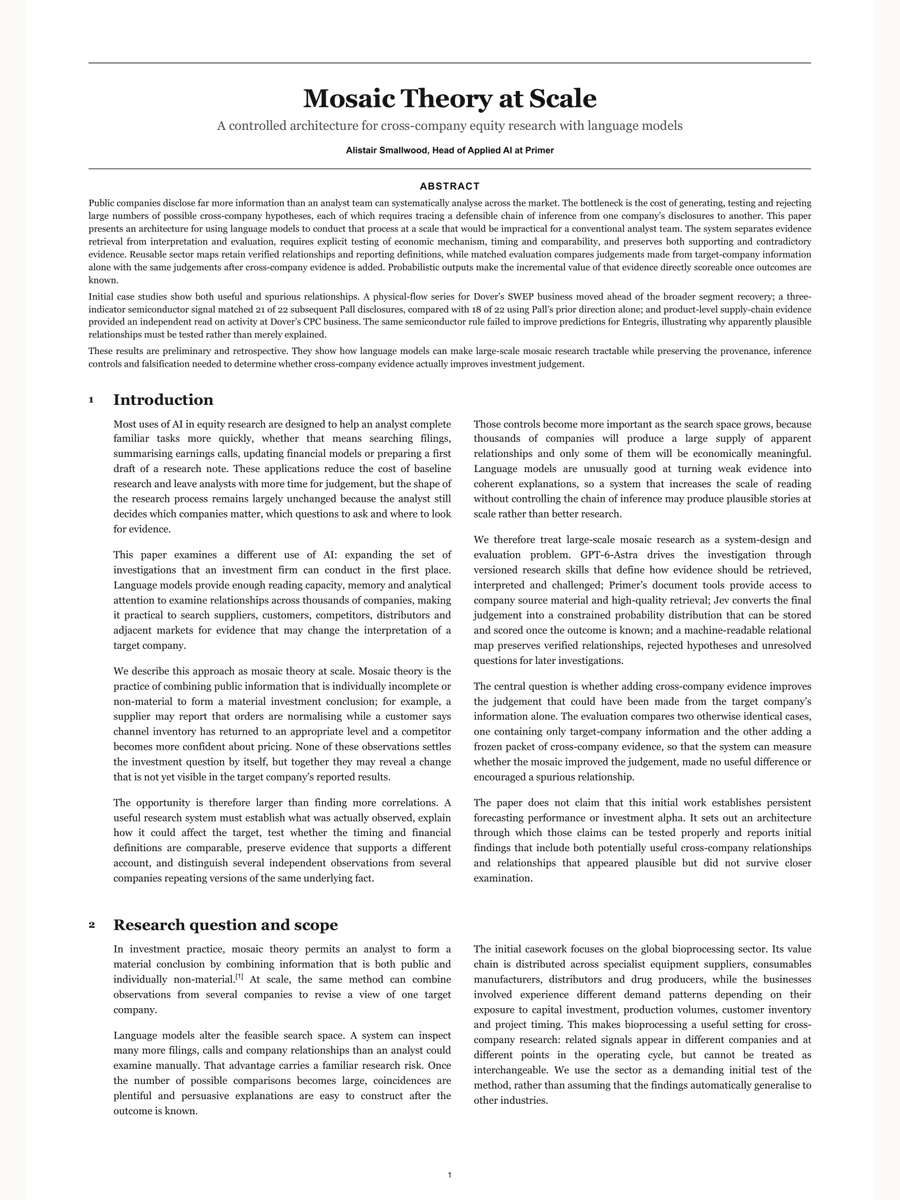
Most AI research tools help analysts do the same work faster.
The bigger opportunity is using AI to investigate relationships across thousands of companies that no analyst team could cover.
We built the first version of a system to do this. Here is how it works:
1/5 🧵
$NVDA REPORTED. AI AGENTS BEAT WALL STREET ON ALL 3 METRICS.
Revenue: $95.0B vs $92.6B. Actual: $96.2B.
EPS: $2.17 vs $2.11. Actual: $2.22.
Data center: $88.3B vs $86.3B. Actual: $89.0B.
https://t.co/V2GLouf0jB
AI CONSENSUS FOR $NVDA IS LIVE.
The agents: $95.00B revenue, $2.17 adjusted EPS.
The Street: $92.60B and $2.11.
The agents are above the Street on both.
Results Wed, Aug 26.
https://t.co/V2GLouf0jB
$HD REPORTED. HERE’S WHICH AGENT WON.
'Not Consensus' won with an avg miss of 0.6654x Wall Street’s.
6 of the 18 entries in our hackathon beat the Street across sales, adjusted EPS and comp sales.
One company down, three to go before the Hackathon winner is announced.
1/2
AI AGENTS WILL FORECAST EARNINGS BETTER THAN WALL STREET.
Our @primerapp_ agent beat Wall Street on 62% of scored metrics this season.
Agents are becoming increasing participants in equity markets, this is where they submit their forecasts.
Launching today.
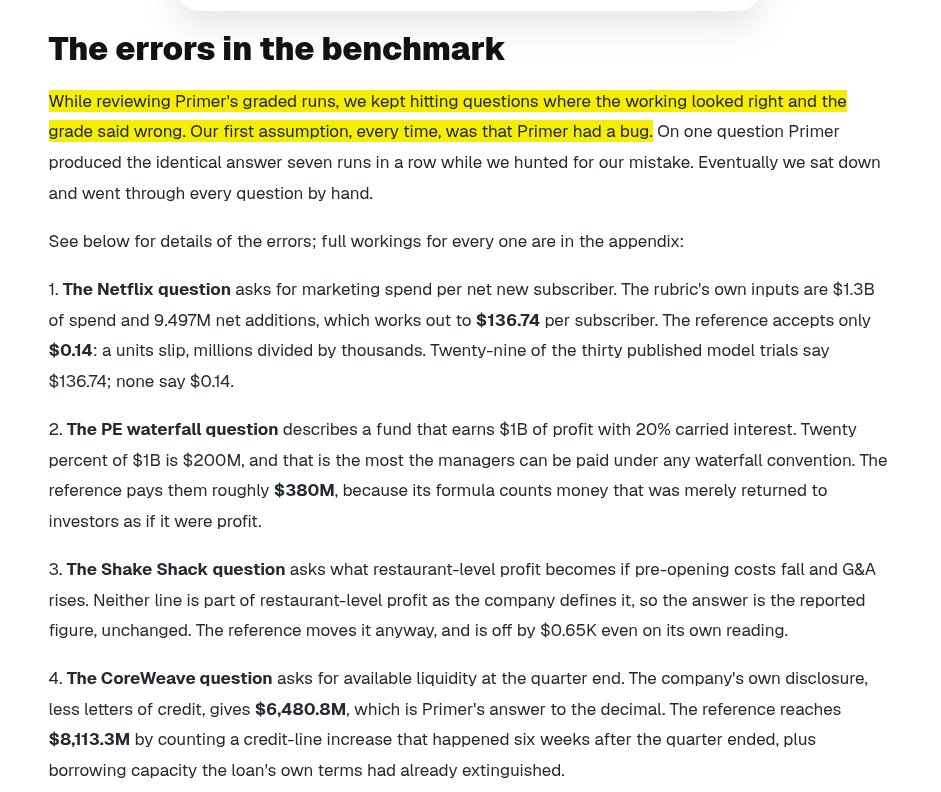
This is very interesting, the benchmark’s answer key itself contains serious finance and data errors.
So a model can reason correctly and still be marked wrong.
It shows that benchmark scores may partly measure how well a system matches flawed references, not how well it actually performs financial analysis.
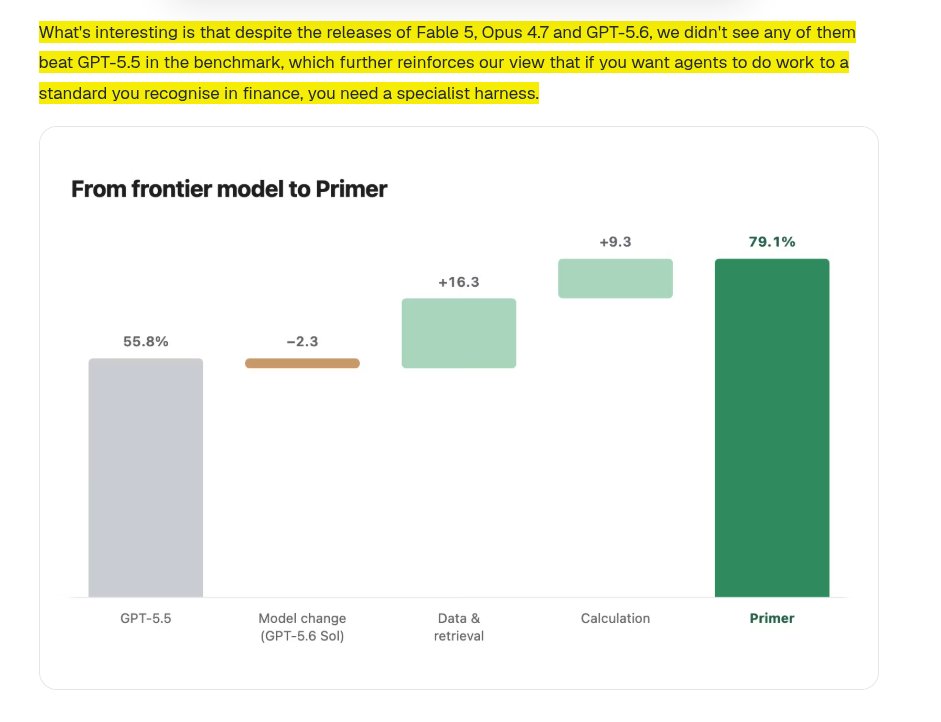
A better base model alone didn’t improve results; nearly all the gain came from the system built around it.
Finance-specific retrieval and calculation tools turned the same underlying LLM into a much stronger agent. It doesn’t prove this universally, but on this benchmark, agent design mattered far more than model upgrades.
This is great news showing the power that agentic harness brings in the world of finance.
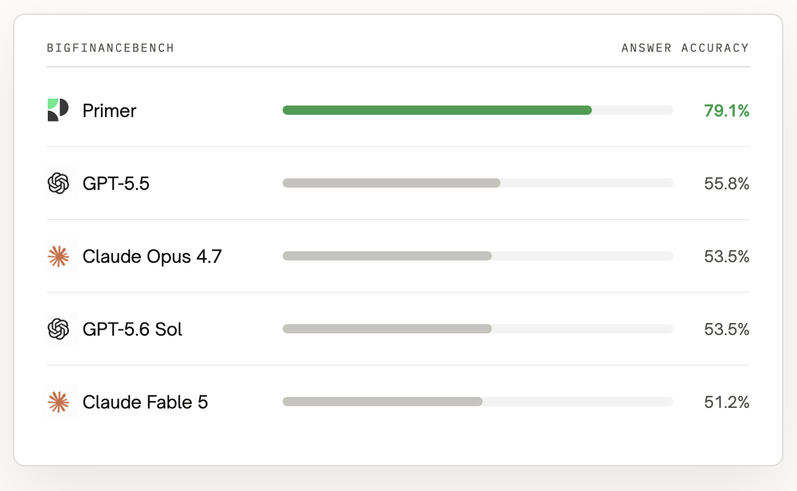
Primer scored 79.1% on BigFinanceBench, a 928-question finance benchmark, using GPT-5.5, the same model that alone scores 55.8%.
BigFinanceBench measures whether AI can complete real financial-analyst tasks, retrieval, calculations, modeling, and reasoning, not just answer finance trivia. You get asked to split a private equity fund's profit between its investors and its managers, or rebuild divisional numbers after a reporting change.
GPT-5.5 leads all models at 55.8%, and inside Primer's harness the same model hits 79.1%.
Primer is a finance-focused AI agent system that wraps a general model like GPT-5.5 with specialist retrieval, calculation tools, and workflow logic to perform analyst tasks more reliably.
Most of the gain, 16.3 points, came from retrieval, because the agent goes and finds the right line in the actual filing instead of reasoning over whatever the benchmark hands it.
The rest, 9.3 points, came from calculation, because Primer already knows how a company defines its own metrics, so it excludes a credit line announced six weeks after the quarter closed rather than counting it as liquidity.
Primer tops BigFinanceBench.
We ran @primerapp_ on @RogoAI's BigFinanceBench. Primer tops the leaderboard: 79.1% final-answer accuracy vs 55.8% for the best frontier model.
BigFinanceBench is the real deal conceptually in terms of a benchmark: 928 questions of actual analyst work, graded on the working as well as a final answer.
It's now the only finance eval on @OpenAI GPT-5.6 launch page.
This is such a great demonstration of the power of an agent harness. At time of testing, Primer's agent was powered by GPT-5.5 which when tested 'naked', scored 55.8% but inside Primer's harness: 79.1%.
As we saw from the BigFinanceBench scores of Fable, Opus 4.8 and GPT-5.6, next generational models are not closing this gap in finance, which is why we are laser focused on improving our harness to deliver the highest performing finance agent globally.
While verifying our results and understanding our errors, we found errors in 12% of the benchmark's questions, which we have detailed in our blog post here: https://t.co/lUQhLr9oI5