Elon Musk explains that first principles thinking - boiling a problem down to its fundamental truths rather than reasoning by analogy - is a more mentally demanding but effective method for achieving significant innovation, such as reducing the cost of battery production.
Chinese Humanoid Robot Beats Human 100m World Record
China’s humanoid robot “Lightning” reportedly completed 100 metres in just 9.32 seconds, faster than Usain Bolt’s 9.58-second world record.
In 2005, Bangladesh held under 2.5% of the world's ready-made garment trade. Twenty years on, that share sits at 6.76%, nearly tripling the country's slice of a fiercely competitive market.
The country's share has now stayed below its 2022 peak of 7.91% for three straight years, dipping in 2023, recovering to 7% in 2024, then slipping again in 2025, even as Bangladesh held onto its position as the world's second-largest RMG exporter.
Bangladesh’s 2026 SSC and equivalent results are out: of 1,829,485 students who sat the exams under 11 education boards, 1,138,877 passed and 690,608 failed, producing a nationwide pass rate of 62.25%, down 6.20 percentage points from 68.45% in 2025.
The Technical Board recorded 58.20%, while the Madrasah Board recorded 55.49%. Only 669 institutions achieved a 100% pass rate, down from 984 last year, while 312 institutions had no passing students, up from 134 in 2025.
(4/4) When your income is not increasing but prices are increasing, your real income and purchasing power start declining. In other words, millions of people struggle to buy food and pay the utility bills when prices are rising rapidly.
(1/4) Bangladesh's inflation rate has remained over 9% for three consecutive months. While the US inflation rate in June 2026 was 3.5%, Bangladesh's inflation rate in June 2026 was 9.16%. 👇
(3/4) However, an over 8-9% inflation rate every month signals that millions of people in Bangladesh, especially the lower and middle income class, are facing higher prices for food, energy, and all the essentials. But their income is not increasing.
When we have fewer foreign reserves, this also means we have to pay more for imported goods, which in turn causes inflation to go up, and millions of people suffer because they cannot afford to pay higher prices.
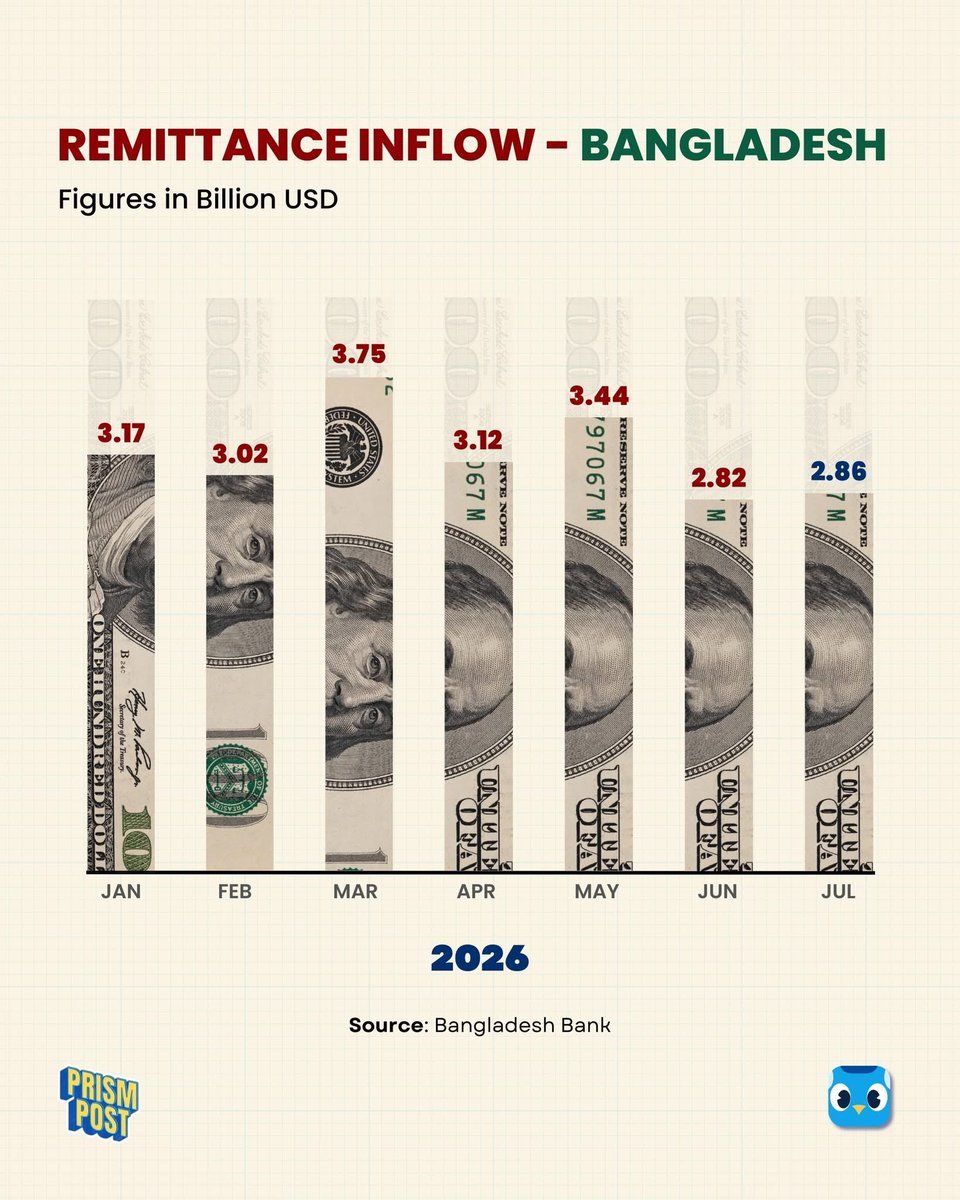
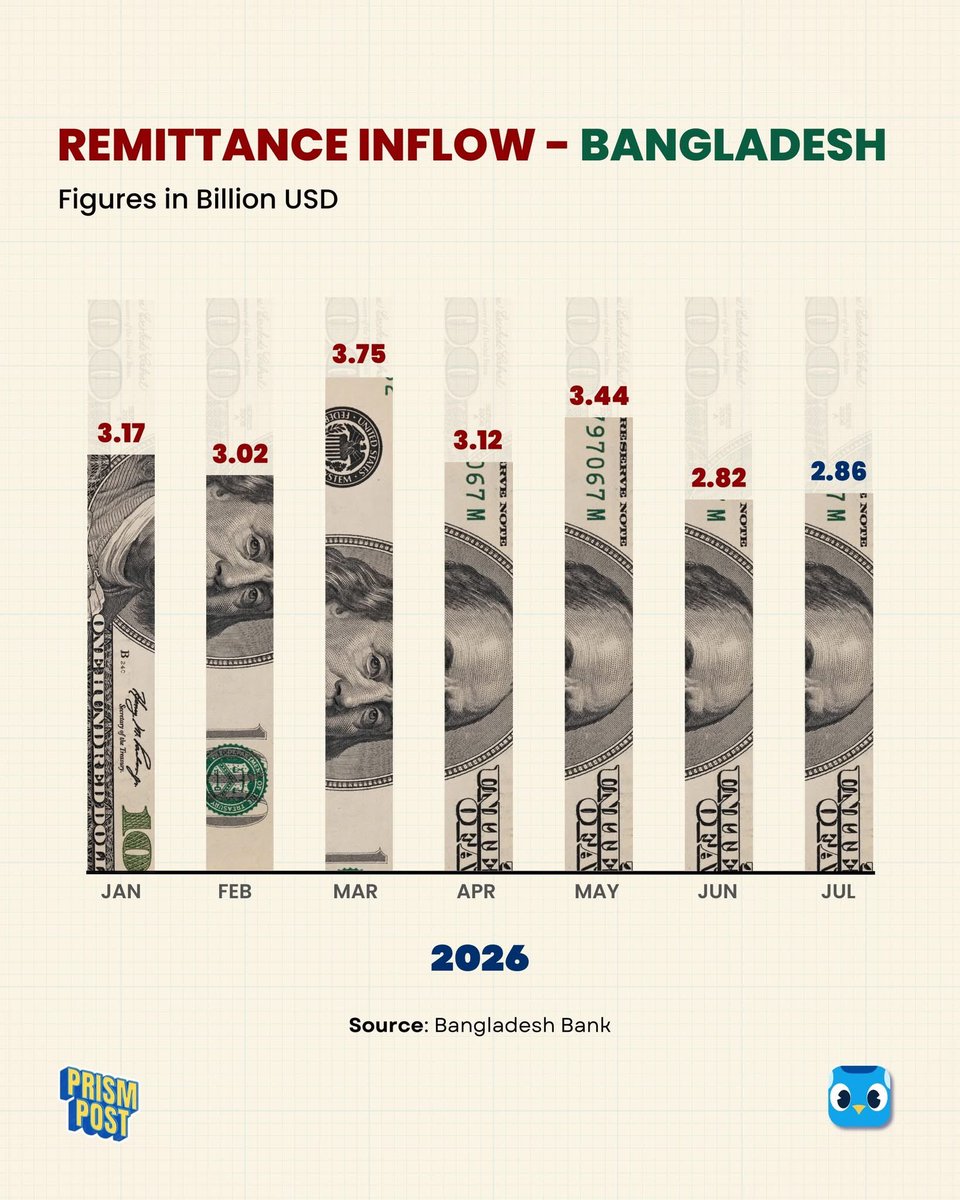
Bangladesh's remittance inflow has stayed below $3 billion for the second consecutive month. In June 2026, Bangladesh received $2.82 billion in remittance, which slightly increased to $2.86 billion in July 2026.
That's why, when the remittance inflow starts slowing down, this puts massive pressure on Bangladesh's economy.
In fact, a growing remittance inflow helps Bangladesh to keep the exchange rate steady.
Bangladesh's remittance inflow has stayed below $3 billion for the second consecutive month. In June 2026, Bangladesh received $2.82 billion in remittance, which slightly increased to $2.86 billion in July 2026.
Why is this important?
Bangladesh's diaspora sends remittance each year, which helps the government to increase Bangladesh's foreign currency reserves. Then the government uses our foreign currency reserves to pay for all the imports and foreign debt obligations. That's why, when the remittance inflow starts slowing down, this puts massive pressure on Bangladesh's economy.
In fact, a growing remittance inflow helps Bangladesh to keep the exchange rate steady. When we have fewer foreign reserves, this also means we have to pay more for imported goods, which in turn causes inflation to go up, and millions of people suffer because they cannot afford to pay higher prices.
@albd1971@ALBDMedia@bdwatch2024@MAarafat71@sajeebwazed@saddamhussainbd@wsj@Prism_Post@adaanist