Welcome to Prismal 🫡!
We created Prismal to make your life in the crypto industry a bit safer
Blockchain gives you freedom of transactions, but not their security, so we help every user feel a bit more confident when making them
What our service does:
- performs an AML check of your wallet and evaluates its risk score
- conducts investigations in cases of theft or fraud with legal support
- helps check the risk score of other wallets and the safety of interacting with them
We are the ones who help prevent your exchange account from being blocked, before it happens
And help you avoid working with those it’s dangerous to interact with, before you start
How it works:
- visit our website https://t.co/ra27N7iQ62
- join our Telegram bot for AML checks
- the bot analyzes the origin of funds using its own AML database and external providers
- receive a report based on this data with a risk score and statistics of your interactions
Prismal works not only for web3 users, but also for companies. We are open to B2B partnerships and can provide our service to you
Your security is in our reliable hands🛡
🚨 Travel security reminder for web3 users
When you travel, take a moment to consider what data and accounts your devices provide access to
The goal is simple: reduce the chances of theft, loss, or unauthorized access. It's basic digital hygiene on the road
Rules (and how they're enforced) vary depending on the jurisdiction
In some countries, authorities may have broad powers to access electronic devices during investigations
Plan ahead. Only travel with the access you really need, especially when it comes to sensitive data and services
Basic travel security tips: https://t.co/gUeOYMjZe2
Stay safe 🛡
Hong Kong: On March 23, 2026, the Hong Kong government changed the implementing rules relating to the National Security Law. It is now a criminal offense to refuse to give the Hong Kong police the passwords or decryption assistance to access all personal electronic devices including cellphones and laptops. This legal change applies to everyone, including U.S. citizens, in Hong Kong, arriving or just transiting Hong Kong International Airport. In addition, the Hong Kong government also has more authority to take and keep any personal devices, as evidence, that they claim are linked to national security offenses. Read more: https://t.co/K5w2tETFu5
AI automation and integration in the security and AML (web3)
At Prismal, we work in AML and investigations within the web3 space, and in practice we were using automation before it became mainstream
Compliance infrastructure in general is built around automated systems: monitoring, detecting risky patterns, identifying high-risk clusters, and large-scale analytics
And the exponential growth of AI technologies will most likely make security infrastructure only stronger, smarter, and more accurate
What might this look like in practice over the next few years?
1. Fewer false positives
Better distinction between actual risk and activity that may look formally suspicious but is in fact harmless
2. Better case prioritization
Ranking cases based on context, behavioral patterns, and wallet history
3. Deeper on-chain behavior analysis
Understanding what the flow of funds looks like, whether it is part of a larger cluster, and how closely the behavior matches already known risk scenarios
4. Faster investigations for analysts
AI can generate concise summaries of what triggered the alert, key connections, why the risk is considered high, and this is a very strong use case for compliance teams
5. Faster adaptation to new clusters than rule-based systems
Detecting unknown patterns that the system has not yet added to automated tracking
This will add more clarity and structure for compliance teams, remove a lot of operational overhead, and start detecting clusters in a smarter way than before
As technology grows, security has to grow with it, otherwise a lot of vulnerabilities will appear, and the consequences can be serious
Stay safe 🛡
The importance of AML in Web3 products and their infrastructure
AML in Web3 has long stopped being just a formal requirement, now it is more of a core part of a project’s infrastructure and security
For wallets, DeFi projects, payment solutions, and so on, implementing AML mechanisms is also very important from the standpoint of meeting regulatory expectations
Overall, an effective AML architecture helps reduce risks, protect users, and build trust with partners, liquidity providers, and financial institutions
Ideally, this means fully automated monitoring with systems for detecting elevated risks and reviewing them, KYC, or simply a risk-based approach
Prismal helps Web3 companies implement AML processes directly into the product: from transaction monitoring to identifying high-risk wallets
If you want to integrate AML into your infrastructure quickly and without unnecessary complexity, get in touch with us, and we'll help choose a solution for your specific use case
We described "AML best practices for Web3 companies" in more detail in our article below ⬇️
@fg_platform We're glad to be partnering with FG Wallet, and we'll do everything we can to make FG Wallet users as safe as possible
We believe every responsible wallet should implement AML as part of its system
> you start selling your services
> client asks to pay in crypto
> you sent your address, they send funds to your wallet
> you send it to an exchange, instant freeze
> source of funds check, "suspicious activity" flags everywhere
> you spend months trying to recover your money
> and you're just a freelancer selling websites…
This can happen to you if you don't understand what AML is
Our article includes tips for both (users and businesses)
Make sure to read this article ⬇️
Strategic Partnership Update
@fg_platform has integrated us as their AML provider for wallet screening
This allows users to check the AML risk score of their own wallet or a destination wallet, helping them assess the safety of a transaction
The feature is free and optional, fully up to the user
As an AML provider, we ensure compliance-related security by identifying high-risk addresses and detecting suspicious transaction patterns
The key advantage of FG Wallet: built on TRX staking mechanics (never need to spend TRX) + full self-custody
More updates coming soon. Stay safe 🛡
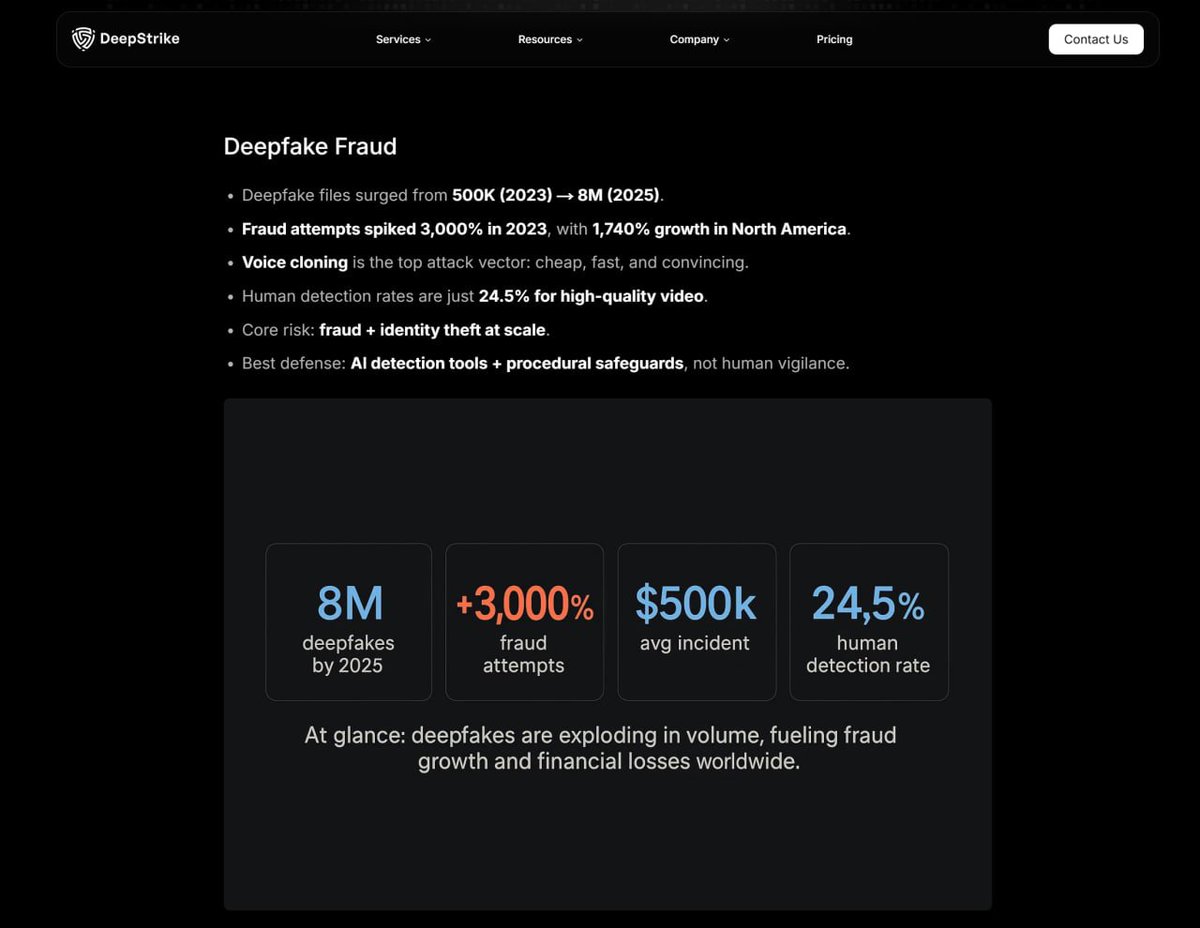
The impact of AI on security in Web3: deepfakes, and new scam schemes (2025-2026)
The situation has moved far beyond theoretical risks, and the statistics speak for themselves. Losses from phishing and social engineering (so-called AI scams) increased by approximately 1000% in 2025 alone
AI has fundamentally reshaped the threat model by lowering the technical barrier to entry
Attacks that once required deep, specialized knowledge are now accessible to almost anyone. AI tools allow low-experience actors to close that gap quickly
The methods vary: from deepfakes and voice cloning to LLM-powered scripts and automated sentiment analysis that adjusts tone in real time based on the victim’s reactions
On top of that, scammers are deploying AI-generated fake trading dashboards that mimic real crypto exchanges
Wallet drainers and Phishing-as-a-Service (PaaS) have become an even greater threat due to aggressive distribution and replication across multiple sites, along with active promotion
Defense & mitigation
INTERPOL, in its Global Financial Fraud Threat Assessment 2026, named fraud one of the most widespread forms of transnational crime:
"Enabled by artificial intelligence, low-cost digital tools, and increased global criminal collaboration, we are witnessing the industrialization of fraud"
That is why security approaches in Web3 are evolving:
- prioritizing hardware wallets and hardware-based multi-factor authentication
- embedding AI-driven security layers into every interaction
- building full-scale security programs (continuous behavioral validation, operational controls, AI-assisted detection)
- moving toward multi-layered verification strategies, as traditional authentication is no longer considered reliable
In reality, AI has made fraud cheaper, more scalable, and almost indistinguishable from legitimate activity
And in Web3, we are facing one of the most dangerous versions of this shift, largely because blockchain anonymity partially shields attackers
Stay safe🛡
How the "first result on Google" can drain your crypto
Newbies keep running into wallet-drainer attacks, one of the most common types of crypto scams
And honestly, the simplest method is still the most effective: advanced phishing sites that look almost identical to the official wallet, exchange, or DEX
Google does separate ads from organic results, but ads can still show up above everything else
For a drainer, it’s enough if you do just one of these:
1. Click a fake site that's actually marked as an ad, and don't notice
2. Connect your wallet and sign a malicious transaction that gives the scammer control over your assets
3. Download a fake app or extension instead of the real one (this happens a lot with wallets)
How not to lose your assets:
1. Always check if a result is labeled "Ad" when you're using Google
2. Double-check the domain character by character, or better yet, go through their official X
3. Never enter your seed phrase on a site "for verification", "sync", or anything like that
4. Read what you're actually signing in your wallet: approve, permit, setApprovalForAl (this allowance are the riskiest)
5. For larger amounts, keep funds on a hardware wallet and don't interact with random sites
Stay safe 🛡
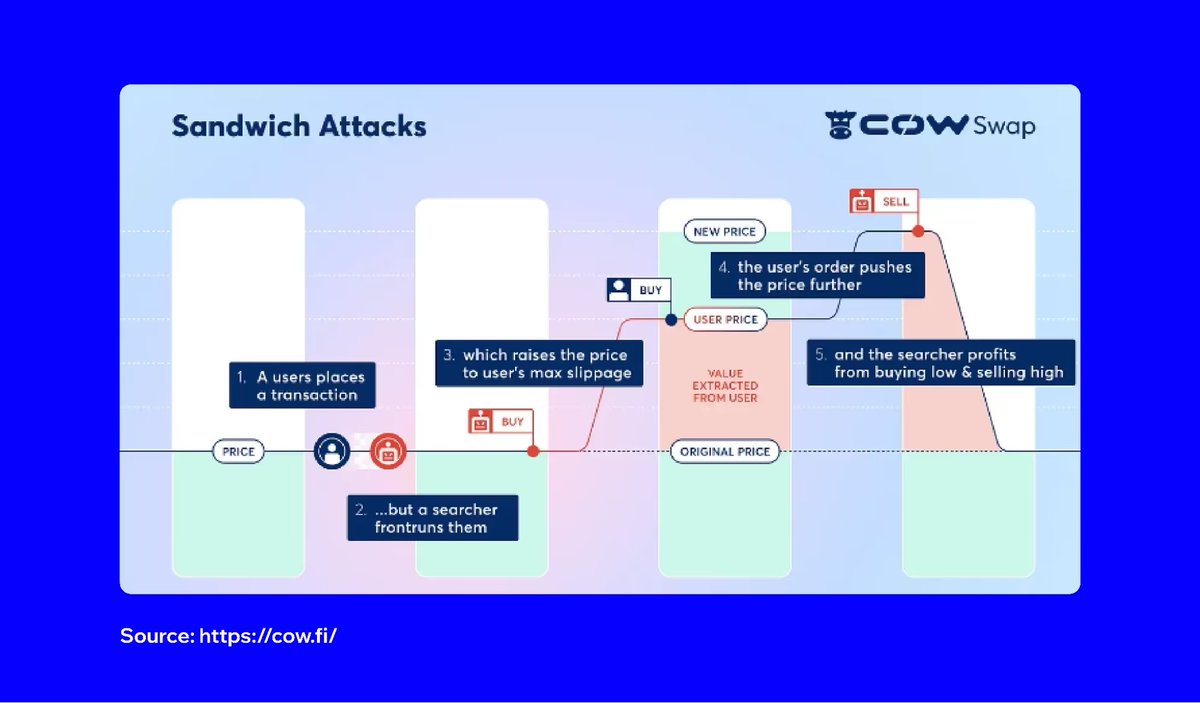
Explained like I'm 5: how sandwich attacks (MEV) work
If you've ever paid more for a token than you expected, even with low slippage, you probably got "sandwiched"
What actually happened (ELI5):
Imagine you're at a market. You walk up to a seller and say:
"I want to buy 100 kg of apples at about $1 per kg"
Some random person standing next to you hears that. Before you can buy, they rush in and buy all the apples first
Then they instantly raise the price to $1.20 and sell them to you, pocketing the difference
That random person is an MEV bot. Here’s how it works on-chain:
- You send a swap transaction
- The bot sees it in the mempool (the public "waiting room" of pending transactions)
- It pays a higher gas fee to jump ahead of you (front-running)
- Your trade executes at a worse price
- Right after, the bot sells (back-running)
That whole combo = a sandwich attack
Why is this even possible?
Because all unconfirmed transactions are publicly visible before they're added to a block. The mempool is basically an open book, and bots read it better than we do
How to protect yourself:
- Use a private RPC (like MEV Blocker or Flashbots Protect) so your transaction skips the public mempool
- Keep slippage as low as possible (higher slippage = easier target)
- Use DEX aggregators with built-in MEV protection
- Avoid big swaps in low-liquidity pools (that's easy prey)
Bots are just playing by the rules of a game the public mempool accidentally created
And we're the food they're trying to eat, if we sit at the table unprepared
Stay safe 🛡
Could quantum computers actually break Bitcoin?
In reality, according to an ARK/Unchained report, about 36.4% of the total supply holds on addresses that could be compromised by future quantum machines:
- ~5M BTC (vulnerable due to address reuse, public keys are already exposed)
- ~1.7M BTC (on old P2PK addresses, pre-2011, Satoshi-era, likely lost forever)
The remaining 65.4% is already resistant to quantum attacks under current conditions
But first, it’s important to understand what Bitcoin’s security actually rests on
Two main things protect it:
ECDSA (elliptic curve cryptography) – protects your private key
SHA-256 – powers mining and proof-of-work
Quantum computers threaten them in different ways
The main target is ECDSA
A quantum computer running Shor’s algorithm could, in theory, derive your private key from your public key
But here’s the key detail: your public key is only revealed after you sign a transaction, or if you’re using an old address format
So what would it actually take to break this?
Roughly 2,330 logical qubits are estimated to be needed to crack Bitcoin’s ECDSA
The best machines today? Around 28 logical qubits
So when does this become a real risk?
About a third of global quantum experts estimate there’s a >50% chance of a serious threat emerging somewhere in the 2030-2035
But solutions already exist – NIST approved post-quantum standards back in 2024
And in the EU, there’s already alignment: migrating to post-quantum cryptography will be mandatory for critical systems by 2035
So the real risk isn’t that Bitcoin gets hacked tomorrow
It’s whether a decentralized network can coordinate in time – upgrade its cryptography, roll out changes, and get everyone on board
That’s why the space is already preparing, discussing it, and treating it as a problem to solve
Stay safe 🛡
Trust Wallet announced a protection system against address poisoning scams
According to their stats:
- 225M+ attempts detected
- $500M+ actually stolen
How did it work?
1. Scammers slipped a fake lookalike address into your transaction history
2. You copy it from your wallet history
3. You don't notice the tiny difference in the address
4. Funds get sent to the scammer instead of your wallet
Now every send gets checked in real time
The feature is already live on 32 EVM chains, with more coming soon according to them
Thanks to @TrustWallet for making this space a bit safer
Stay safe 🛡️
Address Poisoning? ���️ Not on our watch anymore 🛡️
Scammers sneak fake lookalikes into your tx history.
You copy-paste quick → funds gone.
That scam is now dead. Update today: https://t.co/TmDsFSqZRr
Phishing is still one of the most common scams
Always check links and don't open random emails
Especially if they're not from the platform's official domain
Stay safe 🛡️
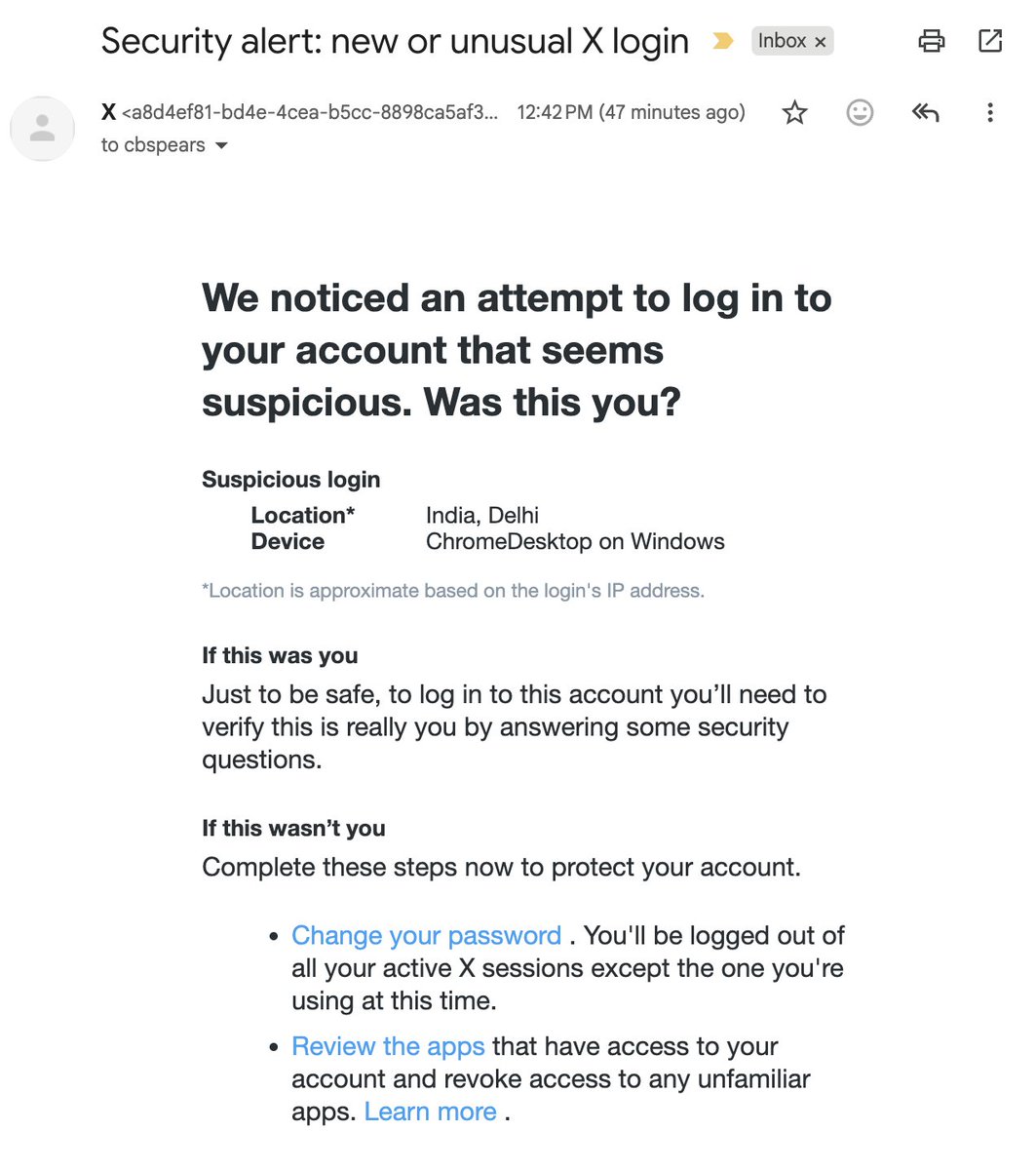
🚨Twitter (X) phishing 🚨
Be careful with this phishing targeting X users. It arrives in the Gmail inboxx, bypassing filters and the links redirect you to a fake app in the X domain. If you authorize it, they will start messaging your contacts and posting scams on your behalf.
Safety rules when traveling to web3 conferences:
- don't discuss deals, exits, or treasury in public places
- don't post photos from the conference in real time
- don't mention details of your trips or where you live on social media
- split your wallets before the trip, leaving yourself no more than you need
- never connect your main wallet to conference websites
- don't scan random QR codes, it's better to open sites manually
- never use conference Wi-Fi
- best option is mobile internet + VPN
- pay attention to what you sign ("blind signing")
- be careful with "investors" and "partners"
- don't store seed phrases on your phone
- ideally use separate devices for travel
These rules give you basic security, which already prevents about 90% of incidents
Scam cases at conferences have increased, and scammers have become smarter
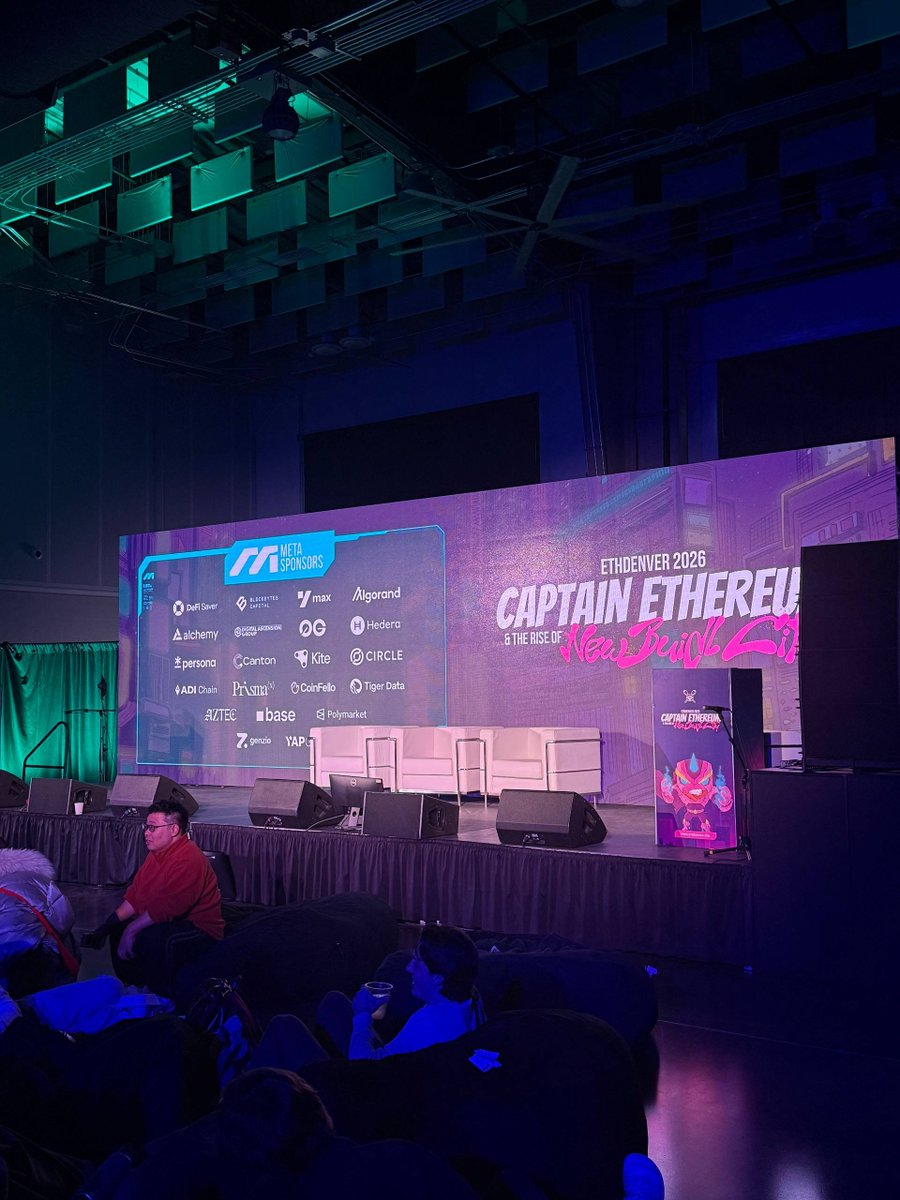
At least at ETHDenver there were 2 incidents where even an experienced user could have become a victim
Stay safe 🛡
Illicit addresses received $154B in crypto in 2025
@chainalysis has released comprehensive data on cryptocurrency flows to illicit addresses
In 2025, the total volume reached approximately $154B
For context on how fast this is growing:
2020: ~$11B
2024: ~$57B
2025: ~$154B
According to analysts, the most active actors driving this growth are sanctioned states and cybercriminal groups
Stay safe 🛡