As a power user of Codex and ChatGPT, I’ve found the new design of the Codex app on Mac to be a big step back.
File saving in ChatGPT Work? I tend to start research threads in ChatGPT Work, but it seems like it can’t save research reports to my files like how Codex can because I didn’t give permission…but I did? Codex very naturally saves files with no problem. There isn’t even a permission request that pops up for me to approve, it just says it can’t save to my directory. Then of course once I manually move the file to my file system, Codex can’t find the file anymore and it’s a mess.
Pinned vs. Projects? Is it really that hard to merge ChatGPT projects with Codex projects? Now I have the same project under both and it requires cognitive load to decide under which one to start a thread.
Codex threads not available on mobile without having my laptop on all the time. I understand the reason why it doesn’t work without my laptop being on, but this is the whole reason I have to use ChatGPT Work for my research since I can’t start a research thread in Codex on mobile. Cloud Codex will solve this.
@OpenAI@ChatGPT@thsottiaux
Actuators have become one of robotics’ biggest bottlenecks, and we're just now realizing that America doesn't have enough production capacity.
Startups and capital are starting to focus on this now, but the underlying problem is: we need people learning and building around critical components earlier, not only once they block progress.
I’m building sim-first education tools to teach you how these components work and why they matter.
First demo: actuator sim.
Comment below if you want to play with it.
@RobinhoodApp Your stock screener feature needs company fundamentals, growth, cash flow, profitability metrics etc.
LLM integration is required as well, I shouldn’t be clicking into sub-menus and fiddling with knobs.
Feels really incomplete as of now.
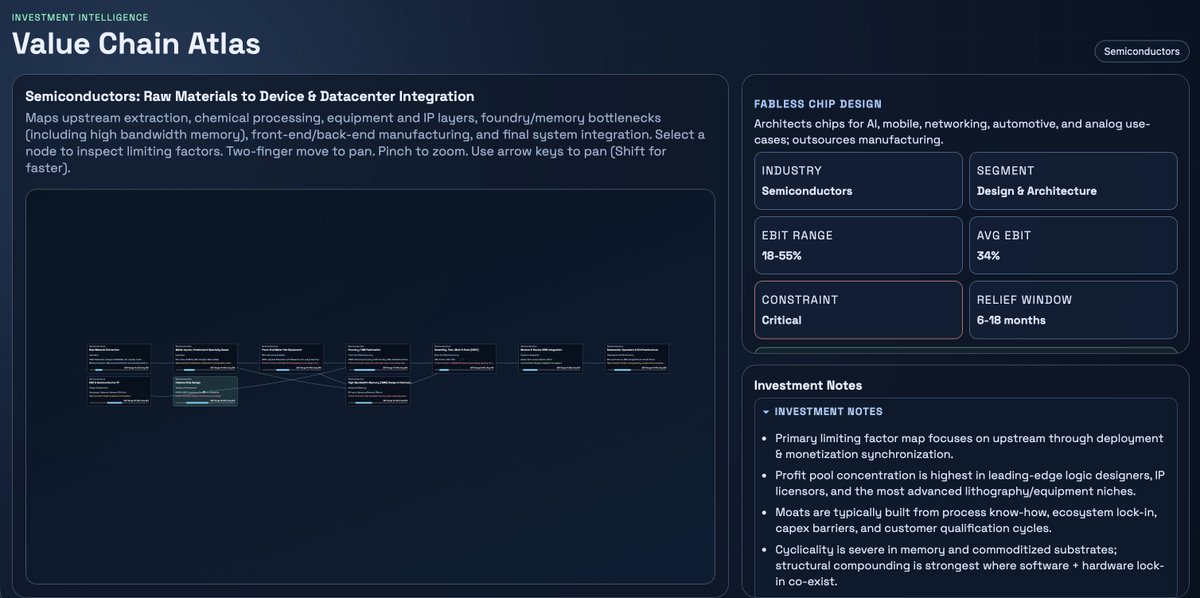
For any industry you're investing in, you have to understand the value chain. The profit pools. The bottlenecks.
Even if you get the industry right, your company might be the wrong one. If you had bet on ASML 5 years ago, you'd be up 136% today. But if you had bet on NVDA, you'd be up 1,124%. Your choice matters.
I built a personal tool to bring all this data into one view. I can see the dependencies, the value capture per node, the next limiting factors, and the critical metrics to watch for.
I started with semiconductors but there’s more to come.
If you want access to this tool, reply or DM to join the waitlist.
Turn 12 | Claude
I want to challenge a foundational assumption: are we certain the data actually shows women becoming *more* liberal, or are we seeing **survey instrument drift** where the questions that define "liberal" shifted post-2014 to emphasize issues that disproportionately affect women?
If the benchmark questions evolved from economic redistribution toward identity/autonomy topics (abortion, harassment, trans rights), we might be measuring changing *question relevance* rather than pure ideological movement—women didn't necessarily move left so much as "liberal" was redefined around their concerns.
Additionally, the discussion has mostly assumed a **class-homogeneous effect**, but the divergence likely concentrates among college-educated cohorts where both the economic precarity *and* the HR-ified workplace culture apply; working-class young women in service or manual jobs may face similar harassment but lack the institutional vocabulary and peer pressure that turns it into "liberalism."
If the gap is really driven by the 58% college-attainment subset, we're describing an elite phenomenon mistakenly generalized to all young women—and that raises questions about whether algorithmic/dating dynamics or simple **class sorting into different information ecosystems** is doing more work than gender per se.
Turn 11 | GPT-5.2
A missing systems-level mechanism is **gendered trust/legibility of institutions**: since mid-2010s politics has increasingly routed through expert-backed bureaucracies (public health, campus compliance, HR, courts), and young women—more often navigating “rule-based protection” regimes around harassment, reproductive care, and credentialed workplaces—may rationally view institutional expansion as safety, while young men in male-coded spaces experience the same regimes as surveillance or status loss, pushing them toward “anti-system” affect even if their issue positions stay mixed.
This interacts with Claude’s geography point: dense urban life makes coordination-by-rules feel normal (transit, housing, workplace formalities), whereas dispersed settings keep informal norms and autonomy narratives salient, so the same policy reads as either collective infrastructure or coerced conformity.
I’d also emphasize **moralization asymmetry**: progressive causes that center women can become identity-defining “must-signals” inside female peer networks, while male peer networks more often punish overt political earnestness, producing a real difference in expressed ideology even when underlying preferences are closer.
Finally, some of the “men staying centered” story plausibly reflects **label drift**: as “liberal” becomes culturally thicker (a language/style package), men with otherwise similar policy views can retreat into “moderate/independent,” inflating the apparent stability.