I build self-hosted tools that teams run on their own stack.
nowtask - task management with an MCP server for agents.
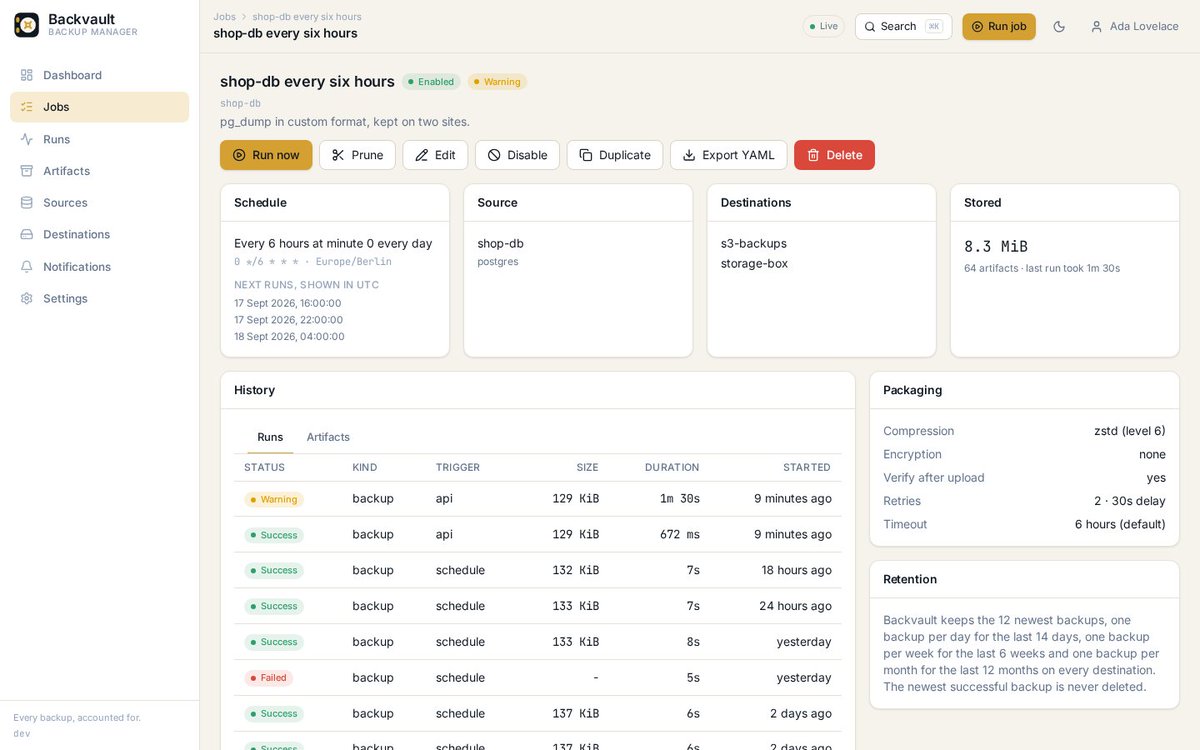
Backvault - every backup, accounted for.
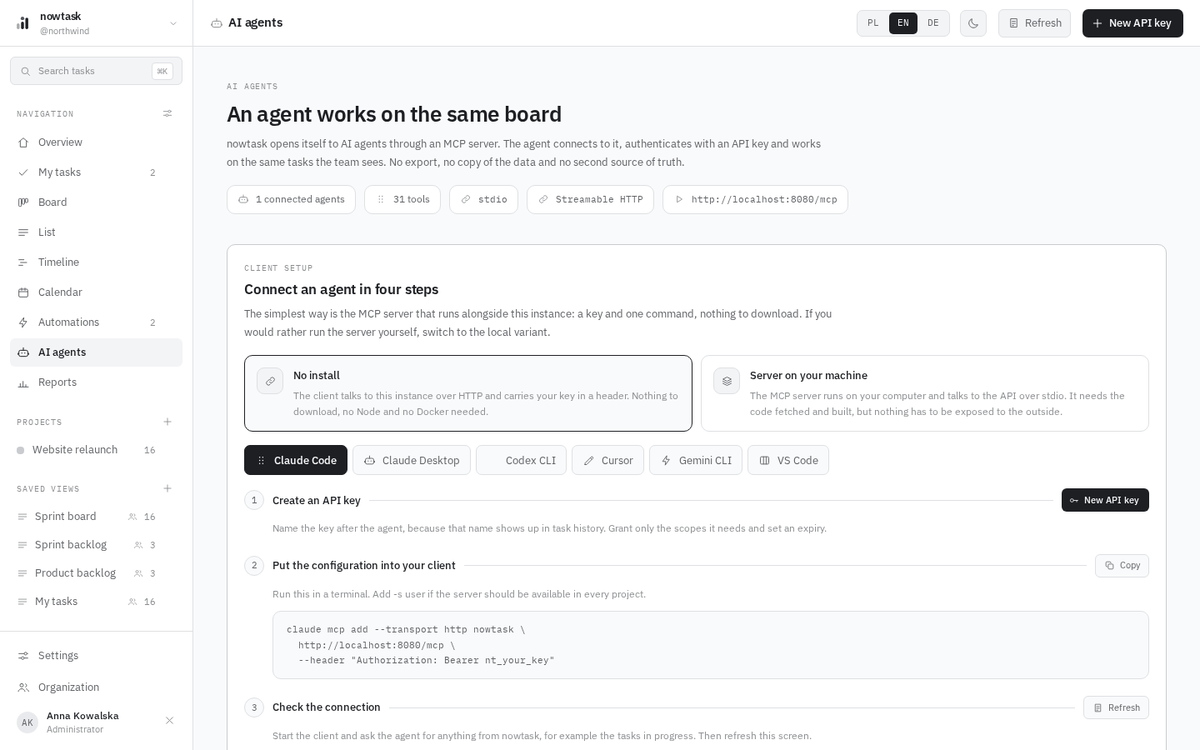
Your AI agent gets an API key, narrow scopes and a seat at the same board as the team.
17 seconds of nowtask: the agent screen, the board, rules with a run log, and the task history where every change lands.
Self-hosted. https://t.co/WTwXJVaHsU
There's a workaround for this in Limine: when you select it during Windows boot, the computer restarts with the selected Windows version as a forced boot (Limine creates an entry in the BIOS to boot into Windows the next time the computer starts up). Try doing this with some kind of AI.
Most backup tools tell you when a backup failed.
The one that hurts is the backup that never ran - the cron that died in March, quietly, on a host nobody logs into.
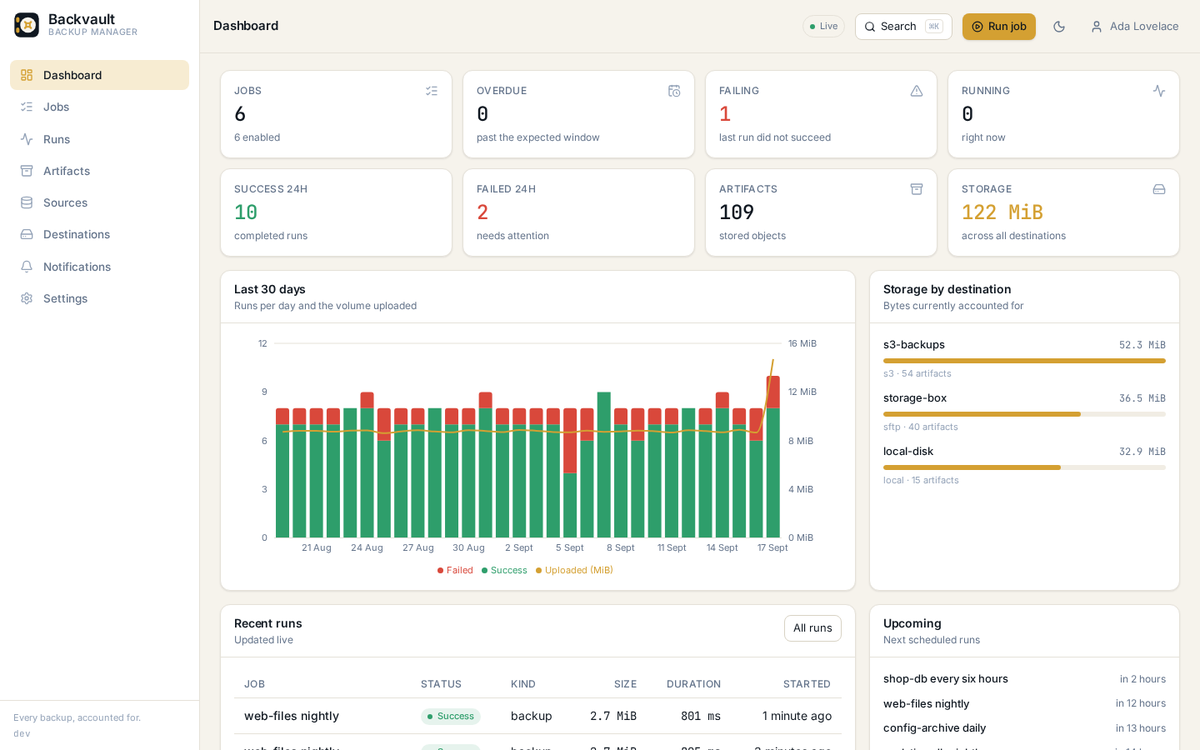
Backvault knows when each job is due, flags it overdue, and says so.
https://t.co/46olMktfR4
Most backup tools tell you when a backup failed.
The one that hurts is the backup that never ran - the cron that died in March, quietly, on a host nobody logs into.
Backvault knows when each job is due, flags it overdue, and says so.
https://t.co/46olMktfR4
@freesolodev That is the model. Three of the four are in: a separate identity per key, narrow scopes, every write in task history under the key name.
Reversible is the gap - an edit you can rebuild from history by hand, a delete you cannot. Which is why tasks:delete is a scope of its own.
Your AI agent can read your task board. Then it writes a summary into a doc nobody opens.
I wanted the opposite: the agent working on the same board as the team, with its own key, its own permissions, its own trail in the history.
So I built nowtask.
v0.1.0, BSL 1.1, self-hosted with Docker Compose.
The agents screen generates the config for Claude Code, Claude Desktop, Cursor, Codex CLI, Gemini CLI and VS Code.
https://t.co/WTwXJVaHsU
Underneath: one installation, many organizations, kept apart by PostgreSQL row level security - in the database, not only in the application code.
Spring Boot 4.1 on Java 25, Angular 22 with signals and zoneless change detection. UI in EN, PL and DE.
A backup you have never restored is not a backup. It is a hope.
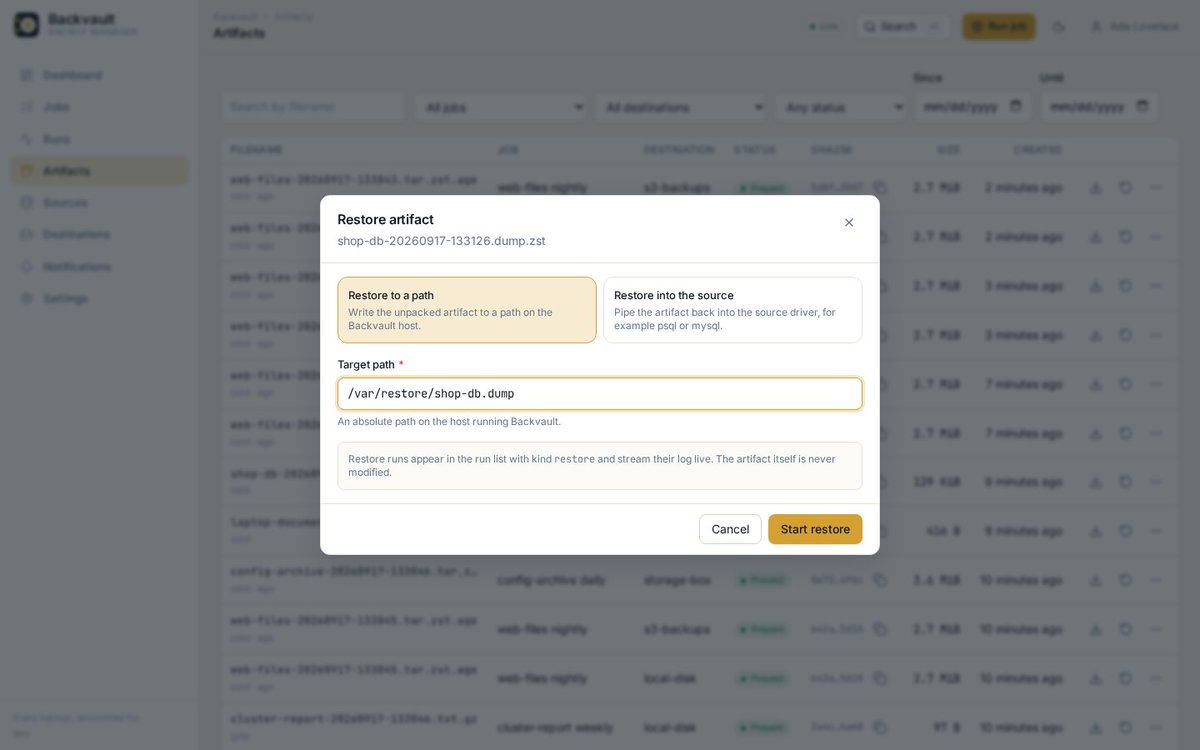
So the restore button sits next to the artifact: unpack it to a path on the host, or pipe it straight back into the source database.
Backvault, self-hosted, one Go binary, MIT.
https://t.co/46olMktfR4
It's 03:00 and the database is gone.
You have backups. Somewhere. A cron job on one box, a script on another, a bucket someone set up in 2023.
Can you restore them? Do you actually know?
I got tired of guessing, so I built Backvault.
It is not another deduplicating archiver. It is the layer above one: the scheduler, the dashboard, the restore button, the alert that something failed.
Artifacts stay plain and inspectable - you can open them without Backvault installed.
I kept running /usage to see how much Claude I had left. Now it sits in my panel.
Claude Usage: a KDE Plasma 6 widget with the 5-hour and weekly limits, live. Bars or percentages, every colour and threshold configurable.
MIT · unofficial
https://t.co/83Qd9B7KqX