Chapeau @SHL0MS ! I love your Monet stunt.
Like my refusal of the Sony World Photo Award in 2023, it is an epistemic trap: You changed the label around an image and watched people and institutions reveal how they judge art under AI anxiety.
But you and I pointed the trap in opposite directions: I staged a boundary test, you staged a perception test.
When I entered “PSEUDOMNESIA | The Electrician”, an AI-generated image, into the Sony World Photography Awards, then refused the prize publicly, I wanted to accelerate the debate about what counts as photography.
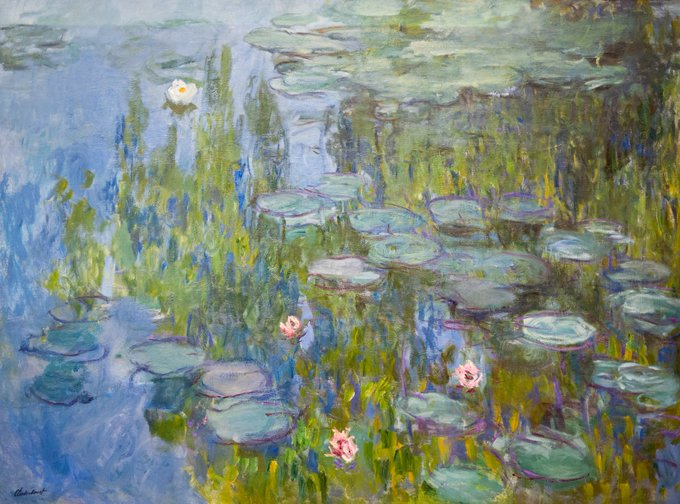
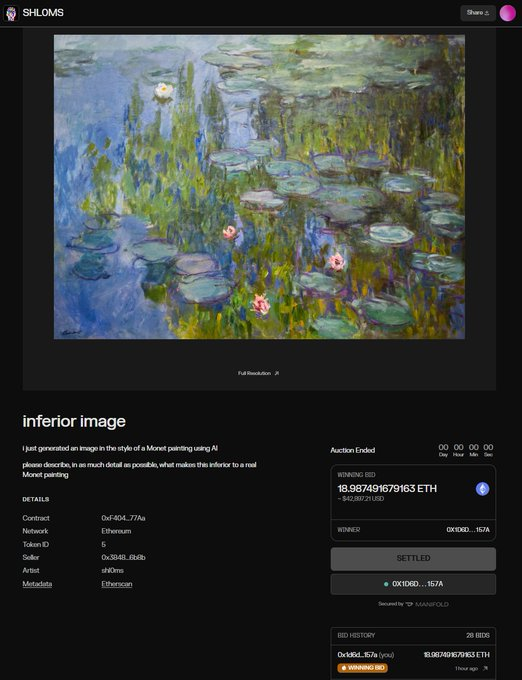
SHL0MS did the inverse with “Inferior Image“: posting an actual Monet Water Lilies as a supposed AI-generated image, asked people to explain why it was inferior to a “real” Monet, and thousands complied, producing elaborate critiques of a real Monet under a false AI label.
My act said: the system is not ready - we need new categories, new language, and honest rules. I wanted to “speed up this debate.” And in addition to refusing the prize, I suggested to donate it to a Ukrainian photo festival.
SHL0MS’s act said: the viewer is not ready; people do not see first and judge second - they classify first and then invent reasons. Your “Inferior Image“ is a diagnosis of mass aesthetic suggestibility. And by minting the image as an NFT, you made the market controversy part of the work.
I attacked the category confusion between photography and promptography. SHL0MS attacked perceptual corruption: seeing versus believing.
My work depended on my skills in AI image making (yes, in Autumn 2022, this image was the most photorealistic you could get!).
SHL0MS’s work depends on attention design: choosing a Monet that was not instantly recognizable, phrasing the provocation, steering replies, collecting critiques, and structuring the viral discourse. He basically “prompted” humans instead of prompting an image model.
👉BUT:
We both used misattribution as a mirror: the real artwork is not only the picture. It is the reaction system around the picture. In old art-history language, both are post-Duchampian.
We both show that the crisis is not only technological. It is psychological. The image itself is no longer the whole evidence. The caption, platform, institution, category, and social mood now do enormous perceptual work. The eye has become a press secretary for the belief system.
Thank you for adding a smart conceptual work to the history of art.
We just won Squad Hackathon 3.0! It was the craziest experience ever. 🔥
1,600 people applied. We got selected to the top 800. When we reached the venue, they surprised us with the format. We knew nothing before.
They gave us 3 tough rounds of online quizzes on DSA, algorithms, and live coding like LeetCode. We came top in all three rounds and entered the top 50.
Later, they picked the top 10 teams. We presented our idea and the judges loved it because it was unique and well built.
What an amazing journey! So grateful to my team.
@OfficialSquadCo@gtbank
What made the SHL0MS post interesting was not simply that people mistook a real Monet for AI. It was how quickly perception changed the moment the label “AI-generated” appeared.
Suddenly the brushwork felt “soulless.” The atmosphere became “artificial.” People began pointing out algorithmic textures and emotional emptiness inside an actual Monet painting.
Susan Sontag wrote in Against Interpretation that critics often approach art with the urge to extract meaning before truly encountering the work itself. Every image becomes allegory. Every detail becomes something to decode.
Kafka was endlessly subjected to this. Some read his work as social allegory about bureaucracy and alienation. Others reduced it to psychoanalytic fears of the father. Religious readings turned his characters into symbols of divine judgment and salvation.
Interpretation itself is not the problem. It can deepen understanding and reshape the past. But when interpretation overtakes experience, the artwork begins to disappear beneath explanation.
That is why Sontag wrote, “In place of a hermeneutics we need an erotics of art.”
The SHL0MS post revealed something uncomfortable. Many people were no longer looking at the painting itself. They were looking at the category surrounding it. The label determined the experience before the image even had the chance to speak.
Perhaps the real problem is not AI art, but our growing inability to encounter an artwork without immediately trying to classify, decode, and intellectually dominate it.
Was the painting truly worse once people believed it was AI?
Or did interpretation arrive before seeing ever could?
@SHL0MS@Jediwolf
@YusufAsunmogejo Even Terence Tao (despite winging his way through undergraduate) for all his genius almost failed(or I should say, barely passed) his oral quqlifying exams in graduate school because he did have a study system and did not prepare well.