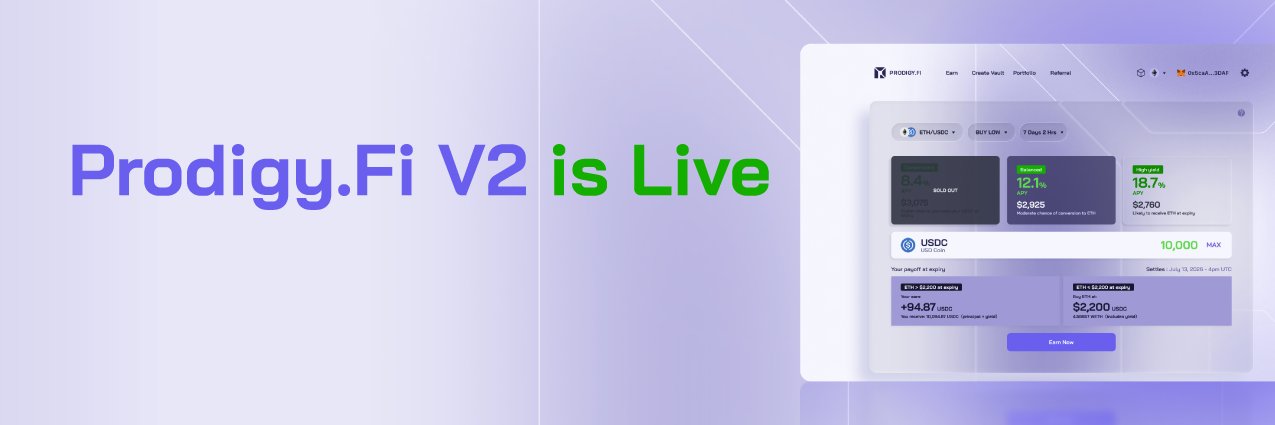
https://t.co/yAc5qSmjOT V2 just dropped.
...with everything you asked for ✨
💫 dynamic pricing. yield that actually moves with the market.
💫 simpler UI. deposit in seconds, no confusion.
💫 no deposit caps. go big or start small.
structured yield, evolved.
live now on @Ethereum and @Base.
https://t.co/7mnXtpsaoE
when it's raining and everyone needs a ride, Uber prices surge.
the driver didn't cause the rain.
they just benefit from the demand.
the same thing happens in ProdigyFi vaults when markets get volatile.
more participants want to hedge their positions.
that demand drives up the premium they're willing to pay.
vault yields go up with it.
you don't need to predict the storm.
you just earn more when it hits.
Vitalik just made the case for options-based DeFi over debt.
he's right. and the rebalancing concern he raises is a design problem, not a fundamental limitation of options in DeFi.
ProdigyFi already runs on this model. fixed-term vaults, yield locked at creation, settled on-chain at expiry. no continuous rebalancing at any layer.
if you're building what Vitalik is describing,
the infrastructure is already here.
Building index-tracking assets on top of options instead of debt
https://t.co/gFNEvCbHct
What if the use options as the base of defi, instead of CDPs and liquidations? So instead of extreme price movements creating a sharp and global "you get liquidated" effect, instead your exposure to the index diverges quadratically from your preferred exposure in a smoother way?
A key benefit is getting rid of the need for instant oracles, and instead making everything work on top of "slow oracles" (ie. the type that prediction markets use)
This design has a significant downside - the need to do regular rebalancing - and an open question of whether and how this rebalancing can be made slippage-resistant enough. But it's worth considering and trying IMO. I would feel much safer holding algostables inside something like this, than in something that depends on an oracle that has to give real-time answers (and therefore could be tricked into giving wrong real-time answers with no time for human recourse).
BTC just dropped below $68,000.
two things happened.
Iran tensions. and Michael Saylor sold Bitcoin for the first time in three years.
32 BTC. to meet obligations. he still holds 843,706.
but the market had priced in "Saylor never sells" as a given.
today that changed.
Geopolitcal risk is rising, and Bitcoin is taking a beating
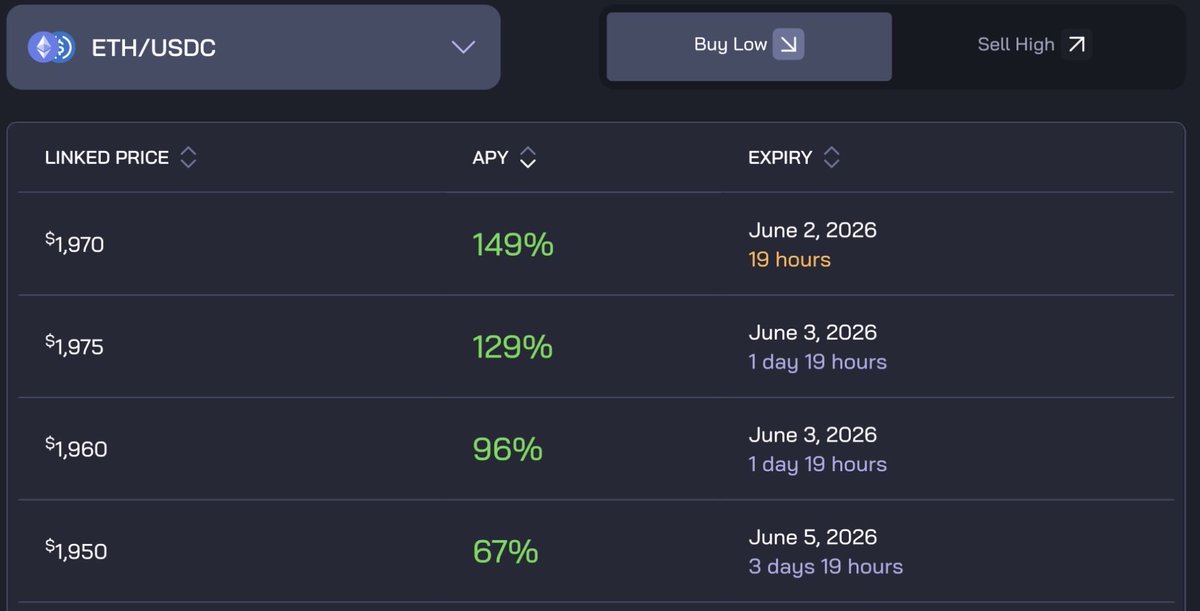
But on https://t.co/POXm6h2zfW, our vault APYs are rising:
Options yield rises in volatile markets.
When others are fearful is a good time to consider buying low, or selling high with https://t.co/POXm6h2zfW
callable deposits are offered by banks to clients with $100,000+ minimums.
the setup: you lock in for a fixed term and earn a better-than-standard rate.
the catch: the bank can call the deposit back early if rates move in their favor.
you don't get that same option. they do.
ProdigyFi vaults don't work that way.
the term is fixed for everyone, including the protocol.
nobody pulls it back early.
the vault opens, runs to expiry, and settles on-chain automatically.
no discretion on either side.
no $100K minimum. no bank holding the right to end the deal whenever it suits them.
btc and eth stuck in their usual sideways grind again.
price can drift all it wants
these vaults lock the terms the moment you deposit.
yield runs on schedule, contract does the rest.
simple as that.