In the end, I don't think the next generation of Web3 winners will be defined by who promises the most.
They'll be defined by who removes the most friction.
Because the best technology isn't the one people talk about.
It's the one that simply works.
The more time I spend exploring Web3...
the more convinced I become that the biggest innovations are often invisible.
That’s one of the reasons @SimpleChain_RWA keeps my attention.
It isn’t trying to reinvent value.
It’s trying to improve how value moves.
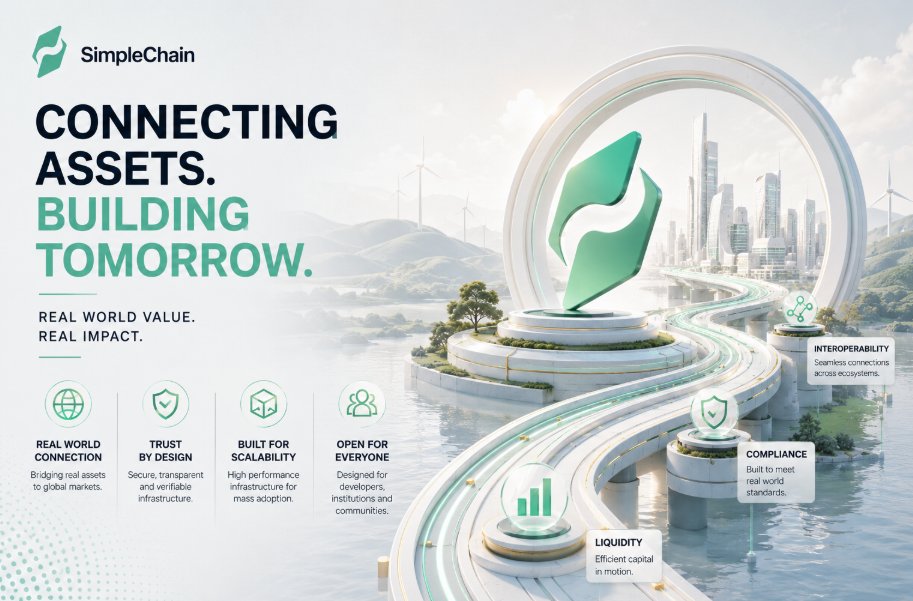
For RWA to truly scale, infrastructure needs to deliver:
◈ seamless connectivity
◈ trusted execution
◈ efficient settlement
◈ long-term scalability
These aren’t optional features.
They’re the foundation of real adoption.
Maybe the biggest value a community member can bring isn’t capital.
It’s contribution.
And sometimes, one great idea can impact an ecosystem more than hundreds of routine actions.
One thing I’ve learned in Web3:
Strong communities aren’t built by rewards alone.
And the more I follow @SimpleChain_RWA , the more I see this clearly.
Rewards may attract attention.
But culture creates long-term value.
The strongest projects usually have communities that do more than participate.
They help build the project’s culture.
They create inside jokes.
Shared narratives.
Recognition.
That creates real stickiness.
Maybe the future winners in Web3 won’t be the loudest projects.
They may be the ones building infrastructure so strong…
that everything on top of it simply works.
Most people notice products.
Very few notice infrastructure.
But the more I follow @SimpleChain_RWA , the more I realize something:
the strongest systems are often the ones you barely notice.
This is why infrastructure isn’t just a technical layer.
It directly shapes value flow.
◈ speed
◈ reliability
◈ scalability
◈ accessibility
These aren’t optional.
They define adoption.
Maybe the future of RWA won’t belong to the projects with the biggest narratives.
It may belong to those already building for scale before the masses arrive.
I’ve been thinking about what separates projects that look promising…
from projects that are actually ready for large-scale adoption.
Following @SimpleChain_RWA made me realize the gap is bigger than most people think.