Management renegade. Bureaucracy buster. 40 years at London Business School. Co-author of The Future of Management, and Humanocracy. Home is Silicon Valley.
If you're looking for a contrarian take on AI--one that's informed by data not magical thinking--you might enjoy this recent piece co-written with @MicheleZanini .
https://t.co/lrGkfP7gx5
The proclamations are breathless: AI is going to destroy white collar jobs. AGI is imminent. AI is going to turbocharge productivity. Well, maybe not. Here's my sober, data-driven take on the state of AI (with @michelezanini). https://t.co/yCTWfqWvqd
What do you think? Is there a possibility that AI will dramatically increase the “knowability” of an organization to everyone working therein? Imagine what happens if an LLM ingested every email, Slack conversation, internal report, project review, planning document, milestone, meeting summary, etc. (Subject of course to privacy constraints). How would this change the way organizations are run? I’ve long argued that there are only 3 reasons someone needs to be “managed” by another human being—because they lack (1) competence, (2) context, or (3) conscientiousness. Arguably, AI will make a difference in all these areas. It will help extend individual skills (filling in competence gaps), provide a wealth of contextual information around organizational goals, priorities, capabilities, timelines, etc., and create company-wide visibility to individual and team performance/value-added. What do you think that would mean for the future of "management?"
CEOs often claim that mega-mergers yield operational efficiencies--but the argument is usually bogus. In most cases, potential efficiency gains are swamped by the costs of integration and the increased bureaucracy that comes with a larger and more complex organization. The real advantages of a mega-scale firm are unmatched political clout and greater pricing power. These gains come at the expense of consumers and citizens. That's why I support the recently introduced bipartisan Bill to Break Up Big Medicine. https://t.co/qgPVMkVVkq
Bureaucracy is exacerbating social inequality, and depriving millions of people of the chance to share in the benefits of capitalism. Here's how to change that. https://t.co/yUyFIOvvLf
Come join the conversation! On Monday, September 29, at 12 pm ET, Harvard Business Review will be hosting a live webinar with the authors of "HUMANOCRACY: Expanded and Updated"--that's Michele Zanini and me! We'll be sharing our latest data-based insights on what can be done to build organizations that are as daring and dynamic as the times demand. You can register here: https://t.co/qqVYQ0HFG5. Hope to see you there!
If you haven't caught up with Aiden McCullen's "Innovation Show" on YouTube, please check it out. He interviewed me for more than 20 hours, and you'll find episodes that cover much of my work over the past many years. Here's episode #1: https://t.co/keZX2Sdamk
It was a pleasure to chat with @Gallup's Global Practice Leader for Leadership Development, Vibhas Ratanjee. Here's what we talked about: https://t.co/Xx1G1772q2
We need a government that's better, not just smaller. @elonmusk didn't know how to make that happen. (Hint, you don't cure obesity with an amputation. There's a better way to reinvigorate America's federal bureaucracies, and here it is: https://t.co/RLI7X1PhFC
America needs a federal government that's better, not just smaller. DOGE mostly failed at both tasks. Here's what Michele Zanini and I think needs to be done to create a federal government that's bold, entrepreneurial and fast. https://t.co/1OP3Dn00y1
One of my core tenets: "Resources are no match for resourcefulness." The June 1 Ukrainian drone attack on Russian bombers illustrates this maxim. More than 100 drones, hidden in trucks that were driven close to Russian airbases, hit 41 Russian bombers worth about $7 billion. The drones cost $2,000 each. https://t.co/uzkDmCrwcE
Who the heck is advising @POTUS? The proposed 25% tariff on iPhones seems very ill-advised. There are 1 to 1.5 million people employed by @apple's Chinese sub-contractors. Barring some sort of moonshot, there's no way to re-create Apple's supply chain infrastructure in the US--and any attempt to do so would wipe $1 trillion+ off of Apple's market value. https://t.co/yChCd0BTuF.
Allan Murray is @wsj's CEO whisperer. I had the chance to share a few thoughts for his latest "CEO Brief" which focuses on the recent, and long-overdue, enthusiasm for flattening org hierarchies. https://t.co/mw79D00avr
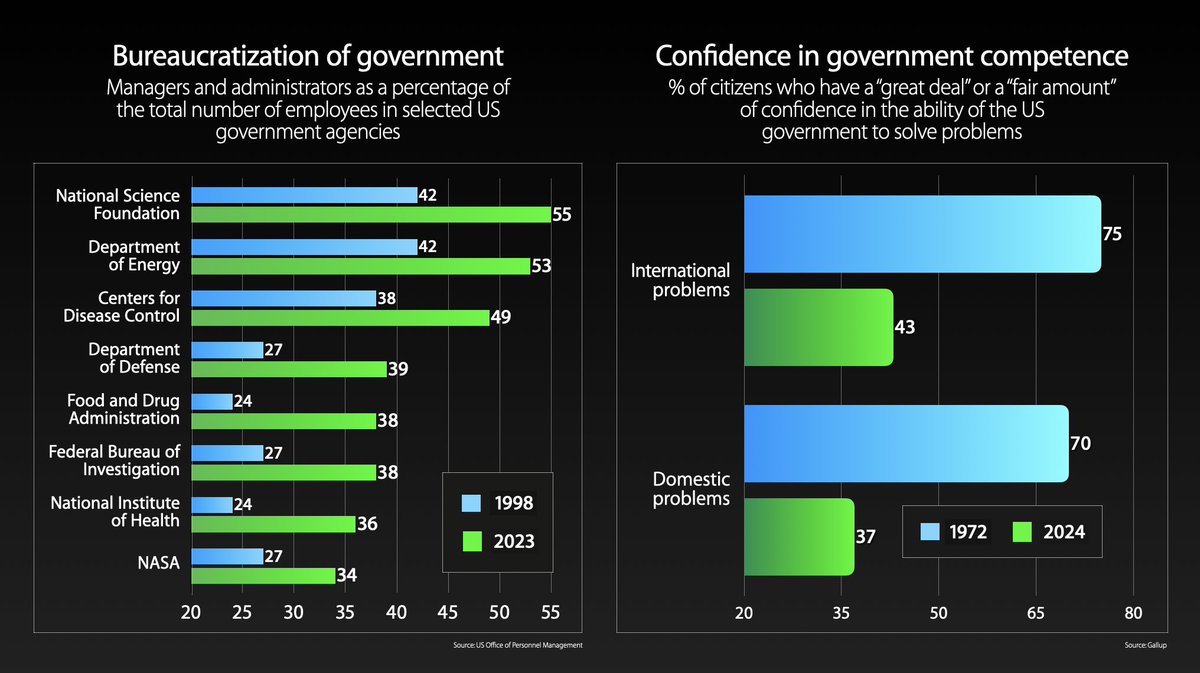
What do you think? Is the correlation between the increasing bureaucratization of government and the declining confidence in government competence mere coincidence? (With US agencies, there's now 1 manager or administrator for every 1.2 non-supervisory employees. The figure for the economy at large is 1:5). BTW, @DOGE is not the way to fix this problem--more on that later.
Though the investor class is currently taking a beating, they did extraordinarily well over the past 30+ years. Those in the top 50% of households by net worth captured 98% of the $134 trillion in gains from the booming stock market. Those in the bottom half captured only 2 percent of the gains. Whatever you think of Donald Trump (and I'm told opinions vary), the two charts below explain much of his appeal to working class Americans. Whether his policies will shrink or exacerbate wealth disparities is for now unclear.
CAN ELON MUSK DO IT?
It may seem impertinent to ask whether @elonmusk is up to the challenge of remaking the federal government.
He is stupendously good at building things—like Tesla and SpaceX. And with the demolition of the USAID, he and his acolytes have also proven adept at breaking things—particularly when empowered to do so by the President of the United States.
No one should be surprised that Musk’s aggressive moves have provoked howls from the guardians of the status quo. (You expect an impaled pig to squeal.) Yet if you believe that many federal agencies are irredeemably dysfunctional, obstructionist, and wasteful, the only option may be to tear things down to the studs.
But then what?
America is facing a slew of mind-bending problems, including runaway entitlement costs, crumbling infrastructure, substandard schools, Chinese militarism, an imperiled middle class, and lackluster productivity growth. To tackle these and other challenges, America needs a central government that’s radically more capable, not just smaller.
And there’s the rub: no one knows if Musk is any good at rebuilding things? Is there anything in his experience that will help him in the hard, grinding work of revitalizing America’s ossified federal agencies? (Twitter isn’t the Defense Department).
Rejuvenating a moribund institution takes steely courage, but also patience and nuance.
Musk might take a lesson from Bill Anderson. During his tenure as CEO of the pharmaceutical business of Hoffman La Roche, the world’s second largest drug-maker, Anderson orchestrated a remarkable metamorphosis. He sliced the number of management layers in half, dismantled insular head office functions, turned fiefdoms into collaborative communities, shifted the leadership model from command-and-control to empower-and-enable, increased the autonomy of those on the front lines, and made every employee accountable for patient impact. The moves not only saved the company $3 billion per year, they also made the organization dramatically more energetic, focused, and flexible.
Insights could also be gleaned from Zhang Ruimin, the recently retired Chairman and CEO of Qingdao-based Haier. Over the course of a decade, Zhang transformed what had been a mediocre, municipally-owned appliance maker into a global, innovation powerhouse. He did so by flattening the pyramid, breaking monolithic business units into thousands of self-managing “micro-enterprises,” using open innovation to source the best ideas from across the world, and giving every employee a financial stake in the success of their team. This radical makeover spawned a slew of new products and businesses and turned a once sleepy company into a global benchmark.
Rejuvenation can’t be accomplished without a certain amount of trauma. Ineffective programs have to be shuttered and seat-warmers shown the door. But the trauma needs be brief and well-aimed. If it is not, the organization will be permanently weakened—not least because the first rats off a sinking ship tend to be the best swimmers.
Maybe America (and the world) can live without USAID, or even the Department of Education. But it can’t live without the US Army, the National Institutes of Health, the Federal Bureau of Investigation, and many other agencies. These institutions need to be downsized, but also rejuvenated. That will be the ultimate test for Musk and his boss.
[Note @MicheleZanini and I are working on a longer piece about DOGE. Watch this space.]
As you may have discovered, bureaucrats hate exceptions, so as their ranks expand, exceptional performance becomes increasingly rare. Hence my maxim: "In any organization, the likelihood of exceptional performance is inversely related to the number of bureaucrats."
I understand the widespread antipathy for Germany's @AfD party, but it's telling that in Sunday's election, AfD was the leading vote winner in the 25-34 year age bracket. With each passing generation, the percentage of young people making into the middle class is shrinking. This is the canary in the coal mine for democracy. https://t.co/gdJP0hveWs












![profhamel's tweet photo. CAN ELON MUSK DO IT?
It may seem impertinent to ask whether @elonmusk is up to the challenge of remaking the federal government.
He is stupendously good at building things—like Tesla and SpaceX. And with the demolition of the USAID, he and his acolytes have also proven adept at breaking things—particularly when empowered to do so by the President of the United States.
No one should be surprised that Musk’s aggressive moves have provoked howls from the guardians of the status quo. (You expect an impaled pig to squeal.) Yet if you believe that many federal agencies are irredeemably dysfunctional, obstructionist, and wasteful, the only option may be to tear things down to the studs.
But then what?
America is facing a slew of mind-bending problems, including runaway entitlement costs, crumbling infrastructure, substandard schools, Chinese militarism, an imperiled middle class, and lackluster productivity growth. To tackle these and other challenges, America needs a central government that’s radically more capable, not just smaller.
And there’s the rub: no one knows if Musk is any good at rebuilding things? Is there anything in his experience that will help him in the hard, grinding work of revitalizing America’s ossified federal agencies? (Twitter isn’t the Defense Department).
Rejuvenating a moribund institution takes steely courage, but also patience and nuance.
Musk might take a lesson from Bill Anderson. During his tenure as CEO of the pharmaceutical business of Hoffman La Roche, the world’s second largest drug-maker, Anderson orchestrated a remarkable metamorphosis. He sliced the number of management layers in half, dismantled insular head office functions, turned fiefdoms into collaborative communities, shifted the leadership model from command-and-control to empower-and-enable, increased the autonomy of those on the front lines, and made every employee accountable for patient impact. The moves not only saved the company $3 billion per year, they also made the organization dramatically more energetic, focused, and flexible.
Insights could also be gleaned from Zhang Ruimin, the recently retired Chairman and CEO of Qingdao-based Haier. Over the course of a decade, Zhang transformed what had been a mediocre, municipally-owned appliance maker into a global, innovation powerhouse. He did so by flattening the pyramid, breaking monolithic business units into thousands of self-managing “micro-enterprises,” using open innovation to source the best ideas from across the world, and giving every employee a financial stake in the success of their team. This radical makeover spawned a slew of new products and businesses and turned a once sleepy company into a global benchmark.
Rejuvenation can’t be accomplished without a certain amount of trauma. Ineffective programs have to be shuttered and seat-warmers shown the door. But the trauma needs be brief and well-aimed. If it is not, the organization will be permanently weakened—not least because the first rats off a sinking ship tend to be the best swimmers.
Maybe America (and the world) can live without USAID, or even the Department of Education. But it can’t live without the US Army, the National Institutes of Health, the Federal Bureau of Investigation, and many other agencies. These institutions need to be downsized, but also rejuvenated. That will be the ultimate test for Musk and his boss.
[Note @MicheleZanini and I are working on a longer piece about DOGE. Watch this space.]](https://pbs.twimg.com/media/GliX0avaYAAfjfr.jpg)