Introducing Claude Fable 5.2 and Claude Mythos 5.2, designed to tackle the most daunting technical challenges.
They’re capable collaborators on ambitious projects in many fields, and show improvements in areas like coding, reasoning, and vision.
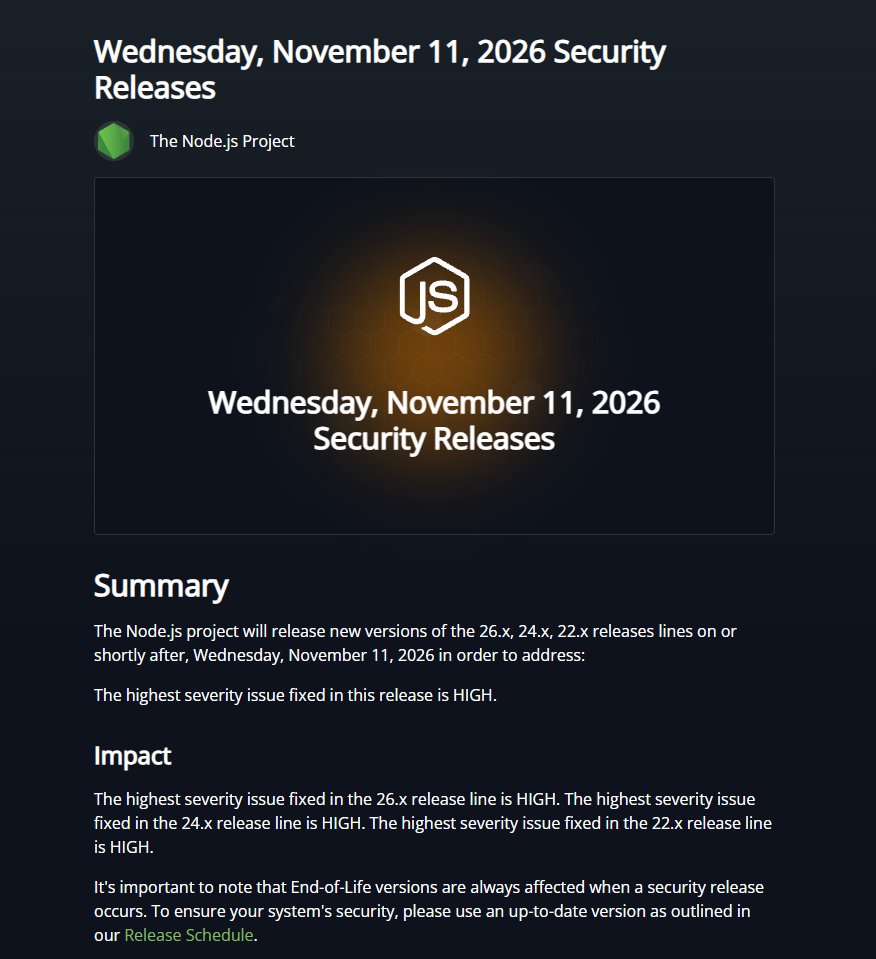
🚨 Node.js warns of HIGH-severity security vulnerabilities.
Security fixes are coming November 11 for Node.js 26.x, 24.x, and 22.x.
All three release lines are affected. Production users should take note.
Details: https://t.co/kyerFMiO8K
Introducing Gemini 4 Carbon, our latest frontier model.
Carbon delivers improved performance across domains — ranking #1 on v5.0 of the @ArtificialAnlys Intelligence Index and sets a new state-of-the-art in cybersecurity and long-horizon capabilities.
It’s rolling out starting this week to cyber defenders through our Fairwind Program, with expanded access coming soon 🧵
Introducing Gemini 4 Carbon, it's a big jump over Argon which we released just 2 weeks ago.
Gemini 4 Carbon is SOTA on cyber, long horizon tasks, ranks #1 on Artificial Analysis V5, significantly improves on usability in domains like coding, and is more aligned.
GPT-6.1 Terra: delivering fast and capable computer use at a lower price.
GPT-6.1 Terra understands what’s on screen, takes action across apps, writes naturally, and is a more capable model for your whole workday with the efficiency to take on more of it.
During this red-teaming exercise, we also found a vulnerability that allows for unauthenticated remote code execution in Brotli, a widely-deployed compression library included in many pieces of software such as Node.js, Bun, and Envoy.
The flaw could let an attacker run their own code on affected systems by sending or replying with malicious compressed data, without any need to create a user account. That is, an unpatched server that accepts compressed input could be taken over by a malicious client, and an unpatched client that accepts compressed input (such as “curl --compressed”) could be taken over by a malicious server.
This root cause issue was actually fixed in the Brotli source code in February, but it wasn’t known at the time that it gave rise to a security vulnerability and there was no more recent release of Brotli. Since Brotli is built into other software, any software which includes this library needs to take the update too, followed by the users of that software. We disclosed the vulnerability to Brotli and other downstream projects such as Node.js, which released or are currently releasing security updates, and Brotli cut new release versions and published a CVE.
More details on the patch and mitigations below:
https://t.co/Y1Y72aHxrW
Evolving threat 🚨 CVE-2026-111497, previously known to affect Node.js (node2shell) and Python has evolved into “HTTP2Shell.”
A significant blast radius.
This vulnerability leaves many libraries and applications using HTTP vulnerable to pre-auth RCE via Brotli decompression.
Please be aware. Fixes not yet available for all affected services. Look for Brotli (1.2.1) dependency upgrades when they become available.