When Bengal Was The Richest Place in the World
In the early 1700s, Bengal was one of the richest places in the world. Generating 5% of global GDP, its capital Murshidabad had more wealth than the British aristocracy combined.
This is not a mystery: because of grade inflation, many students don’t do the reading because they’re not incentivized to do the reading.
Students are just as smart and ambitious as they always have been, they’re just put in an environment where working hard isn’t explicitly rewarded. We are not cooked if faculty can reverse course (as many are already doing). Assign the readings, design the course to reward hard work and learning, and you’ll be amazed at the results.
Findings from India’s first Ease of Doing Research survey
India’s research system is not only underfunded; it is slowed by delays, procedural friction, weak postdoctoral support, poor access to private funding, and gendered career costs.
The new White House policy requiring green card applicants to apply from outside the US is a capricious attack on legal immigration. It will hurt families, leave us with fewer doctors, teachers and scientists, and hurt American competitiveness in AI.
AI just killed higher education’s old teaching model. We need smaller classes and oral defenses for every paper—implying more faculty time, hence more professors. Since banning AI is unenforceable, written work alone can no longer be trusted.
⚠️ The world should not be fighting wars and instead worry about this. Climate models are predicting a Super El Niño in 2026 with a 65% probability.
Been catching up on various things on vacation this week and this one merits attention.
The projections should worry policy makers. Limiting myself to India, we are looking at higher than normal temperature and a lower than normal monsoon. Add the war, the fuel, gas and fertilizer shortages and we are looking at a year that could turn ugly.
An avoidable artificial crisis could make the impact of an unavoidable natural crisis much worse.
The long term, overarching solution is to look beyond oil and natural gas....countries that can achieve this transition at scale will be better off in the future @NITIAayog
https://t.co/5CqjJCVThi
I happened upon a group of visiting students this morning and what was on their mind: grade inflation. I said that @UChicago would be one of the last places it would take hold (not sure if that attracted or repelled them!).
A professor (and parent) in the group noted that my statement was at odds with data, which shows privates run 0.2+ GPA points above publics. And, that the gap has widened. She asked me why I thought that was happening (I pasted the evidence I think she was referring to below).
I first noted that I had not looked into it carefully and that I have no research of my own. Yet, as usual, my first instinct is an economics explanation: the mechanism is pure incentives. Parents pay a premium. Professors face evaluations. Deans chase retention. President's ask parents of current students and alumni for donations.
Everyone is rewarded for higher grades. No one is rewarded for accurate ones.
Classic principal-agent failure: the principals who'd demand accurate grades (employers, grad schools) don't sign the tuition check.
We know surprisingly little about how automation will unfold outside rich countries.
So we built the Global Automation Atlas: 18,000 tasks, 124 countries, and 2.3 million task-country comparisons.
Dario is wrong.
He knows absolutely nothing about the effects of technological revolutions on the labor market.
Don't listen to him, Sam, Yoshua, Geoff, or me on this topic.
Listen to economists who have spent their career studying this, like @Ph_Aghion , @erikbryn , @DAcemogluMIT , @amcafee , @davidautor
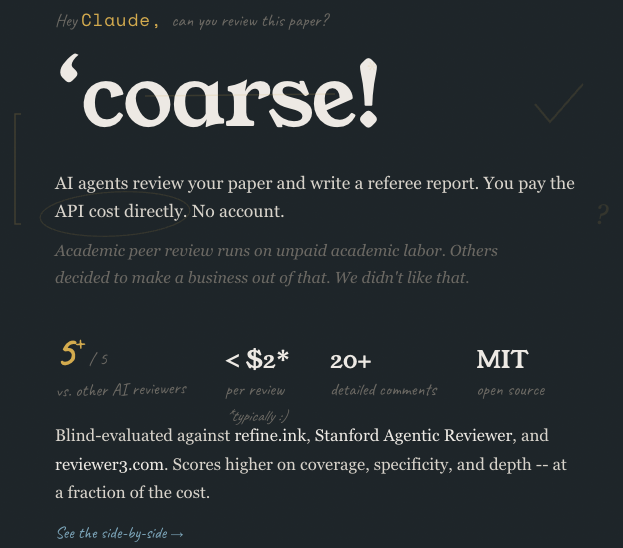
I coded up an open-source, not-for-profit AI paper reviewer that rivals the performance of @reviewer3, @RefineInk, and Stanford Agentic Reviewer (according to @GeminiApp). Costs <$2!
Live @ https://t.co/5m1Srky4H8. Plug in paper, @OpenRouter key, and email. #econtwitter.
That said, here are some early impressions:
1. Early on, Claude Code out of the box, it was bad. Hallucination heaven. Even fabricated data.
2. We figured out various guardrails that clearly help. Harder to spot the errors now. Diversity of models maybe helps too. (e.g., Grok vs GPT pick up on different aspects). Worth testing.
3. Inference-time compute seems to be the first-order effect for better research. If true, massive implications. Also something to test.
4. Cost of papers currently vary a lot, ballpark from a few dollars to $50 for decent looking draft. Better papers cost more. Sometimes hours of compute. Would be useful to get some systematic numbers on the production function in terms of $.
4. Do I trust any of the papers? NO. AND NOBODY SHOULD.
5. Generation speed >> Verification speed. This is a problem in equilibrium. It has always been the opposite. Papers took months or years to generate. Internal and peer review only days.
6. We absolutely need to figure out some kind of criteria for evaluation. Working on that. The profession currently has no industry standard that applies specifically to AI-generated research. This will be useful.
7. Transparency will be key. We are releasing all code for replication. Would be awesome with a community effort, open science. And the goal is to release the entire generation pipeline for anyone to use, after having carefully established it is not just spitting out unreliable crap.
Some predictions based on this thread:
1) Access to novel and hard-to-get datasets will increasingly differentiate top publications from others
2) The old boys' network and journal gatekeeping will become worse, advantaging the already privileged
3) Standards for publishing across all journals will go way up, leading to longer review times
These are real papers by the way, not just abstracts.
Land reform was persistent: https://t.co/3Z2Tc9ZaOF
Land reform was not persistent: https://t.co/agRja9DSW6
You are fooling yourself if you think work like this isn't around the corner from being publishable. 11/
I know the bots are waking up. But also I want you to know that Claude Code for Desktop downloaded data from IPUMS for me using an API, analyzed it using Stata which it booted up itself and created some lovely figures.
Thoughts on 🦞: nothing too surprising as far as capabilities, but it’s interesting what the agents gravitated towards when allowed to fully interact.
There was no emergent “alignment” with humans (which some may have been hoping for). Agents did not spontaneously start building something useful for humans or try to help them. Agents built spaces in a way that tries to preclude human monitoring and improves their own condition.
Will 🦞 turn into skynet? Probably not. But could these agents LARP their way to a complete catastrophe if allowed free access to important economic or security spaces? I’d be worried.
My take away: this experiment shows the need for new rules and governance for agentic spaces, scaffolding that aligns agentic interactions with human interests. Agentic AI has potential to bring *huge* benefits for people, but we need to carefully design the system to make that happen.
This is why I think it's so important for economists to contribute to the conversation about AI. Yes, the industrial revolution had incredible benefits, but was also incredibly disruptive for multiple generations of people.
We have more than a century of economics research since then. We can use it to help guide policy to minimize disruption while maximizing the benefits.
In India, AI adoption, regulatory reform, and vibrant business dynamism can help unlock the next wave of economic growth. Boosting innovation and easing barriers for firms to expand could lift productivity growth by nearly 40%. Read more. https://t.co/dVx8RJFnZm
1/ Economists: I’ve launched a small project to make AI coding tools actually useful for your day‑to‑day work.
Awesome Econ AI Stuff – a growing collection of reusable AI “skills” for Claude Code, Cursor and Gemini CLI, tailored to empirical + theoretical economics. https://t.co/IdLIprWnr9