Prof. Brenda Shaffer specializes in intl energy, natural gas, Middle East, Azerbaijan, Caucasus, Caspian energy, and East-Med. Passion-mountain gorillas
Reuters, citing officials: Iran has drawn up detailed plans to target undersea cables in the Gulf in case of renewed war
Two senior Iranian security officials told Reuters that Tehran has drawn up detailed plans to target undersea communications cables in the Gulf region in the event of a renewed attack on Iran by the United States and Israel.
Their statements followed warnings from Iranian officials indicating that undersea communications cables in the region could become targets in any renewed conflict should diplomatic efforts with Washington collapse.
The two Iranian security officials, speaking on condition of anonymity, provided brief details, without specifying how or where Tehran might carry out such attacks. However, one of them indicated that Iran would seek to prevent repairs after any attack in order to prolong the disruption of communications, including internet services.
One of the officials said: "If Iran is attacked, there will be no red lines; this will include everything from undersea cables to military bases, including secret ones."
The official warned Washington against "playing with fire," emphasizing that Iran has the full capability to access and easily destroy undersea cables.
NEW: Greta Thunberg urged followers to join and fund Paris protests that quickly turned violent—cars burned, clashes with police, businesses hit and more expected this weekend.
Fox News Digital investigations and @AsraNomani uncovered the broader “red-green-green” network of communist groups, Islamist/Palestinian activists, and environmental orgs (only ~1/3 of the protests in Paris were actually student-led).
We’re anticipating more activity in the streets of France this weekend as French authorities plan to deploy military force—dubbed by PM Sébastien Lecornu as Operation Sentinelle.
From “how dare you” to omnicause agitator — how Thunberg went from climate causes to dubbing Israel as the “killers of children.”
https://t.co/pB8vjwv9t6
New Momentum Emerged in the Azerbaijan-India relations
India’s External Affairs Minister S. Jaishankar is in Baku on the first bilateral visit by an Indian foreign minister in eight years. He called it “a continuation of the meeting between our leaders in Bishkek.”
At the joint press conference, FM Jeyhun Bayramov did not avoid the difficult past. He said the two sides’ differences had “affected bilateral relations and cooperation within international organizations,” and added: “Today, we discussed these issues openly and constructively. We will see the results of this discussion in a short period of time.” Jaishankar said the two countries can raise their relations to a higher level.
The economic case is strong. Trade reached about $600 million in the first half of this year, already well above the $401 million recorded for all of 2025. In Bayramov’s words, however, this “does not reflect the potential of the two countries.” More than 1,000 Indian companies are registered in Azerbaijan. ONGC Videsh has invested over $1.2 billion and holds stakes of 2.925% in the Azeri-Chirag-Gunashli fields and 3.097% in the BTC pipeline. Indian companies remain interested in Azerbaijan’s oil and gas sector, and both sides see potential in pharmaceuticals, digital services and mining. The ministers agreed to bring their business communities together.
Connectivity was high on the agenda. The two sides discussed the opportunities offered by Azerbaijan’s East–West and North–South corridors, including the Baku–Tbilisi–Kars railway, the Port of Baku and the Alat Free Economic Zone. “Connectivity is very important in the global economy,” Jaishankar said. “Our discussions on this matter will continue.” For India, Azerbaijan is a gateway to the Caspian, Central Asia and Europe. For Azerbaijan, India is a market of 1.4 billion people and an important part of its effort to diversify partnerships toward Asia.
People-to-people ties are growing too. 500 Indian students will begin studying in Azerbaijan this year, more than 30 Indian films have been shot in the country in recent years, and the two sides will hold talks on increasing direct flights.
Azerbaijan Airlines runs seven weekly flights each from Delhi and Mumbai to Baku. IndiGo’s seven weekly Delhi–Baku flights are currently suspended, which cuts total capacity on the route by a third. The number of Indian visitors to Azerbaijan fell by 31.5%, from 243,589 in 2024 to 166,944 in 2025, so restoring and expanding direct flights is one of the quickest ways to recover that momentum.
Overall, there is indeed great potential in the India-Azerbaijan relations, and good news for both sides is that there is now political will to realise this potential.
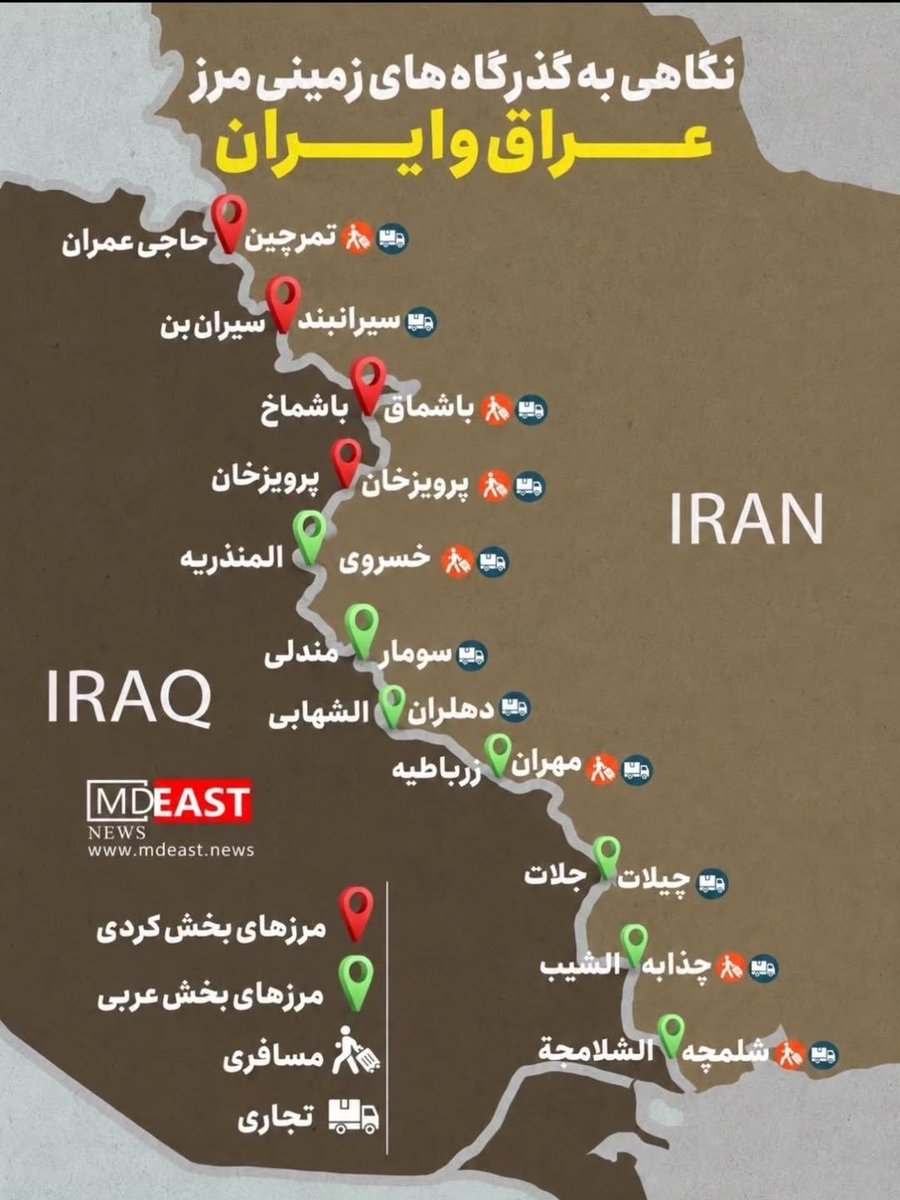
Iraklı yetkililerin açıklamalarına dayanılarak yapılan haberlere göre, İran ile Irak arasındaki bütün sınır kapılarının kademeli olarak kapatılacağı bildiriliyor.
"Fossil fuels provide 86 percent of global energy consumption, higher than in 1973, when the world started to seek alternative energy, and there is no scalable alternative available yet. Wind and solar are intermittent and geographically restricted; they provide 2–3 percent of global energy needs, and they depend on fossil fuels to deliver reliable power. Chopping away at our primary energy sources with no viable replacement is dangerously bad policy."
https://t.co/xAwoMNhOyg
"It is astounding that the question was even posed, let alone debated. If you asked people on the street whether we should import gas at higher prices and with greater environmental impact from foreign countries or use local, cheaper, less polluting gas, it’s hard to imagine they would choose the former."
https://t.co/xAwoMNhOyg @scoopercooper@thebureauJ1
"Government investment taxonomies have even larger implications than lowering domestic energy production. They enable increased government control over the economy, changing companies’ business models from innovation and production to chasing government funds.
That means government bureaucrats, not markets, pick the winning technologies to develop because they decide what aligns with the taxonomy.
Under this model, energy systems are no longer built based on efficiency and effectiveness but on government policy priorities. Companies must retain teams of “sustainable finance” experts, lawyers, and accountants to comply with the green taxonomy requirements. This creates a market advantage for larger firms, leading to market concentration."
When Green Agenda Bureaucrats Decide Where Energy Capital Flows, Hidden Costs Mount and The West Loses https://t.co/aiuR3xBXTw @scoopercooper@thebureauJ1
Following Iraqi Shi'ite cleric and politician Muqtada al-Sadr's call, Iraqi schoolgirls demonstrated against secular school uniforms instituted in Azerbaijan that don't allow religious dress, including hijab, on schoolgirls.
https://t.co/7yHjCpDWlV
When Green Agenda Bureaucrats Decide Where Energy Capital Flows, Hidden Costs Mount and The West Loses https://t.co/aiuR3xBXTw @scoopercooper@thebureauJ1
The protesters were encouraged "to rise up against laïcité, France’s principle of secularism. In their sights are the 2004 law banning religious symbols (including the hijab) in schools, and former prime minister Gabriel Attal’s 2023 ban on the abaya in state schools."
https://t.co/u4udElnxc9
@NoraBussigny@TheFP
@MizellPreston@AsraNomani https://t.co/kzWbbxemX4
The "Red-Green-Green" network has been active undermining our electricity supply and against AI and data centers.
Ottawa commits $8.8 million for 30 electric vehicles for a First Nation with 140 people living on reserve
Thirty zero-emission vehicles, $8.8 million in federal commitments, and no ridership figure on the record.
https://t.co/WG23PlPtYn
@MizellPreston@AsraNomani https://t.co/kzWbbxemX4
The "Red-Green-Green" network has been active undermining our electricity supply and against AI and data centers.
Mehdi Hasan's Zeteo has a new documentary out on AIPAC, asking whether the "Israel lobby" is really an agent of a foreign power.
A shadowy, fabulously rich network pulling Washington's strings: it's one of the most enduring antisemitic tropes of our age. So I did Mehdi a favour and checked the numbers.
Over the past decade, Israel ranked tenth for registered foreign lobbying spending, behind China, Japan, Saudi Arabia, Qatar, the UAE and even the Marshall Islands. AIPAC came 191st among Washington's lobbies. The entire pro-Israel lobbying category spent less than gun-rights groups, and a fraction of what the drug companies spend.
Elections? AIPAC's super PAC spends serious money. But it competes in a system where outside groups have poured in nearly $2 billion this cycle, and six organisations have each spent over $60 million.
Strangely, Zeteo seems far less curious about Riyadh, Beijing or Doha.
The truth about the Israel lobby. Link to my new column here 👇
https://t.co/qgtjTKYPmw
Following Iraqi Shi'ite cleric and politician Muqtada al-Sadr's call, Iraqi schoolgirls demonstrated against secular school uniforms instituted in Azerbaijan that don't allow religious dress, including hijab, on schoolgirls.
https://t.co/7yHjCpDWlV