Export controls aren’t the only risk to #AI Chipmakers right now,
The US Dollar is up 10% since the election which will be a headwind for the Top 10 US -based Semiconductor stocks that generate over $213 billion in ex-US sales or roughly two-thirds of total revenue,
The most exposed stocks to currency headwinds are $ON, $MRVL, $QCOM, $AVGO and $INTC
$SMH $SOXX $QQQ $SPX $AVGO $MU $TXN $ADI $AMD $NVDA
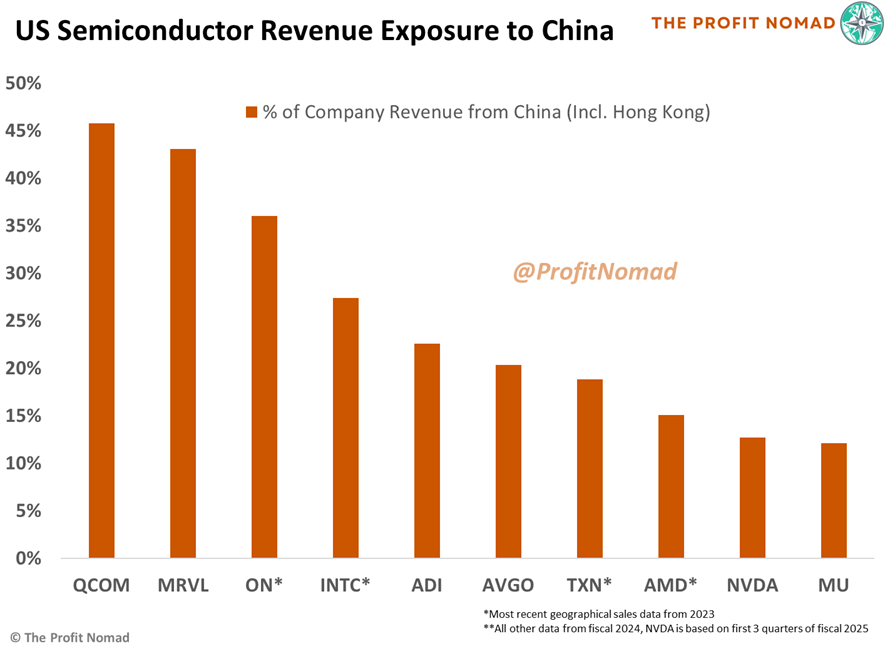
The Top 10 US-based Semiconductor companies export over $71 billion to China or roughly one-fifth of their total revenue,
New export restrictions on advanced #AI chips is expected to mostly impact $NVDA with its estimated 90% mkt share on AI GPU chips used in data centers/ training gen AI models,
13% of NVDA’s $91 billion in revenue in the first 9-months of 2024 came from China,
$AMD AI chips are also at risk with the new rules set to take place within 120-days if the #Trump administration doesn’t pull back on Biden’s last minute restrictions,
15% of AMD’s revenue in 2023 came from China,
Trump is now expected to phase in #tariffs, but he still talks the toughest on China with threats of 35%-60% tariffs on Chinese goods,
These tariffs would have a big impact across the Semi industry with the biggest effect on $QCOM, $MRVL and $ON that pull over one-third of their sales from China
$AVGO $MU $TXN $ADI $INTC $SPY $QQQ $NDX $SPX $SOXX $SMH
$MU, $NVDA and $AMD have lowest revenue exposure to China of the major US semi co's,
$QCOM, $MRVL and $ON have the most with over one-third of annual revenue tied to China,
$SMH
The Top 10 US-based Semiconductor companies export over $71 billion to China or roughly one-fifth of their total revenue,
New export restrictions on advanced #AI chips is expected to mostly impact $NVDA with its estimated 90% mkt share on AI GPU chips used in data centers/ training gen AI models,
13% of NVDA’s $91 billion in revenue in the first 9-months of 2024 came from China,
$AMD AI chips are also at risk with the new rules set to take place within 120-days if the #Trump administration doesn’t pull back on Biden’s last minute restrictions,
15% of AMD’s revenue in 2023 came from China,
Trump is now expected to phase in #tariffs, but he still talks the toughest on China with threats of 35%-60% tariffs on Chinese goods,
These tariffs would have a big impact across the Semi industry with the biggest effect on $QCOM, $MRVL and $ON that pull over one-third of their sales from China
$AVGO $MU $TXN $ADI $INTC $SPY $QQQ $NDX $SPX $SOXX $SMH
Faster, Cheaper, Better, 24/7
That's the value proposition for #AI-as-a-Service stocks capitalizing on the trillion dollar AI automation trend,
Just posted Part II with 2 #Stocks poised to ride the automation wave higher,
See article link in my next post👇👇
$SPY $QQQ $IWM $NDX $SPX
PROJECT STARGATE ENERGY ANALYSIS
Project Stargate is going to need an enormous amount of power: each of the five Stargates needs about 5 gigawatts (about five million people's worth) of constant electricity for each ~$100b supercomputer project.
Let's break it down.
Each center will want at least 6 GW of firm capacity available, minimum, at all times.
I expect total power costs to run (very roughly) $4 billion per year per Stargate, or about $100 per MWh. For reference, Microsoft is paying a bit more than $100/MWh to get 17% of one Stargate's-worth from restarting Three Mile Island.
This price will allow for building new power plants and securing power from old ones.
This is going to start as a natural gas and coal play. New natural gas turbines from GE-Vernova and others will be the backbone of this effort for the short and medium term.
Combined cycle natural gas plants use a natural gas-burning turbine (much like what powers jetliners), but with the hot turbine exhaust directed onto pipes filled with water, which boils into steam and runs a steam turbine. Combining the gas turbine and the steam turbine gets you above 60% efficiency converting fossil heat into electrical power.
Five GW of efficient gas turbines will need about 0.7 billion cubic feet per day (bcf/day) or 7 billion cubic meters (7 bcm) per year, just under 1% of the USA's current daily production of natural gas. Five of these 5GW centers would require about 4% of America's current natural gas production, if totally fueled by gas.
America currently exports about 10% of its natural gas production. If you are wondering why the "Energy Emergency" Executive Order, here it is: we can't increase gas exports to Europe and Asia while powering Project Stargate without natural gas price increases for Americans, unless we also increase and maintain that increase of natural gas production. Which in turn means we need to expand exploration and drilling straight away, to have the gas in a few years.
A number of coal plants will get a new lease on life, to provide replacement power for the grid, because power from nuclear, gas, and coal plants located close to a new Stargate cluster will be redirected to these centers instead of their existing customers.
Because Stargate will require ultra-firm power at highly concentrated locations, renewables will probably not play a major role in directly powering Stargate except as an accounting fiction to "offset" emissions from the steady fossil power built for each center.
So these companies may pay for some solar somewhere to be built to "lower the carbon" but it'll be even faker than it's been up until now.
NUCLEAR STARGATE?
Nuclear is 4 to 5 years behind where it should be for this exact moment. We can partially blame the companies behind Stargate because until very recently they had superwoke "100% Renewables" policies driven by their marketing/investor relations/ESG teams.
China can build America's best large reactor design in 5 years, plus a few years before that setting up the power plant location. We have lots of locations more or less ready to roll for these exact reactors. Each Stargate would require 6, or three pairs of 2 GW reactors linked together by transmission lines.
Existing nuclear can get small capacity uprates, and we can restart a few reactors in different states. That's not enough, though it will help a bit.
Can we use small reactors? Well, the designs aren't ready yet, so even in an optimistic case we won't get the first tiny prototypes turning on before 2028, and as late as 2031.
It would take 500 little 10 MW reactors running constantly to power a Stargate. It would take 5 large reactors. China will be building ten of these per year, year after year, by 2030.
I expect Stargate participants to make bets on one or more microreactor and small reactor plays just in case.
If we can get ready to build large reactors straight away, and if the US government supports with loans, we can aim to replace natural gas plants and retire the old coal plants ten years from now with new large reactors. To make this "gas first, then uranium" policy work, Stargates and their new gas plants will have to be sited near transmission corridors connecting them to nuclear plants ready to host new reactors.
Each Stargate would require 5% of America's current nuclear fleet to run, but there are only a few clusters of reactors close enough together to power a full center today.
More later.
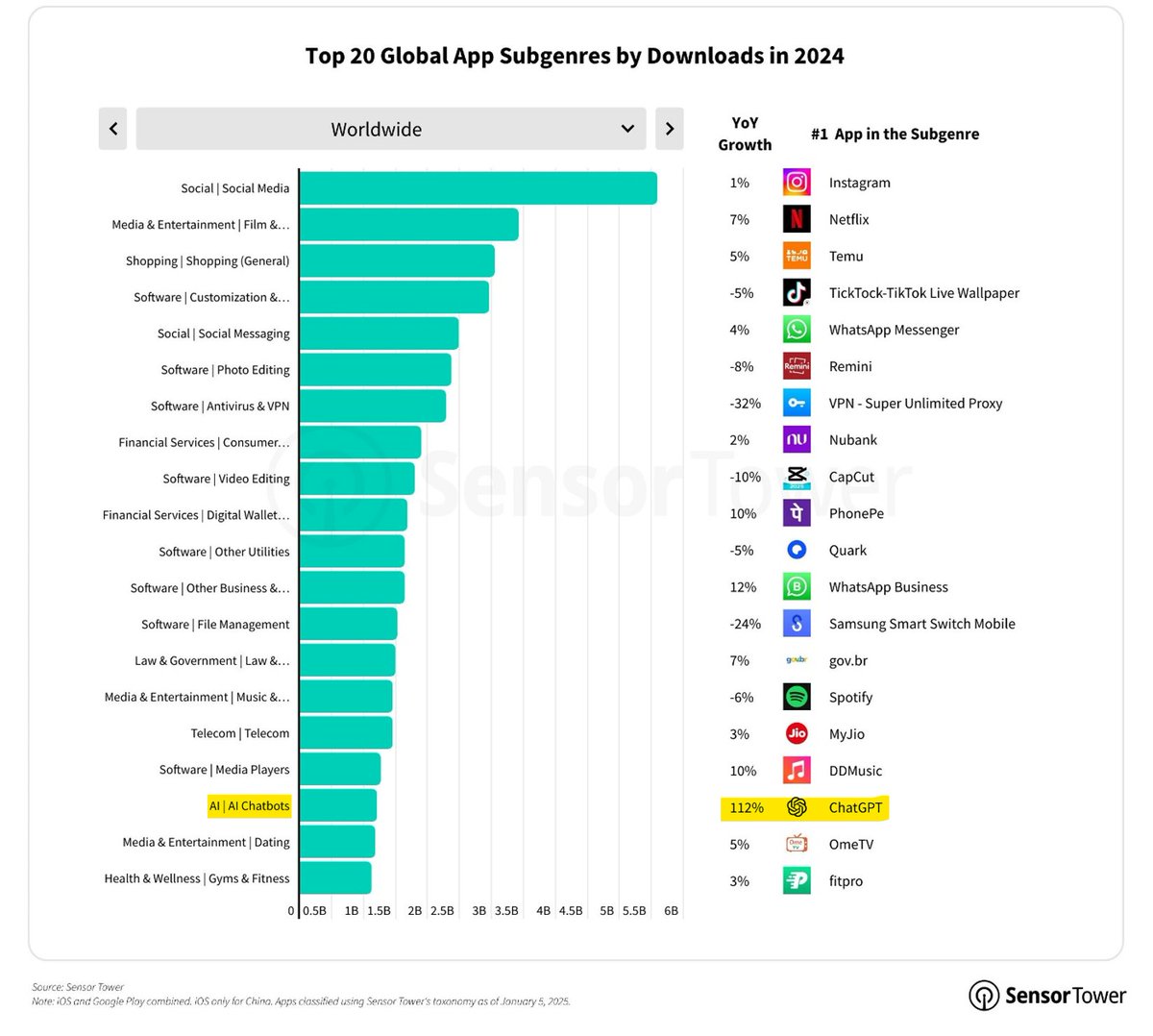
Consumers spent $150 billion in-app purchases/ subscriptions in 2024 (+13% yoy)
"AI Chatbots that stole the show in 2024. A surge of interest in generative AI saw consumers spend nearly $1.1bn (+200% YoY) in apps such as ChatGPT, Google Gemini and Doubao, growing at a rate that could catapult the subgenre into the top ten by consumer spending within just a year."
"Time spent in AI apps like Character AI and ChatGPT nearly eclipsed 7.7 billion hours, and apps mentioning AI were downloaded 17 billion times, emphasizing the growing appetite among consumers for AI features at their fingertips." ~SensorTower
#AI @ChatGPTapp $GOOG
H/T @SensorTower
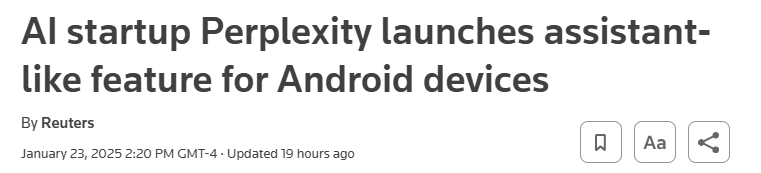
Here come the #AI agents...will you trust the 1st gen AI agent to take over your browser and email?
I'm confident AI agents are the future, but I'll let others work out the kinks and deal with the hallucinations even it requires human interaction to put in the credit card info to complete the transactions.
h/t @TechCrunch@Reuters @ChatGPTapp @perplexity_ai
"imagine early cancer detection, the development of a cancer vaccine for your particular cancer aimed at you and have it have that vaccine available in 48 hours. This is the promise of AI and the promise of the future." @larryellison
That sounds like $500+ billion well spent...
$ORCL #Stargate #AI #biotech
The $500 billion in AI infrastructure spend committed by the Stargate project isn’t big enough!
According to @ApolloGlobal estimates, it will take $2.2 trillion to add the 60 gigawatts of additional data center capacity necessary to meet AI’s meteoric rise in data consumption and processing needs by 2030,
It costs about $10 bil to add a gigawatt of data center capacity by current estimates, so adding 60 gigawatts by 2030 = $600 bil,
The scale up will also require about a $7 bil investment into new electricity generation capacity (costs vary depending on gas, solar, nuclear etc.) and about $19 bil in GPUs for every gigawatt increase in data center capacity,
All together it will require $2.2 trillion to build out all the new data center capacity needed to fuel the #AI revolution and that’s just the projected growth until 2030,
This is the biggest industrial scale-up in history and the biggest investment opportunity of our lifetimes,
The top 3 hyperscalers currently control 15 of the 20 gigawatts of data center capacity in the US and ApolloGlobal estimates that 90% of data center growth will be driven by $MSFT, $AMZN, $GOOG, $META and $ORCL,
The key is to invest in where these hyperscalers will be spending their money to build out these data centers,
That includes all of the Upstream value chain for AI like the chipmakers and specialized equipment makers required to build out the data centers,
To learn how you can invest in the best Upstream AI stocks see the link in the next post/ comment on this post below 👇👇
@SoftBank@OpenAI #Stargate
Risks to $NVDA's earnings from the new AI Diffusion rules extends beyond China,
Singapore, which wasn't restricted from previous chip regulations, is now considered a Tier 2 country (the same as Yemen!),
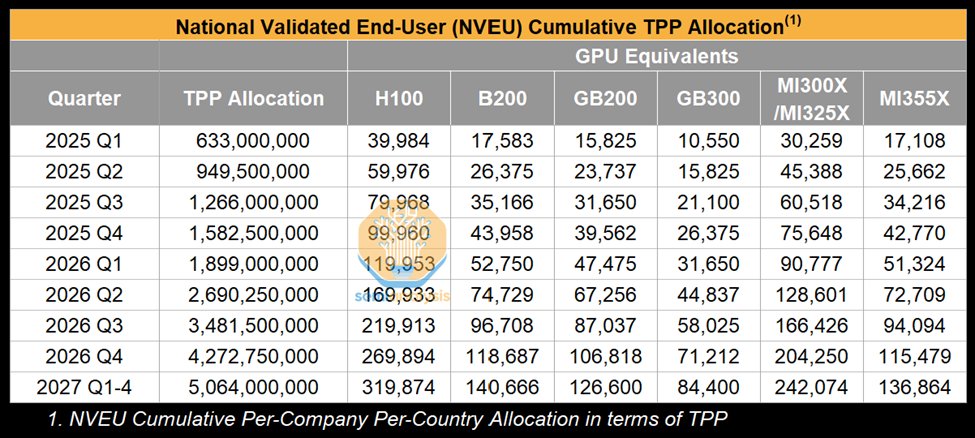
Tier 2 countries will be subject to import quotas for advanced AI chips and only after being authorized as a "Validated End User" which requires 19 separate certifications and 4 US regulatory agencies! (Dep of Commerce, Energy, State & Defense)
If a Tier 2 country wants to double it's export quota it can sign a security agreement with the US (something Trump may like too),
Not only is NVDA's $11.5 bil in rev from China in limbo or 12.7% of total rev (based on first 9 calendar months of 2025),
Singapore, NVDA's second largest customer with $17.4 bil or 19% of total rev in first 9-mo's of 2025, will now be severely restricted,
That's at least one-third of NVDA's revenues (most of which is tied to data centers) is now in jeopardy by strict export regulations,
The good news is that hyperscalers like $AMZN, $MSFT, $GOOG and $META are projected to increase capex from $209 bil in 2024 to $257 bil in 2025,
Some back of the envelope math says that the $48 bil annual increase in hyperscale capex more than makes up for the roughly $36 bil in China/ Singapore data center chip exports for NVDA...
But the big question is IF hyperscalers capex will continue be allocated towards NVDA chips and when, as outlined in the post below this is probably a post-2025 issue but beware of NVDA earnings guidance as the canary in the coal mine...
H/T @nvidia
$SPY $QQQ $SOXX $SMH
Industry expert @SemiAnalysis_ just put out an excellent new overview of the new AI Diffusion rules,
The rules create a three-tier system for countries based on their AI compute access. Tier 1 (US & allies) gets the easiest access, while Tier 2 (like India & Malaysia) faces strict quotas, and Tier 3 (China, Russia) gets little to no access.
They say $ORCL stands to lose the most, while US hyperscalers $AMZN, $GOOGL and $MSFT will benefit at the expense of foreign competitors:
“Ultimately it may not meaningfully constrain shipments of AI Chips in aggregate due to increased building in tier 1 and reconfiguring AI Chip deployment plans, shifting them into the hands of major US Hyperscalers operating overseas, or reshoring demand back to the US” SemiAnalysis_
(BTW, this conclusion would appeal to Trump’s agenda, lowering the chances his administration changes the rules before the rules take effect in 120-days)
But that's a big IF the hyperscaler demand can make up for lost sales,
The new export restrictions on next generation GPUs would hit $NVDA the hardest with its roughly 90% mkt share for data center chips used to train AI models,
“To be clear, the impact to Nvidia is still large in the medium term in so far as it reduces GPU access for China which does make the market smaller. The question is if Western demand makes up for it, and the answer is likely not as the pricing of H100’s is tanking. While Nvidia’s H20 and B20 production targets keep being increased, these products are lower margin and ASP than the regulated H200 and B200.” SemiAnalysis_
Since these new rules will take 120-days to enforce and there will still be an opportunity to export higher margin chips until the quotas are reached, I wouldn’t expect to see an much impact on NVDA’s earnings in 2025 but the company’s forward guidance will be extremely important,
Manufacturing issues slowed NVDA��s rollout of the H100 chips (and we may see similar issues for the next gen chips), which led to hyperscalers and others ordering as many chips as they could get their hands on,
Now the question is if hyperscaler and tier 1 country purchases of high margin chips from NVDA can replace potential lost demand from countries/companies impacted by AI Diffusion regulations,
That’s the big new risk posed by the new regulations for a stock that single-handedly was responsible for more than one-fifth of the S&P 500 returns last year
H/T @SemiAnalysis_
$SPY $QQQ $SOXX $SMH
Industry expert @SemiAnalysis_ just put out an excellent new overview of the new AI Diffusion rules,
The rules create a three-tier system for countries based on their AI compute access. Tier 1 (US & allies) gets the easiest access, while Tier 2 (like India & Malaysia) faces strict quotas, and Tier 3 (China, Russia) gets little to no access.
They say $ORCL stands to lose the most, while US hyperscalers $AMZN, $GOOGL and $MSFT will benefit at the expense of foreign competitors:
“Ultimately it may not meaningfully constrain shipments of AI Chips in aggregate due to increased building in tier 1 and reconfiguring AI Chip deployment plans, shifting them into the hands of major US Hyperscalers operating overseas, or reshoring demand back to the US” SemiAnalysis_
(BTW, this conclusion would appeal to Trump’s agenda, lowering the chances his administration changes the rules before the rules take effect in 120-days)
But that's a big IF the hyperscaler demand can make up for lost sales,
The new export restrictions on next generation GPUs would hit $NVDA the hardest with its roughly 90% mkt share for data center chips used to train AI models,
“To be clear, the impact to Nvidia is still large in the medium term in so far as it reduces GPU access for China which does make the market smaller. The question is if Western demand makes up for it, and the answer is likely not as the pricing of H100’s is tanking. While Nvidia’s H20 and B20 production targets keep being increased, these products are lower margin and ASP than the regulated H200 and B200.” SemiAnalysis_
Since these new rules will take 120-days to enforce and there will still be an opportunity to export higher margin chips until the quotas are reached, I wouldn’t expect to see an much impact on NVDA’s earnings in 2025 but the company’s forward guidance will be extremely important,
Manufacturing issues slowed NVDA’s rollout of the H100 chips (and we may see similar issues for the next gen chips), which led to hyperscalers and others ordering as many chips as they could get their hands on,
Now the question is if hyperscaler and tier 1 country purchases of high margin chips from NVDA can replace potential lost demand from countries/companies impacted by AI Diffusion regulations,
That’s the big new risk posed by the new regulations for a stock that single-handedly was responsible for more than one-fifth of the S&P 500 returns last year
H/T @SemiAnalysis_
$SPY $QQQ $SOXX $SMH
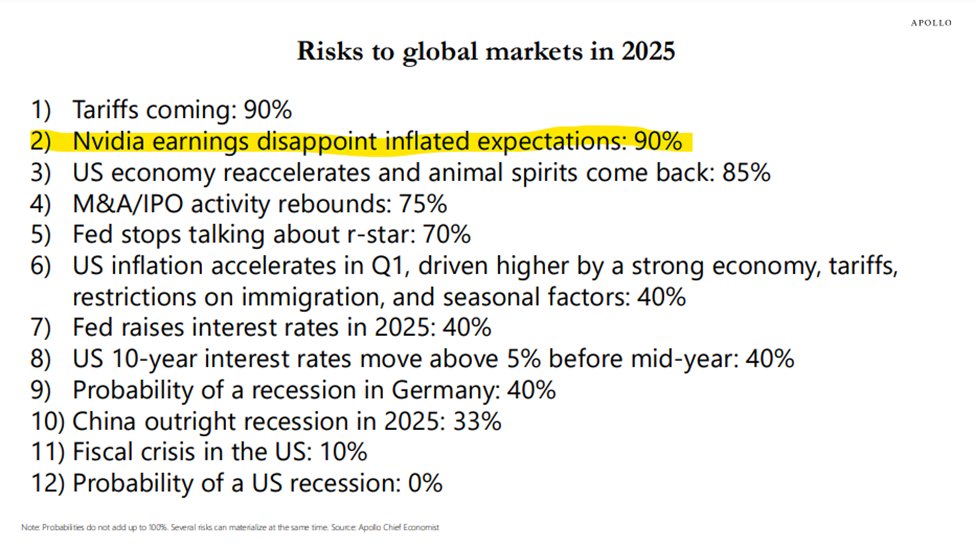
The new AI Diffusion regulations increase risks for a $NVDA earnings disappointment/ lowered guidance that could disrupt markets,
NVDA contributed more than 22% of the gain in $SPX in 2024, so there’s a lot riding on the +$3 trillion company,
@apolloglobal’s Chief Economist Torsten Slok gave a 90% chance of NVDA earnings disappointment (before the new export rules) and called it one of the top risks to global markets in 2025,
Here’s how the new rules could impact NVDA…(1/2) 👇👇
$SPY $QQQ $SOXX $SMH
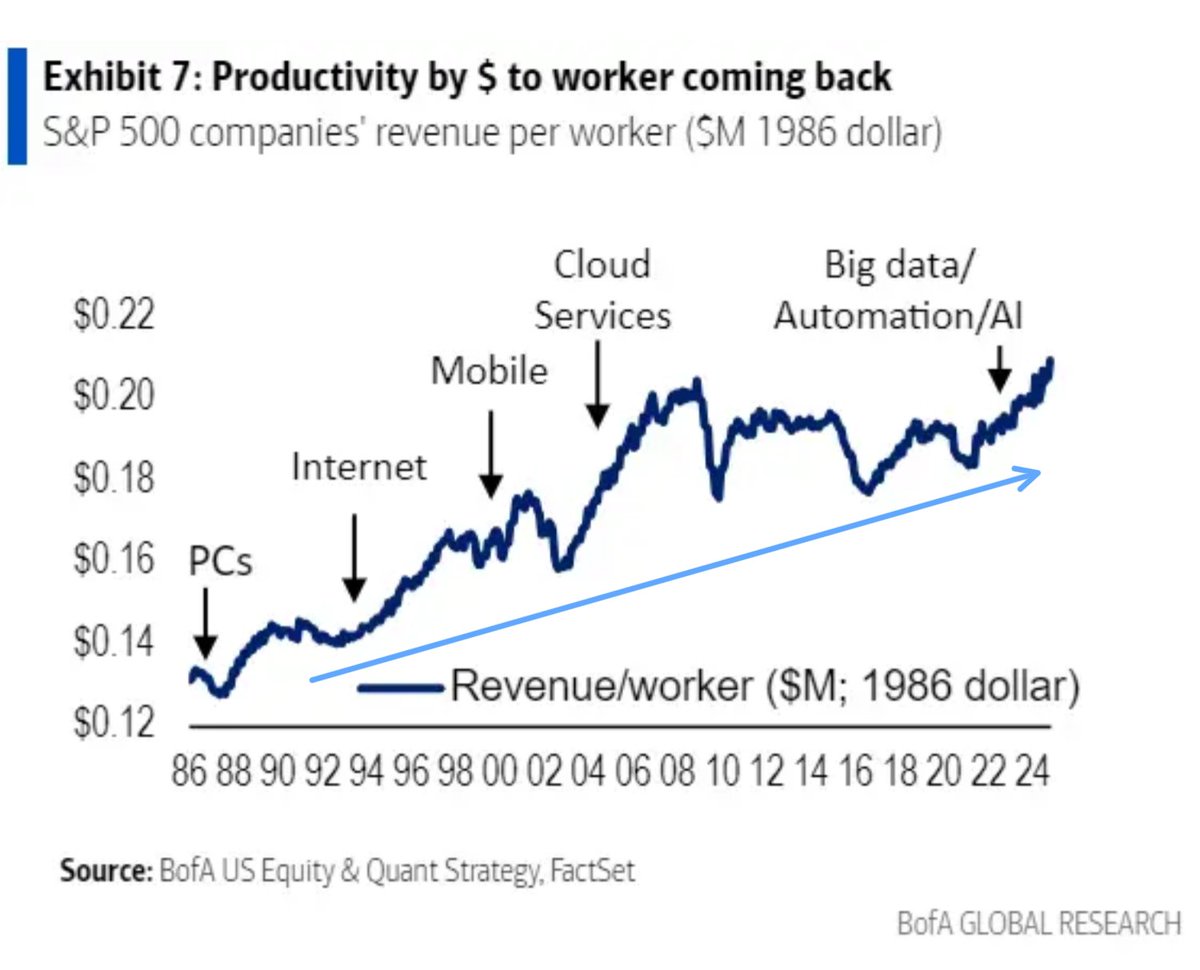
Already seeing this with co's like $CRM that said they won't be hiring any software engineers in 2025 but plan to add 2000-3000 more sales people to help educate customers on their AI agent platform. Creating new jobs, but skewed away from expensive software engineers to sales commission-based employees
I was just looking at the Revenue Per Employee for S&P 500 companies by sector and was surprised to see the technology sector towards the bottom...
Any thoughts on why that may be? @eugeneng
$SPY $SPX $XLK
Absolutely. And SaaS company's are prime candidates for disruption. AI will makes expensive coders more productive, so SaaS companies will be able to do more with a lot less expensive software engineer salaries. so the best at implementing AI will see higher rev per employee, which will also translate to the bottom line
@eugeneng I've been researching rev per employee as a metric for effective AI adoption, especially co's using AI to automate tasks in the service industry - a $5 trillion opportunity according to 8VC. Shameless plug if you're interested https://t.co/yLSurljDmr
@eugeneng Great point. I understand why energy and real estate would have higher rev per employee. I was just surprised to see tech so low on the totem pole. Splitting it up by B2B/ B2C makes a big difference. Thanks for sharing