I’m pleased to announce the publication of my new book, “Event Horizon Strategy: Enhance Careers, Create Business Value, and Avoid Industry Disruption with Generative AI.” This book is about how organizations can navigate an era of dramatic technological acceleration by AI without being overwhelmed by it. AI’s impact is like a black hole—a singularity with a strong gravitational pull, beyond which it is difficult to predict the outcome. Generative AI is reshaping competitive landscapes, organizational capabilities, and the very nature of work. The central question that Event Horizon Strategy answers is how to prepare for this profound uncertainty without either halting progress or rushing forward recklessly.
Event Horizon Strategy is intended for practitioners – executives, managers, frontline employees, engineers, entrepreneurs, and investors – who are grappling with where to invest their attention and resources. It provides a strategic framework for understanding when to delay, when to commit, and when to selectively experiment with emergent AI capabilities.
The book is unique in highlighting best practice use cases for deriving value from AI. It takes an organizational perspective, including across various lenses – individuals seeking to improve their workplace productivity, the functions like HR, finance, sales & marketing, and R&D that are transforming their activity systems, and industry verticals like banking, manufacturing, software development, and retail that are competing with best practices around generative AI adoption.
Rather than prescribing one universal path, the framework emphasizes deliberate, iterative learning—an approach I term “flexible experimentation.” It is my view that those organizations able to navigate uncertainty by thoughtfully adopting and refining their generative AI applications will be better positioned for long-term adaptability and resilience.
In some ways writing a book about AI is a fool’s errand, as AI is changing so fast, so anything you write down may be obsolete soon after you publish it! Still, there are enduring principles and concepts that can guide thinking and decision-making. The book attempts to distill the core strategic patterns, highlight best practice use cases, and provide a language through which we can debate and refine our approaches. I plan to update the cases and specific best practices in future editions, ensuring that the foundational frameworks remain useful as the technology advances.
I’m grateful to the many individuals who informed these ideas. Over recent years, I’ve conducted field research at bigtech and startup companies building large language models (LLMs), engaged in discussions with AI executives and engineers, and worked closely with leaders and learners across various industries through my teaching in my Executive Education program “Leading AI and Digital Transformation” and my MBA course “AI Entrepreneurship,” where I have used cases I’ve written on Tesla, OpenAI, and Palantir in my teaching. Their insights, feedback, and sometimes skepticism have sharpened this project. It’s my hope that Event Horizon Strategy will help open further dialogue around how best to navigate a future defined by generative AI, and that it will serve as a resource for those seeking both intellectual rigor and practical guidance.
https://t.co/A6LmJBg8tT
Why did xAI hand over a 220,000-GPU cluster to Anthropic?
The technical backdrop to xAI's decision to hand Colossus 1 over to Anthropic in its entirety is more interesting than it appears. xAI deployed more than 220,000 NVIDIA GPUs at its Colossus 1 data center in Memphis. Of these, roughly 150,000 are estimated to be H100s, 50,000 H200s, and 20,000 GB200s. In other words, three different generations of silicon are mixed together inside a single cluster — a "heterogeneous architecture."
For distributed training, however, this configuration is close to a disaster, according to engineers familiar with the setup. In distributed training, 100,000 GPUs must finish a single step simultaneously before the cluster can advance to the next one. Even if the GB200s finish their computation first, the remaining 99,999 chips have to wait for the slower H100s — or for any GPU that has hit a stack-related snag — to catch up. This is known as the straggler effect. The 11% GPU utilization rate (MFU: the share of theoretical FLOPs actually realized) at xAI recently reported by The Information can be read as the numerical fallout of this problem. It stands in stark contrast to the 40%-plus MFU figures achieved by Meta and Google.
The problem runs deeper still. As discussed earlier, NVIDIA's NCCL has traditionally been optimized for a ring topology. It works beautifully at the 1,000–10,000 GPU scale, but once you push into the 100,000-unit range, the latency of data traversing the ring once around becomes punishingly long. GPUs need to churn through computations rapidly to keep MFU high, but while they sit waiting endlessly for data to arrive over the network fabric, more than half of the silicon falls into idle. Google sidestepped this bottleneck with its own custom topology (Google's OCS: Apollo/Palomar), but xAI, by my read, has not yet reached that stage.
Layer Blackwell's (GB200) "power smoothing" issue on top, and the picture comes into focus. According to Zeeshan Patel, formerly in charge of multimodal pre-training at xAI, Blackwell GPUs draw power so aggressively that the chip itself includes a hardware feature for smoothing power delivery. xAI's existing software stack, however, was optimized for Hopper and does not understand the characteristics of the new hardware; when it imposes irregular loads on the chip, the silicon physically destructs — literally melts. That means the modeling stack must be rewritten from scratch, which in turn means scaling is far harder than most of us imagine.
Pulling all of this together points to a single conclusion. xAI judged that training frontier models on Colossus 1 simply was not efficient enough to be worthwhile. It therefore moved its own training workloads wholesale onto Colossus 2, built as a 100% Blackwell homogeneous cluster. Colossus 1, on the other hand — whose mixed architecture is far less crippling for inference, which parallelizes more forgivingly — was leased in its entirety to an Anthropic that desperately needed inference capacity.
Many observers point to what looks like a contradiction: Elon Musk poured enormous capital into building Colossus, only to hand the core asset over to a direct competitor in Anthropic. Others read it as xAI capitulating because it is a "middling frontier lab." But these are surface-level reads.
Look at the numbers and a different picture emerges. xAI today holds roughly 550,000+ GPUs in total (on an H100-equivalent performance basis), and Colossus 1 (220,000 units) accounts for only about 40% of the total available capacity. Colossus 2 — built entirely on Blackwell — is already operational and continuing to expand. Elon kept the all-Blackwell homogeneous cluster (Colossus 2) for himself and leased out the older, mixed-generation Colossus 1. In other words, he handed the pain of rewriting the stack — the MFU-11% debacle — to Anthropic, while keeping his own focus on training the next generation of models.
The real point, then, is this. Elon's objective appears to be positioning ahead of the SpaceXAI IPO at a $1.75 trillion valuation, currently floated for as early as June. The narrative SpaceXAI now needs is that xAI — long the "sore finger" — is not merely a research lab burning cash, but a business with a "neo-cloud" model in the mold of AWS, capable of leasing surplus assets at high yields.
From a cost-of-capital perspective, an "AGI cash incinerator" is far less attractive to investors than a "data-center landlord generating cash."
As noted above, the most important detail of the Colossus 1 lease is that it is for inference, not training. Unlike training, inference requires far less tightly synchronized inter-GPU communication. Even when the chips are heterogeneous, the workload parcels out cleanly across them in parallel. The straggler effect — the chief weakness of a mixed cluster — is essentially neutralized for inference workloads.
Furthermore, with Anthropic occupying all 220,000 GPUs as a single tenant, the network-switch jitter (unanticipated latency) that arises under multi-tenancy disappears. The two sides' technical weaknesses end up complementing each other almost exactly.
One insight follows. As a training cluster mixing H100/H200/GB200, Colossus 1 was an asset that could only deliver an MFU of 11%. The moment it was handed over to a single inference customer, however, that asset transformed into a cash-flow asset rented out at roughly $2.60 per GPU-hour (a weighted average of the lease rates across GPU types). For xAI, what was a "cluster from hell" for training has become a "golden goose" minting $5–6 billion in annual revenue when redeployed for inference. Elon's genius, I would argue, lies not in the model but in this asset-rotation structure.
The weight of that $6 billion becomes clearer when set against xAI's income statement. Annualizing xAI's 1Q26 net loss yields roughly $6 billion in losses per year. The $5–6 billion in annual revenue generated by leasing Colossus 1 to Anthropic, in other words, almost perfectly hedges xAI's loss figure. This single deal effectively pulls xAI to break-even.
Heading into the SpaceXAI IPO, this functions as a core line of financial defense. From a cost-of-capital standpoint, if the image shifts from "research lab burning cash" to "infrastructure tollgate stably printing $6 billion a year," the entire tone of the offering can change.
(May 8, 2026, Mirae Asset Securities)
The past year has been the happiest period of my life.
Genesis is a place of miracles.
We set countless ambitious goals.
None of them seemed possible with existing technology.
One by one, we made them real.
The density of breakthroughs coming from such a small team, across so many directions at once, feels almost rare in human history.
What you see here is fully autonomous, 1x speed, run on the exact same model.
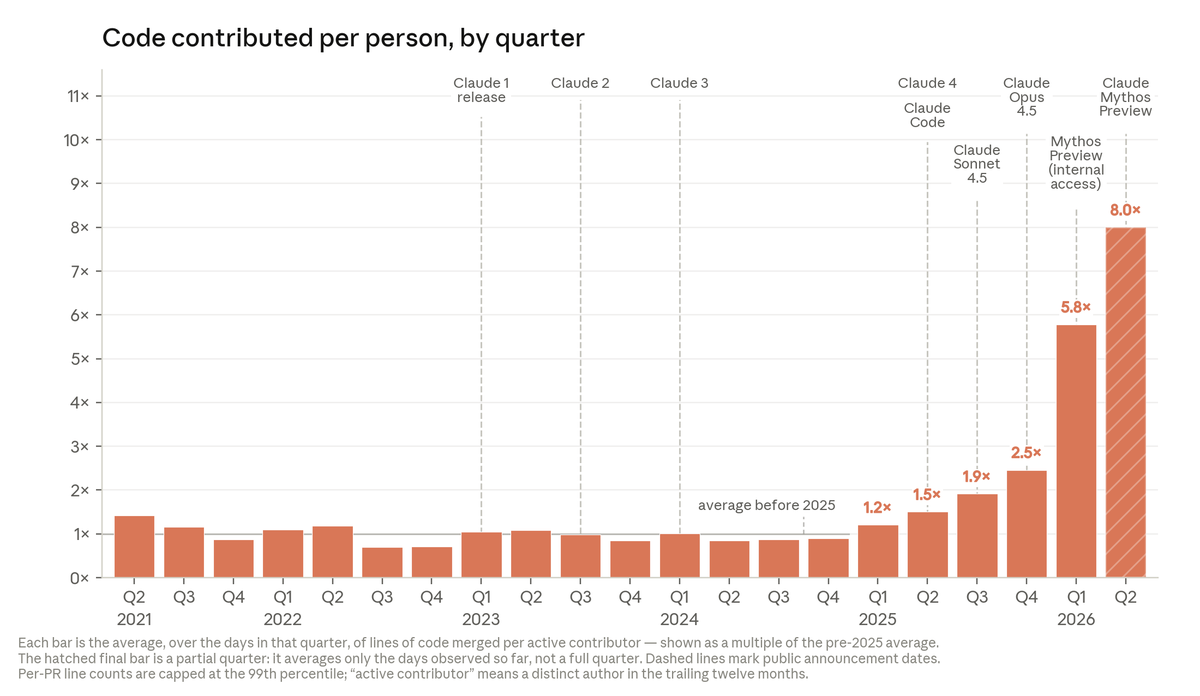
shoutout to kurzweil who was doing “straight lines on graphs” before it was cool and managed to predict the timeline to certain ai capabilities extraordinarily well
this is excellent
>GitLab founder diagnosed with rare cancer (osteosarcoma)
>standard care works but cancer comes back later
>medical team says there's not much else to do
>"It became my own job to keep myself alive. Nobody else was going to do it for me at this point"
>starts researching, assembles his own medical team, uses AI for deep research
>“I’ll talk to anyone, I’ll go anywhere, and I can be there anytime" to collect information
>does as many diagnostic tests as he can find as often as he can (maximal diagnostics)
>develops his own therapeutic ladder with repurposed drugs, personalized medicine, etc
>Sid’s cancer currently in remission
After building their AI Apps, the MBAs in my AI Entrepreneurship elective at INSEAD stepped it up again with their AI Agents 🤖
Great use of tools like Telegram/WhatsApp bots, browser automation (Selenium), GitHub integrations, and AI coding agents across the stack.
Their agents tackled real-world problems such as: a trip planner that autonomously polls group preferences and coordinates itineraries for seamless planning; a rental agent that monitors listings, evaluates options, and even contacts agents; a job search agent automating discovery, evaluation, and applications; a CV customization agent that tailors resumes and applies via LinkedIn workflows; an automated social media agent for a health/wellness platform; and a Chrome extension for personal knowledge management and synthesis.
Awesome to see deeper agentic workflows layered on top of their apps, congrats to the teams on some impressive builds! It was great to have you in class :)
Some very interesting apps developed by the students in my “AI Entrepreneurship” INSEAD MBA class today!
This year’s apps include an AI powered personal stylist, social trip planner, wellness coaching app for the overwhelmed, body care guide, banking credit evaluation took, and a cross-language strategic insight engine about companies. Some use of Replit, Lovable, and Vercel, but a lot more adoption of AI coding agents in the cli like Claude Code and Codex. Congrats folks on some nice apps. :)
I cannot wait until the White House changes hands and all of you ghouls switch back from "you're a traitor unless you bootlick so hard your tongue goes numb" to "the government asking any questions about my offshore fentanyl casino is vile tyranny and I will throw myself in the San Francisco Bay in protest", like werewolves at the last ray of the setting moon.
Tech world finding out about complementary asset strategies in real time… bottleneck owners will take their cut… but there is a reason Amazon, Google and others are not just resting on their Cloud laurels… usually growth demands that you play in the part of the value chain with innovation.
This was the Standard Oil play from Rockefeller.
He realized early all the risk was in finding/drilling oil so he just refined it and sold it as safer and standardized.
He dumped the risk onto everyone else and didn't care who won because he was the distributor not the one taking the risk.
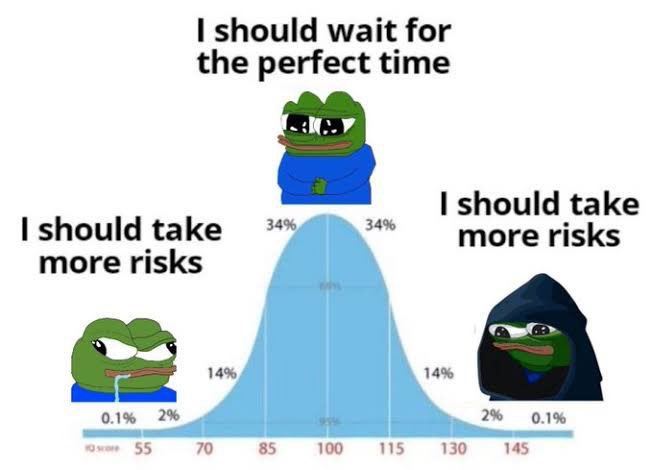
I realised as I listened to this brilliant answer that we end-users are all asking a similar question:
How much AI do I buy today vs tomorrow?
Do we just YOLO it and risk going bankrupt if our timelines are off by a year? ;)
Dwarkesh asks Dario a fantastic question relating to how he is so bullish on AGI yet so conservative on data center build out - Dario has an amazing take on this:
Dario Amodei details the staggering financial risk of the AI race, explaining that if growth continues at 10x a year, a company could be looking at a $1 trillion revenue run rate by the end of 2027. He notes that to support this, a firm might buy $5 trillion worth of compute.
However, he highlights a "ruinous" dilemma: if that revenue is even slightly lower than projected. specifically if it comes in at $800 billion instead of $1 trillion the company would collapse. He explains that if you are off by just a year or if the growth rate drops to 5x, "there's no force on earth, there's no hedge on earth, that could stop me from going bankrupt" after committing to that level of spend.
Because of this, Amodei argues that "behaving responsibly" means not just "yoloing" hundreds of billions of dollars. He suggests that some competitors may not have "written down the spreadsheet" and don't fully grasp the existential risks they are taking with these massive, unhedged bets on infrastructure.
This is a great catch by Matt Levine.
KPMG is trying to force its auditor to accept less money, since accounting work can be significantly automated by AI.
But KMPG ... makes money ... from accounting. So this looks like a company accidentally announcing to the world that its business model is under attack.
Matt: "'Auditing can basically be done by Al so why should we pay for it?' is not a crazy thing for most companies to think, or to say to their auditors. But it is a crazy thing for an auditing firm to say to its auditor."