You Held $AMD for years.
It performed well. Really well.
But selling means a big tax bill. And holding means that capital just sits there while the market takes leaps and bounces.
There is a third option where you create income from your appreciated stock.
Here is how it works. 🧵
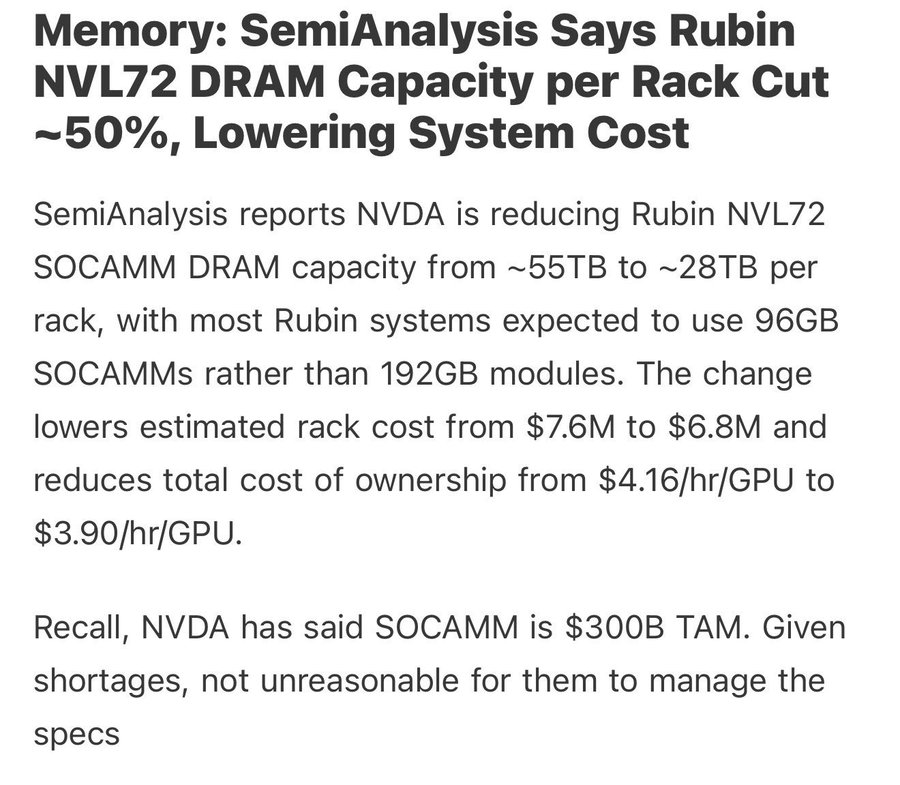
Especially to mention semis taking everything down, one of the nuances was the trigger in SemiAnalysis saying NVIDIA's next gen Vera Rubin rack will ship with roughly half the expected CPU side memory.
Korean memory stocks dumped overnight. Micron crashed 10% from its all time high, wiping out over $100 billion in market cap in a single session.
Did a small deepdive here:
https://t.co/DwxXJ0yCnA
FULL BREAKDOWN on why Memory stocks are in crash state:
SemiAnalysis published a report recently saying NVIDIA's Vera Rubin NVL72 rack will likely ship with 28TB of CPU side memory instead of the expected 55TB.
That is nearly half.
Korean memory stocks dumped overnight. Micron crashed 10% from its all time high, losing over $100 billion in market cap in a single day.
Sounds terrible right?
Except the market completely misread what actually happened.
The memory on Vera Rubin uses modular SOCAMM slots. It is not soldered.
You can pull out a 96GB module and drop in a 192GB or 256GB module anytime.
NVIDIA showed at CES that the entire compute tray swaps in 5 minutes. It is a starting config with a built in upgrade path.
The reason for lower initial configs is supply, not demand.
Micron said last week at the Wolfe conference that LPDDR5X demand significantly exceeds supply well beyond 2026.
Their entire HBM capacity for fiscal 2026 is sold out. Samsung and SK Hynix are maxed out too. NVIDIA is not cutting memory because nobody wants it.
They are shipping what they can get their hands on so racks go live faster.
Less memory per rack also means more racks ship under the same supply.
Total memory consumption stays the same. It just gets spread across more units.
Now add Broadcom reporting the same morning. Revenue up 48%, beat on EPS, but the CEO did not raise full year AI guidance.
Market read that as AI spending cooling off. AVGO dropped 15% and took the entire sector down with it.
Two unrelated catalysts hit at the exact same time. Broadcom shook AI sentiment across the board. SemiAnalysis gave traders a specific number to panic about on memory.
For a stock sitting at all time highs in 12 months, that is all the excuse anyone needs to take profits.
NVDA, AVGO and the broader semi names are not structurally impacted here.
The demand picture has not changed. Memory is a different story though.
Not because the fundamentals broke, but because it was priced for perfection with zero room for any headline risk. And it just got two in one morning.
Dylan Patel from SemiAnalysis put it perfectly. People who shared his report left out most of the content.
The nuance got stripped, the context disappeared, and the market traded off a headline.
The most expensive mistake in semis is not getting the direction wrong. It is reading the right headline and plugging in the wrong formula.
Follow @ProflexFinance for more breakdowns on macro, markets and beyond!
@Barchart Semis doing the heavy-lifting in taking things down, SemiAnalysis said NVIDIA's next gen Rubin rack is cutting memory in half. Korean markets dumped overnight. Micron lost $100 billion in a single day from its all time high.
We did a complete deepdive:
https://t.co/pzAEH2SoKr
FULL BREAKDOWN on why Semis are crashing today:
SemiAnalysis published a report recently saying NVIDIA's Vera Rubin NVL72 rack will likely ship with 28TB of CPU side memory instead of the expected 55TB.
That is nearly half.
Korean memory stocks dumped overnight. Micron crashed 10% from its all time high, losing over $100 billion in market cap in a single day.
Sounds terrible right?
Except the market completely misread what actually happened.
The memory on Vera Rubin uses modular SOCAMM slots. It is not soldered.
You can pull out a 96GB module and drop in a 192GB or 256GB module anytime.
NVIDIA showed at CES that the entire compute tray swaps in 5 minutes. It is a starting config with a built in upgrade path.
The reason for lower initial configs is supply, not demand.
Micron said last week at the Wolfe conference that LPDDR5X demand significantly exceeds supply well beyond 2026.
Their entire HBM capacity for fiscal 2026 is sold out. Samsung and SK Hynix are maxed out too. NVIDIA is not cutting memory because nobody wants it.
They are shipping what they can get their hands on so racks go live faster.
Less memory per rack also means more racks ship under the same supply.
Total memory consumption stays the same. It just gets spread across more units.
Now add Broadcom reporting the same morning. Revenue up 48%, beat on EPS, but the CEO did not raise full year AI guidance.
Market read that as AI spending cooling off. AVGO dropped 15% and took the entire sector down with it.
Two unrelated catalysts hit at the exact same time. Broadcom shook AI sentiment across the board. SemiAnalysis gave traders a specific number to panic about on memory.
For a stock sitting at all time highs in 12 months, that is all the excuse anyone needs to take profits.
NVDA, AVGO and the broader semi names are not structurally impacted here.
The demand picture has not changed. Memory is a different story though.
Not because the fundamentals broke, but because it was priced for perfection with zero room for any headline risk. And it just got two in one morning.
Dylan Patel from SemiAnalysis put it perfectly. People who shared his report left out most of the content.
The nuance got stripped, the context disappeared, and the market traded off a headline.
The most expensive mistake in semis is not getting the direction wrong. It is reading the right headline and plugging in the wrong formula.
Follow @ProflexFinance for more breakdowns on macro, markets and beyond!
What's moving the markets?
* Markets are selling off on a blowout jobs print & sector rotation: May payrolls came in at 172,000 against an 85,000 consensus, with Yields jumping to 4.54% on the 10-year as rate-hike odds surged to 60% before year-end under incoming Chair Kevin Warsh.
* The yield spike hit semiconductors hardest after a strong run with tech falling for a third straight session as Broadcom's margin miss compounds the selling pressure and rotation into defensives accelerates.
* US-Iran peace talks remain deadlocked into the weekend, keeping geopolitical risk priced in with Brent at $93, while S&P Global confirmed SpaceX will not receive fast-track S&P 500 entry post-IPO.
@GlobalMktObserv Most of the extreme-pessimism signs are suggesting that this is the last leg of capitulation. We did a breakdown on what one of the top digital asset desks has to say about bitcoin bottoming.
https://t.co/fwPdxi1aT0
Bitcoin just dropped 20% in 9 days.
Your timeline is full of "it's over" takes.
Meanwhile Standard Chartered's head of digital assets just published a note called "The Low Is Almost In."
Here's what he's seeing that most people are missing 🧵
@KobeissiLetter Most of the extreme-pessimism signs are suggesting that this is the last leg of capitulation. We did a breakdown on what one of the top digital asset desks has to say about bitcoin bottoming.
https://t.co/fwPdxi1aT0
Bitcoin just dropped 20% in 9 days.
Your timeline is full of "it's over" takes.
Meanwhile Standard Chartered's head of digital assets just published a note called "The Low Is Almost In."
Here's what he's seeing that most people are missing 🧵
@BitcoinMagazine@BitcoinMagPro Most of the extreme-pessimism signs are suggesting that this is the last leg of capitulation. We did a breakdown on what one of the top digital asset desks has to say about bitcoin bottoming.
https://t.co/fwPdxi1aT0
Bitcoin just dropped 20% in 9 days.
Your timeline is full of "it's over" takes.
Meanwhile Standard Chartered's head of digital assets just published a note called "The Low Is Almost In."
Here's what he's seeing that most people are missing 🧵
@CoinDesk Most of the extreme-pessimism signs are suggesting that this is the last leg of capitulation. We did a breakdown on what one of the top digital asset desks has to say about bitcoin bottoming.
https://t.co/fwPdxi1aT0
Bitcoin just dropped 20% in 9 days.
Your timeline is full of "it's over" takes.
Meanwhile Standard Chartered's head of digital assets just published a note called "The Low Is Almost In."
Here's what he's seeing that most people are missing 🧵
But here's the part nobody wants to hear:
He's not saying go all-in right now.
"There are a lot of ifs: accumulation is a better strategy than trying to outright declare the low has been printed."
Translation: don't try to be a hero calling the exact bottom.
Just keep buying while everyone else is too scared to.
The people who win aren't the ones who timed it perfect.
They're the ones who showed up when it hurt.
Follow @ProflexFinance for more breakdowns like this!
Bitcoin just dropped 20% in 9 days.
Your timeline is full of "it's over" takes.
Meanwhile Standard Chartered's head of digital assets just published a note called "The Low Is Almost In."
Here's what he's seeing that most people are missing 🧵
His exact words:
"When we look back at the end of 2026 with BTC at 100,000 and ETH at 4,000: we will say this was the buying zone we all wanted."
Not "could be." Not "might be."
He said we will look back and say this was it.
Same guy compared ETH right now to Amazon during the dot-com bust. Let that sit.
What's moving the markets?
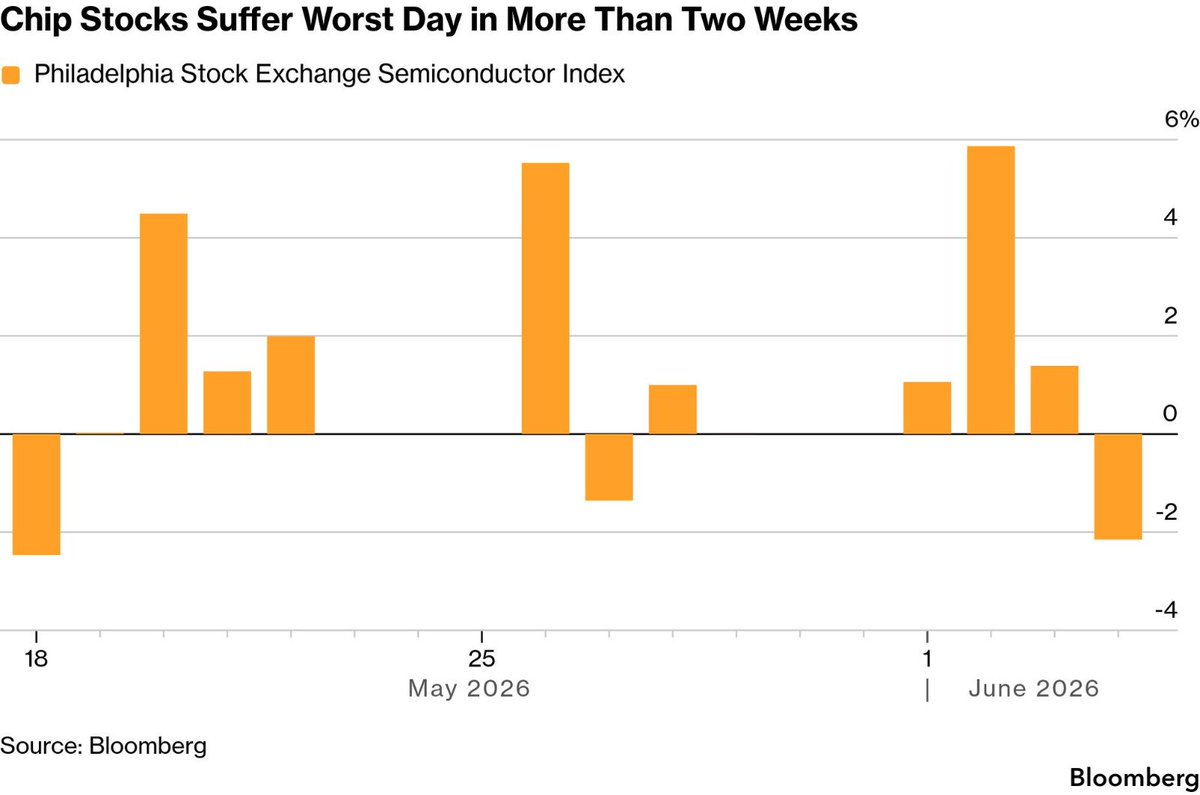
* The Dow is surging ~900 points while the S&P 500 holds near flat as a sharp sector rotation out of tech into defensives, healthcare, and retail (chart) dominates today's tape, with chip-stock weakness dragging the Nasdaq down ~0.76%.
* Iran remains the key macro overhang with Trump saying a nuclear deal could come "this weekend" while Tehran says there's been no significant progress, keeping oil elevated and the 10-year yield sticky near 4.4%.
* Friday's May payrolls print is the next big catalyst with consensus at a historically soft 85K jobs, down from 115K in April, and markets watching closely for any signal that shifts the Fed's rate path heading into the June 16-17 meeting.
What's moving the markets?
* U.S. indices are pulling back as investors digest a fresh round of escalation with Iran launching missile and drone strikes at Kuwait and Bahrain overnight, and the U.S. responding with strikes on an Iranian ground control station near the Strait of Hormuz.
- Brent crude has jumped back toward $98 a barrel on the news, pushing the 10-year Treasury yield up to 4.49%, and markets are now pricing in a 60% probability of a Fed rate hike by December as inflation remains sticky. (Chart)
* Crypto is in capitulation mode as Bitcoin dropped to $65-66k levels, its lowest level in three months, after spot ETFs recorded 11 consecutive days of net outflows totaling over $3.5 billion with The Fear and Greed Index sitting at 11, deep in Extreme Fear territory.
@DeItaone The real question remains to be if the market correctly priced the shift from high-growth innovators to capital-hungry infrastructure utilities or not.
We did a small deep-dive on complete current situation from Mag7 lens, hope it helps: https://t.co/e0Vn9UGdZJ
The Magnificent Seven are trading at a 10-year relative P/E low.
Wall Street calls it a generational buying opportunity.
The business model that earned that premium has changed.
Earnings are growing, but free cash flow isn't keeping up.
Buybacks are drying up.
Capex is eating everything.
5 of 7 Mag 7 names are trading below their 5, 10, and 20-day moving averages while the broader index pushes higher.
The valuation looks cheap — until you look at what you're buying today 🧵
@KobeissiLetter The real question remains to be if the market correctly priced the shift from high-growth innovators to capital-hungry infrastructure utilities or not.
We did a small deep-dive on complete current situation of Mag7, hope it helps: https://t.co/e0Vn9UGdZJ
The Magnificent Seven are trading at a 10-year relative P/E low.
Wall Street calls it a generational buying opportunity.
The business model that earned that premium has changed.
Earnings are growing, but free cash flow isn't keeping up.
Buybacks are drying up.
Capex is eating everything.
5 of 7 Mag 7 names are trading below their 5, 10, and 20-day moving averages while the broader index pushes higher.
The valuation looks cheap — until you look at what you're buying today 🧵