Professeur - Droit européen - Droit économique - concurrence - régulation - UEM - Bien-être des animaux - M2 Droit européen du marché et de la régulation
I am delighted that the @EUCouncil has supported the nomination of @LaurenceBoone and @MarkusEconomist to the ECB's Executive Board.
Congratulations to both of them. If confirmed, I am confident that their experience and expertise would make a valuable contribution to the Board.
#CJUE#AG Medina : la Cour devrait rejeter les pourvois contre les arrêts du #TribunalUE confirmant l’interdiction de fournir des services de conseil juridique au gouvernement russe et aux entités établies en #Russie#SanctionsUE 👉 https://t.co/7DLZ35sP9w
#CJUE : Certaines activités des sociétés du groupe @Amazon Italia pourraient être considérées comme des services postaux et nécessiter une autorisation 👉 https://t.co/r58a1yflPb
We have signed an agreement for Sweden to join T2, the Eurosystem’s real-time gross settlement system.
This agreement builds on our partnership with Sveriges Riksbank and our joint commitment to safe and efficient payments.
Read the press release link https://t.co/lkJn4jO8z8
Highly relevant!
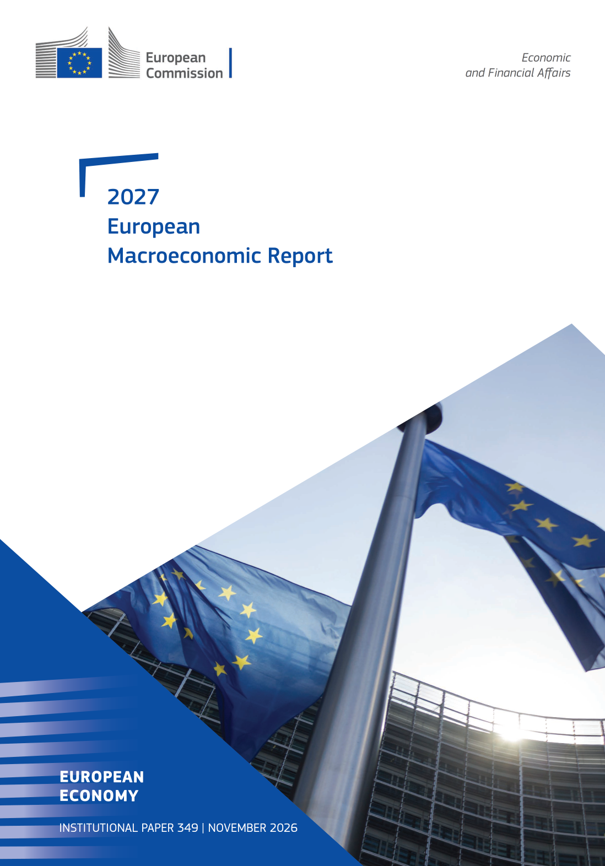
"2027 European Macroeconomic Report" (European Commission)
"The World and European economies are facing a number of major shocks...However, in recent years, the EU economy has proved resilient to successive shocks. The damaging impact of these events (in 2020 with the pandemic; in 2022 with Russia’s aggression against Ukraine and the rise in energy prices, in 2025 with the change in US trade policies), was smaller than expected on each occasion...Yet resilience has not translated into dynamism. Productivity growth has slowed, and the EU’s share of world GDP fell from around 18% to less than 14% between 2010 and 2026. This is not for lack of means for investment: the EU generates enough annual savings to finance its ambitions. But in many cases, those savings were channelled abroad rather than invested in European industries. The growing financial investment overseas and the increasing exposure to US financial assets point to the untapped potential of deeper, more integrated European capital markets, while persistent macroeconomic imbalances call for timely action. To examine these challenges and the policy responses they call for, the report is divided into four chapters. The first two cover the macro-structural landscape, and imbalances and vulnerabilities, while the two thematic chapters examine global financial flows and the AI’s macroeconomic impact."
https://t.co/rVGC8pV7w2
Very valuable!
"Geoeconomics and International Legal (Dis)Order," edited by Dan Hanqvist and Jens Hillebrand Pohl (available in April 2027).
The book can be preordered here:
https://t.co/vIxxB7rLys
"Economic interdependence creates leverage where trade routes, financial networks, technologies and legal authority converge. Geoeconomics and International Legal (Dis)Order examines how law shapes that leverage and how governments, regulators and firms respond when familiar channels of commerce become contested. The chapters address Greenland’s Arctic power struggle, economic coercion, China’s party-led order, investment screening for chips and AI, and the supervision of crypto-assets. They examine payment systems and distributed ledgers, special economic zones, the human costs of corporate lawfare, the European Union's trade autonomy and research security in the AUKUS states. Across these cases, the volume asks how legal rules distribute power, when institutions can reduce vulnerability, and how attempts to secure one actor may shift risks onto others. It brings international legal and policy analysis to scholars, policymakers, legal advisers and practitioners working on economic security and geoeconomics.
The book can be preordered here:
https://t.co/vIxxB7rLys
------------------------------
In our activities, we place special emphasis on the topic of "Critical Minerals, Climate Change, and Geoeconomics." High-quality research and policy papers, podcasts, and other relevant content are featured across our channels. In addition to our own selections, we encourage you to submit your contributions via this form:
https://t.co/AMTk0y5d2L
On 26-27 November, EU leaders will meet in Brussels to discuss:
▫️my proposal for the next long-term EU budget (MFF)
▫️Ukraine’s financing needs for 2027
▫️the renewal of the ECB leadership
My invitation letter ↓
https://t.co/0vrX3UTalh
À @AssasUniv, lors de la conférence Italia France Future célébrant les 5 ans du Traité du Quirinal. Échange avec notre Min Conseiller Franco Impalà et le Chef de mission pour l’Europe méditerranéenne @francediplo Antoine Starcky, sur l’amitié et le renforcement des relations 🇮🇹🇫🇷
Grand merci à Mickaël Lavaine pour l’envoi de son bel ouvrage, fruit d’une HDR dont je garde un excellent souvenir. Très belle idée que d’avoir proposé ce travail à un éditeur !
Un signal encourageant pour la liberté de la presse en Serbie. L’autorité de la concurrence a suspendu vendredi son feu vert au rachat d’Adria News Network, qui détient notamment N1, Nova, Danas et Radar, et relancé son examen du dossier.
Le 19 octobre, nous avions alerté, avec @sandrogozi et @VPrebilic, la Commission européenne, les autorités luxembourgeoises et le Conseil européen des services médiatiques sur les risques pour l’indépendance de ces médias.
Cette nouvelle décision montre que ces inquiétudes étaient fondées. Le dossier reste sous surveillance et le changement de contr��le n’a toujours pas reçu le feu vert du Luxembourg.
Nous resterons vigilants. La propriété des médias doit être transparente et l’indépendance des journalistes protégée par des garanties concrètes. En Serbie comme partout en Europe, la démocratie ne peut exister sans une presse libre, à l’abri des pressions politiques.
Great books of 2026: Thought-provoking, perhaps controversial, and certainly worth reading!
"The Unanchored Central Banker: Demography, Fiscal Instability, and an Erosion of the Central Bank's Inflation-Fighting Ability" by Manoj Pradhan and Charles Goodhart.
https://t.co/oUG7kKLfPV
"Through little fault of their own, central banks face an erosion of their ability to fight inflation single-mindedly as they have done in the past...Manoj Pradhan and Charles Goodhart argue that real interest rates will rise because increasingly ageing societies will create a persistent and still-underappreciated deterioration in the government’s fiscal position. Could AI offset demographic headwinds? Possibly, but AI is unlike technological shocks of the past, and history suggests innovations tend to lead to net gains in employment, especially in the medium term. Similarly, China could generate uncertain near-term effects, but is unlikely to be a disinflationary force in the medium term. The net outcome for monetary policy is not encouraging. Fighting inflation in highly indebted economies can lead to financial instability in the near term, or (ironically) more inflation in the future. The glory days of central banks, the authors argue, may be behind us."
https://t.co/oUG7kKLfPV
Sur la règle d’or (ou l’interprétation qu’en ont Le Pen ou Macron) et l’idée d’un referendum. Premieres réactions.
Pourquoi ne pas commencer par respecter les règles budgétaires mises en place par l’Union Européenne ? 😊 Ce serait un bon début. Ce serait même largement suffisant.
Et il y a plein a apprendre de l’histoire de ces règles. Lesson essentielle : La simplicité est l’ennemi de la flexibilité.
Les premieres règles Européennes, mises en place avec le Traité de Maastricht, étaient toute simples. Deux chiffres, 60% pour la dette, 3% pour le deficit.
Quand le temps s’est dégradé, les règles se sont révélées trop rigides et contre-productives. Elles ont été d’abord violées, et puis abandonnées.
Les nouvelles règles, mises en place en 2024, sont complexes. Elles ne sont pas parfaites, mais elles essaient de prendre en compte la complexité de toute situation économique. C’est ce qui fait leur complexité.
Je vois le danger d’un referendum. Soit la proposition est simple, et la règle est dangereuse. Soit elle est complexe, et il est impossible pour l’électeur moyen de la comprendre.
La solution est autre part. Donner plus de moyens et de pouvoir au Haut Conseil des Finances Publiques. Et si les choses vont mal, une loi exceptionelle, et temporaire. Ce sera le sujet d’un autre tweet.
After 10 years of negotiations, we did it, @prabowo!
We have signed the EU-Indonesia Comprehensive Economic Partnership Agreement.
One of the most ambitious deals the EU has concluded in Asia, connecting 730 million people.
Terima kasih 🇪🇺🇮🇩
https://t.co/DyehIS9m7N
Kelsen, H. (2026). Constitutional democracy and political philosophy: Selected writings (L. Vinx & D. Ragazzoni, Eds.). Oxford University Press.
https://t.co/4SBePzbsuN
1920~1937年の民主主義、自由と平等、議会、政党、比例代表、ファシズム・共産主義批判に関する9篇英訳。
https://t.co/mGFSv8IAw3
La proposition du MFF 2028-2034 de la @EU_Commission est déjà plus faible que le budget pluriannuel européen en cours.
Les coupes proposées par @EUCouncil aujourd’hui sont dommageable pour l’ambition européenne 🇪🇺
Nous ne pouvons sacrifier notre autonomie stratégique en coupant le volet sécurité et résilience du fonds de compétitivité, alors que la protection des citoyens en dépend.