"The West’s precious, almost unique, achievement has been the limitation of state power. Since Magna Carta in 1215, the West gradually placed constraints on rulers — through rights for citizens, independent courts, a sovereign church and the sanctity of private property." 1/
Reminds me of what one of the law firm partners I worked for many years ago, said:
“the main value of law school is making new lawyers three years older”:
This won't be popular with my fellow law school professors (or many lawyers), but the best possible outcome of the turmoil with ABA accreditation of law schools would be for states to allow undergraduate law degrees to suffice for admission to the bar. Universities could establish undergraduate law departments and students could combine the 7 years of education into 4. An internship would probably be required for admission to the bar after the undergraduate degree.
This would align us with much of the rest of the world. The JD would remain as an optional graduate degree credential. If it has value, people will pay for it. If it doesn't, then they won't. There's just no need to have a separate undergraduate major in political science or French or whatever before beginning legal training.
‘International #Arbitration Agreements in #Insolvency: Seeking a Happy Medium’ My latest article benefited from discussion at INSOL Europe & INSOL International conferences and from thoughtful comments by Eugenio Vaccari Robert Lawless & Laura Coordes
https://t.co/aTFdA42BH1
This is a bad policy. Lots of people are calling it unenforceable. They're almost right, but that's not the real issue. It's a bad policy because it's bad pedagogy.
First, a prediction: Berkeley walks this back within three years. If you disagree, be brave enough to stake your position now.
On enforceability. Technically it's enforceable, in the same way prohibitions on apostasy are enforceable: you collect testimony and you punish people. Detection here hinges on the professor's gut. Too many em dashes? F. You don't have the occasional typo? Sus!
The pro-enforcement camp implicitly assumes professors possess some innate AI-detection power. They don't. The result is a regime saturated with Type 1 and Type 2 errors. oh, and if you mess up your bluebooking? a citation to a non-existent source automatically "raise[s] a presumption of prohibited AI use."
But I care more about the pedagogy. Tucked into the rule is a prohibition on uploading "course materials, including assignments, readings, slides, class recordings, or other class content" into generative AI systems. That means a Berkeley student can't ask ChatGPT to quiz them before an exam. Can't ask it to explain voir dire at a tractable level. Can't use it as a patient, infinite, on-demand tutor on the vagaries of the rule against perpetuities
These are extraordinary tools, and we're building more of them (wait for it). Students at competing schools will have them. Berkeley students won't. Beyond the competitive disadvantage, the harder question is this: how do faculty explain that this isn't about protecting professorial IP, real or imagined, but about serving students?
The motte defenders retreat to is this: we need to build Core Competencies(TM), and you can't do that by letting students reach for AI on day one.
The motte's true. But it is vastly narrower than the bailey that the policy creates. The policy rests on the assumption that the core competencies of a 1990 lawyer will remain the core competencies of a 2029 lawyer, that the AI revolution will be no bigger than the move from print reporters to Boolean searching on Westlaw. That's wild! Practice is already changing. If you don't have an agentic swarm running in the background right now, you're behind.
Push defenders on which competencies, exactly, and the answers fall into three buckets. First, skills heading for obsolescence: manual bluebooking, drafting boilerplate from scratch, first-pass document review, summarizing depositions by hand. Second, skills that are real but almost certainly better trained with AI than against it: issue spotting drilled against an infinite supply of hypotheticals, brief feedback in seconds rather than weeks, writing improved through structured iteration with a tireless reader. Third, skills so vague they can't be measured. "Thinking like a lawyer." "Professional judgment." For these we have no way to know whether AI helps or hurts, yet the policy assumes it must hurt.
But it's only a default, right? Well defaults matter, and this one's sticky. Professors have to opt out in writing. Even when they do, students *must* disclose every instance of AI use, which today already implicates using Google. Any ambiguity resolves against the student. The structural message is legible and loud: AI use is presumptively cheating.
That message is wrong about almost everything. It's wrong about the technology, which isn't a shortcut but a new kind of cognitive partner. It's wrong about practice, where AI is already pervasive in the firms students are about to enter. It's wrong about teaching, by suggesting pedagogy needs no innovation in the face of the most powerful educational tool in a generation. And it's wrong about students, by casting those who use AI thoughtfully as people who lack fundamental skills, rather than as the lawyers Berkeley should be proudest to graduate.
The best legal careers of the next decade will belong to lawyers who know when to use AI, when not to, how to verify it, how to weave it into legal reasoning, and how to supervise it in client matters. Policies like this one belong to those who resigned themselves to sit out this future.
In 1985 it took 4.7 years of work for the median worker to purchase the median home. In 2025 it took 6.6 years.
This is an increase, and of course there is geographic variation, but going from 4 to 27 years would be a huge outlier.
Of course, don’t submit anything without checking all the sources. And it’s easier with decades of experience to have a sense of what assertions sound dubious and worth investigating. But seems like even new Law students can benefit from AI as sparring partner.
5/
I’ve found it helpful to ask Chat to analyze a legal issue and then ask Gemini to find the weaknesses in Chat’s work and then ask Chat to respond to Gemini’s challenges, and so forth. Claude seems particularly good.
4/
Wow. Surprised at the breadth of this AI BAN at @BerkeleyLaw.
Higher education—particularly professional schools—should develop AI tools to accelerate learning. Cognitive offloading is a real problem, but mounting evidence shows that the thoughtful redesign of courses and offering personalized AI tools can level the playing field and accelerate learning.
The Berkeley Law policy BANS AI for EVERYTHING except identifying sources.
Brainstorming with AI - BANNED
AI for exam outlining - BANNED
AI grammar check - BANNED
AI translation - BANNED
Difficult to understand the rationale for banning grammar check and translation, which will disproportionately (and unnecessarily) harm first-generation students and nonnative speakers of English.
Faculty may opt out of the Berkeley Law policy, but faculty must then require that students disclose AI use.
The Berkeley Law policy BANS students from uploading course materials into generative AI systems. Sadly, this BANS some of the most useful ways in which law students are using AI tools, including to generate additional practice problems and exams for courses.
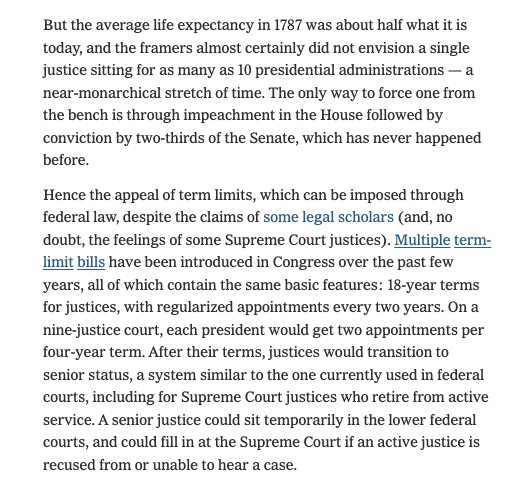
Re the NYT essay below on 18-year terms for Supreme Court Justices, I have two thoughts.
First, the "Framers couldn't have foreseen this" gets the point wrong. I don't think we have reason to believe the Framers couldn't have foreseen a Justice staying on the court for many decades. As far as I can tell, no one flipped out when Chief Justice Marshall was on the Court for over 34 years, from 1801 to 1835. What the Founders couldn't have foreseen is that the Court would be as powerful as it has become in the modern era. That's the problem, I think.
More broadly, I'm a huge fan of 18-year terms for Justices, but just telling the NYT audience that it could be done by regular legislation is a disservice to readers. I know some people have made the argument that such reforms wouldn't require a constitutional amendment, but the argument is not a good one. As I see it, it's the kind of argument you make when you're deeply committed to an outcome and will take anything that sounds plausible. I get that this describes a non-zero number of influential people, but that doesn't improve it as an argument.
Anyway, I realize this puts us in a cruddy position. Our Republic would be much healthier with 18 year terms for Justices, and yet we can't get there without a constitutional amendment that is, as a practical matter, out of reach. But I think that's where we are.
https://t.co/69Cxf3BQgN
If you agree with this, don't you have to think that Ivy League students are getting considerably better every year? Consider that a Princeton GPA that is right in the middle of the class today would have been Phi Beta Kappa (Top 10%) 40 years ago. Seems unlikely.