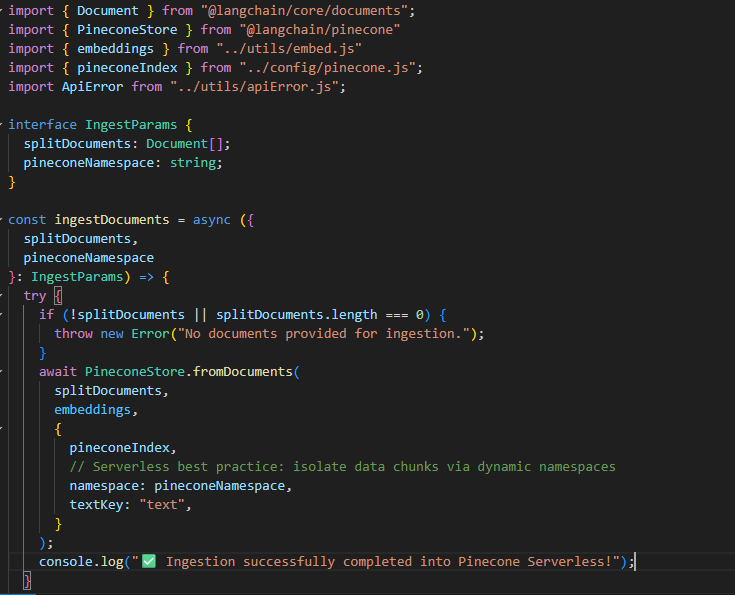
Finally, the rag ingestion pipeline completed successfully today. After more than 1 day of debugging code, I found a problem with the LangChain library version. 😀🥱 Good night, LangChain
Just dropped a massive video
AWS S3 - In One Shot
✅ Bucket +Security
✅ Static Website Hosting
✅ Versioning & Replication
✅ Storage Classes + Lifecycle
✅ Event Notification
✅ Encryption,CORS,MFA Delete & more
Full complete guide
https://t.co/oRxFMTo5C1
Win AWS Credits 🚀
I am building pdf chat rag webapp using Next.js (only frontend) and a backend (nodejs expressjs mongodb zod langchain pinecone aws...) . i am facing this error again and again - what is wrong in my code? Pinecone-3072 dimension index and Google Gemini emed model also 3072 dim.
Learn coding with @rohit_negi9
Brother @CoderArmy and java with @adityatandon02 brother and if want to learn devops join live class https://t.co/CoAMu4w12k
If you always chase a roadmap, you are just continuing the behavior of sticking to a predefined syllabus from your school days, when it was discouraged to go beyond it.
I understand that roadmaps provide a sense of comfort and a structured and clear way to achieve something, but if you are focused on doing the bare minimum, then you
1. are at risk of developing a shallow understanding
2. miss the opportunity to stumble upon something amazing
More importantly, you are robbed of experiencing the joy of learning something super interesting. Some of the most interesting and helpful things I know happened because I went out of the way and spent days understanding the nuances.
To be honest, going out of the syllabus forced me to dig deeper because I started exploring it out of curiosity and genuine interest and not because of some peer pressure. I was driven by intrinsic motivation rather than an external impulse.
I personally believe that deeper understanding is what separates good engineers from the better. By not sticking to some predefined roadmap, you
1. become comfortable with uncertainty and change
2. learn how to navigate through errors quickly
3. build an ability to learn any and every concept
4. become great at connecting the dots
5. and most importantly, you learn how to learn.
Again, I am not telling you to abandon roadmaps entirely. They are useful guides, especially when you're starting out. The key is to use them as a starting point, not an endpoint. Let them not limit your learning and curiosity.
You excel when you dare to differ.
Hope this helps.
🚨 We're hiring a Full Stack Developer (Fully Remote)
Europe-based startup looking for an engineer who can take ownership and ship real products end-to-end.
What we offer:
• Fully remote role
• ₹10–15 LPA (will be renegotiated based on the value you deliver)
• No DSA rounds. No puzzle interviews.
• Evaluation based purely on your ability to build and ship real products
We’re looking for someone who:
• Communicates clearly and effectively
• Uses AI tools to work faster and smarter
• Can take a product from design → development → delivery
• Takes complete ownership of their work
How to apply:
Comment below or email [email protected] with:
• Proof of work (GitHub + shipped projects/portfolio)
• Why you’d be a great fit
• Short video introduction (preferred)
If your profile stands out, I’ll personally forward it to the team.
Shortlisted candidates will be invited for a work trial where we’ll evaluate real collaboration, communication, and problem-solving.
I was reading Clean Code by @unclebobmartin , and in the section on craftsmanship, there’s a topic called “Harm.”
It begins with this line:
“The first promise of the software professional is: DO NO HARM! And that means that your code must not harm your users, your employers, your managers, or your fellow programmers.”
This is something we rarely talk about in software development.
Too often, we hide behind the excuse: “It’s my job. I was asked to do it.”