@Waymo is investing another $220 million in Arizona with a 5,458-acre site in Surprise.
More private investment, safer roads, and more accessible transportation options.
And all we had to do was just not say no to new technology.
Seems like a good trade. Keep it comin'
If "it uses water" is the standard, Arizona would not build much of anything.
@EIAgov reported the average large commercial building uses about 22,000 gallons/day: https://t.co/U6ahSKsYxO
Project Blue’s stated estimate is 15,000–20,000 gallons/day once fully operational, for standard office use and fire suppression, not evaporative cooling.
Arizona has fewer than 200 data centers statewide. Not 3,000. Not 5,000.
The better questions are: how much water, for what purpose, from what source, and compared to what?
Notice which state is largely missing from this article?
Arizona.
That matters because Arizona keeps getting folded into a national data center debate that often skips the Arizona-specific context.
Not every project has the same water profile.
Many of the projects drawing attention here use air cooling, closed-loop systems, or other low-water designs that look very different from the worst-case examples driving national headlines.
Project Blue, the data center project in Pima County, is expected to use roughly 15,000 to 20,000 gallons of water per day once fully operational.
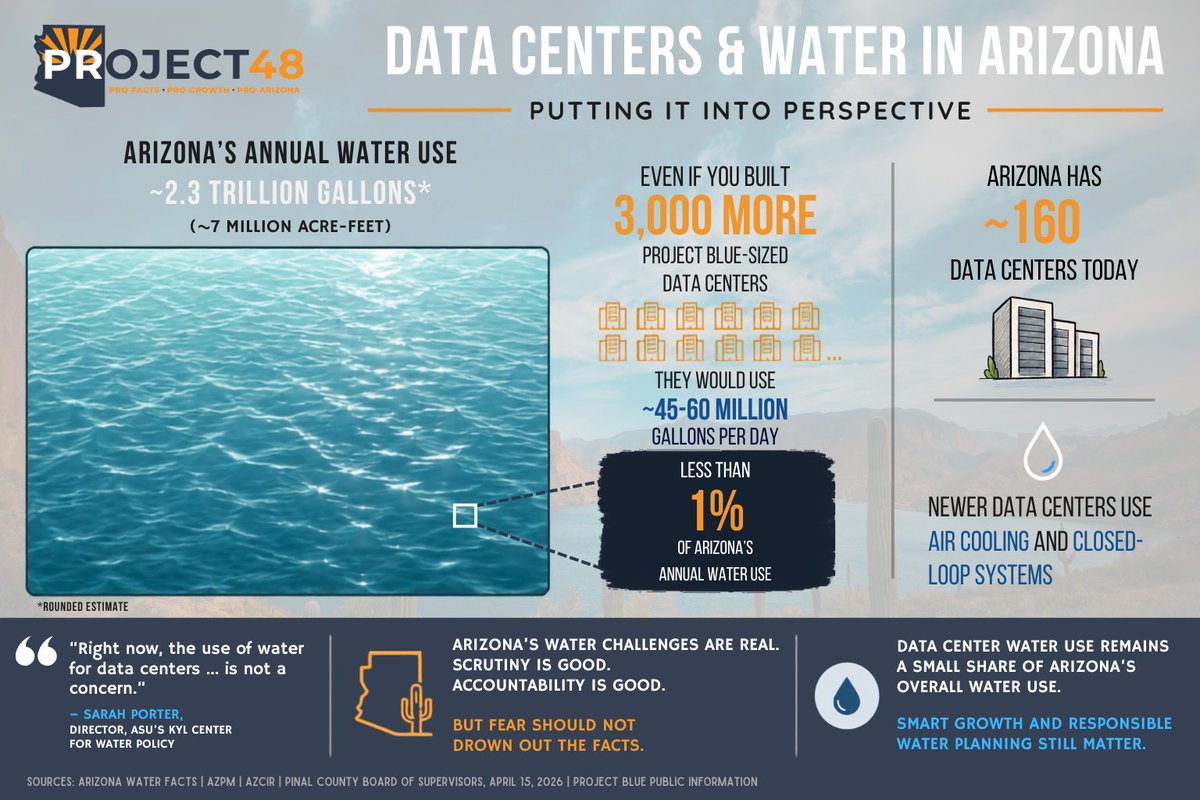
Put that in perspective: Arizona could build 3,000 Project Blue-sized data centers and still use less than 1% of the state’s annual water use.
Water matters here. That is why the facts matter.
Majority of US' new AI datacenters to be built on drought-hit land, our analysis finds.
Two-thirds of new datacenters, some taking 5m gallons of water a day, are in places in drought over past year. "I think a crunch point is inevitable," one expert says https://t.co/eGFsQzqFni
Fair. Data centers are not exactly built for curb appeal. Like many warehouse and industrial facilities, they are large, often windowless buildings, and communities are right to care about design.
But the fact that a comparison like this can be made shows how far public opinion has turned against them.
Perception is not reality.
These projects bring jobs, tax revenue, infrastructure investment, and long-term opportunity.
They deserve scrutiny too.
But the debate should be grounded in facts, not preconceived notions.
"At this point, I think the approval rating for syphilis is probably higher than it is for data centers."
Why do so many Arizonans hate data centers?
@stacypearson says it comes down to two things: They're ugly — and "inherently creepy."
Watch the clip from @AZMorningNews:
The “small number” is Project Blue’s stated fully operational estimate: 15,000–20,000 gallons/day.
AZPM: https://t.co/tDzpAzqZ7J
Arizona’s annual water use is ~7 million acre-feet, or ~2.3 trillion gallons.
Arizona Water Facts: https://t.co/qyElzQi40p
The comparison is about scale.
Woah. There are now 35 driverless @pepsi trucks operating on Arizona roads.
No public-road accidents so far. 99% on-time arrival performance.
Arizona keeps getting autonomous vehicles right. Safer roads and more reliable deliveries are worth being excited about.
Exclusive: PepsiCo is using autonomous trucks to distribute beverages and chips to multiple grocery stores in Texas, Arizona and Arkansas https://t.co/iIQnJ0LKoW
Setbacks? Write setback rules.
Noise? Require noise studies.
Fire safety? Enforce fire code and emergency access.
Projects still have to comply with the rules cities and counties already have on the books.
“Stop all data centers” is not regulation. It is just avoidance.
This is exactly how the data center debate gets distorted: https://t.co/tFxmqWxSC3
Start with a park. Add a playground. Mention that 7 in 10 Americans oppose data centers in their local area. Then make it sound like if people don’t act now, a data center is coming for every neighborhood open space in America.
But that is not what is happening, especially not in Arizona.
Arizona has about 160 data centers statewide. Not 160 in your neighborhood. Statewide.
And the projects making headlines here are generally being proposed on undeveloped agricultural land, vacant land, warehouse sites, or property already zoned for industrial use.
That does not mean every project should be approved.
It does mean this is a zoning, infrastructure, and local planning issue. Not a reason to pretend data centers are uniquely “swallowing” Arizona.
The fiscal argument is even weaker.
Yes, Arizona’s data center incentive means the state forgoes some sales-tax revenue. The estimate is roughly $40 million.
But that is only one side of the ledger. Data centers generated an estimated $863 million in combined state and local tax revenue in Arizona in 2023.
That is the part that gets left out.
As more states move toward bans, pauses, and political panic, Arizona has an opportunity to keep leading.
Banning data centers may be politically convenient, but it is not serious policymaking.
Responsible growth means asking serious questions about water, power, noise, siting, and infrastructure.
It does not mean letting fear do the planning.
FACT: More than 90% of the potential energy still remains in spent nuclear fuel.
Some advanced reactors under development could consume or even run on this fuel in the future.
Some of Arizona’s most important projects have a perception problem.
Data centers. Nuclear energy. Autonomous vehicles. And plenty of others.
The benefits are real: jobs, tax revenue, infrastructure, investment, safer roads, more reliable energy, and long-term opportunity.
But the politics are often upside down.
Public perception is low. Public benefit is high.
That gap is where Arizona loses.
Perspective matters.
Based on Project Blue's estimated water use, Arizona could add 3,000 more projects of that size before reaching 1% of Arizona's annual water use.
For context, Arizona is estimated to have about 160 data centers today.
Let’s talk about data centers and water in Arizona. 💧
I appreciate this @WIRED article acknowledging that data center operators are taking water seriously: https://t.co/G2mbcSFb8g
But national water-use figures need Arizona-specific context.
Much of the concern about data centers stems from evaporative cooling, which can use large amounts of water. The article cites a 2024 report that hyperscale data centers could consume up to 33 billion gallons of water by 2030.
A scary figure. But without context, it can be misleading.
It assumes they rely “heavily on evaporative cooling.”
And that’s just not what we are seeing with many of the major projects drawing attention in Arizona.
Take the projects that have made headlines here.
Project Blue outside Tucson, Project Baccara near Luke Air Force Base, and projects in Chandler and Pinal County are using air cooling, closed-loop systems, or other lower-water designs specifically because water matters here.
So what does that mean for water? Let’s put the numbers in perspective.
@EIAgov estimates large commercial buildings average about 22,000 gallons of water per day.
Project Blue is estimated to use roughly 15,000 to 20,000 gallons per day once fully operational.
For perspective, you could build another 3,000 Project Blue-sized facilities using that amount of water, and they would still account for less than 1% of Arizona’s annual water use.
For context, Arizona is estimated to have roughly 160 data centers today.
Sarah Porter, director of @ASU's @KylCenter, said it plainly: data center water use in the Phoenix, Pinal, and Tucson AMAs is “not a concern” right now.
Arizona’s water challenges are real. Water is precious here, especially with the ongoing Colorado River negotiations.
Scrutiny is good. Accountability is good.
But fear should not drown out the facts.
The cost of producing, expanding, and maintaining the electric grid has risen nationwide. That is a major reason residential rates are rising in Arizona and across the country.
But the WSJ article includes an important piece of context: from 2020 to 2025, residential electricity rates rose 32% nationally. In Arizona, they rose 26%.
In other words, Arizona’s increase was meaningfully lower than the national average.
At the same time, Arizona’s largest utilities have been clear: large users should pay the costs they create. Growth should pay for growth.
@apsFYI: https://t.co/BGa70UiyZR
@SRPconnect: https://t.co/1dCQfgcgty
@TEPenergy: https://t.co/Q9FiBVYdvE
Even @CorpCommAZ has noted a "clear consensus" around protecting ratepayers and ensuring large users shoulder new infrastructure costs: https://t.co/0HaXKG27aO
Arizona needs to take power demand and cost allocation seriously. But the claim that data centers are driving runaway electricity costs here is not supported by the available data, the utilities’ own public statements, or the direction Arizona regulators are already moving.
Arizona’s largest utility is proposing a 45% electricity-rate increase for data centers and a 14.5% hike for households. No one is happy. https://t.co/MCZ7OJUG6L
Let’s talk about data centers and water in Arizona. 💧
I appreciate this @WIRED article acknowledging that data center operators are taking water seriously: https://t.co/G2mbcSFb8g
But national water-use figures need Arizona-specific context.
Much of the concern about data centers stems from evaporative cooling, which can use large amounts of water. The article cites a 2024 report that hyperscale data centers could consume up to 33 billion gallons of water by 2030.
A scary figure. But without context, it can be misleading.
It assumes they rely “heavily on evaporative cooling.”
And that’s just not what we are seeing with many of the major projects drawing attention in Arizona.
Take the projects that have made headlines here.
Project Blue outside Tucson, Project Baccara near Luke Air Force Base, and projects in Chandler and Pinal County are using air cooling, closed-loop systems, or other lower-water designs specifically because water matters here.
So what does that mean for water? Let’s put the numbers in perspective.
@EIAgov estimates large commercial buildings average about 22,000 gallons of water per day.
Project Blue is estimated to use roughly 15,000 to 20,000 gallons per day once fully operational.
For perspective, you could build another 3,000 Project Blue-sized facilities using that amount of water, and they would still account for less than 1% of Arizona’s annual water use.
For context, Arizona is estimated to have roughly 160 data centers today.
Sarah Porter, director of @ASU's @KylCenter, said it plainly: data center water use in the Phoenix, Pinal, and Tucson AMAs is “not a concern” right now.
Arizona’s water challenges are real. Water is precious here, especially with the ongoing Colorado River negotiations.
Scrutiny is good. Accountability is good.
But fear should not drown out the facts.
A 60mph+ reckless wrong-way driver on a 40mph road can easily lead to severe collisions. Two different Waymos (and an attentive human ahead!) avoided tragedy in Phoenix the other week by taking evasive action.
Arizona’s growth is putting more pressure on the grid, and utilities are responding with real investments to replace aging infrastructure before it becomes a bigger problem.
With more than $4 billion in projected near-term infrastructure investments, utilities are upgrading older poles, lines, and equipment to strengthen reliability, reduce disruptions, and keep power dependable for Arizona communities.
Opinion: "This is a deeply troubling technology, and while it's fun to think of a far-off future where trips are effortless, we are far from that." https://t.co/8VqFtb11eX
Data centers are critical infrastructure for the modern economy, bringing billions of dollars in investment to Arizona.
@dbseiden argues the focus should be on getting the policy right: protecting ratepayers, ensuring growth pays for growth and maintaining certainty for businesses making long-term decisions. ⬇️
This part is worth emphasizing: increased load from a data center does not automatically mean residential customers are footing the bill.
"It's naive for somebody to say just because there's an increased load for a data center, there's automatically going to be a rate increase for residential customers."
This is a great example of how it should work.
The proposed site is in an industrial park with other major warehouses and manufacturing facilities, and it is already within a zoning district that allows data centers.
Questions about water, power, noise, and infrastructure will still be reviewed through the normal city review and development process.
That is the kind of predictability Arizona needs if we want to keep attracting major investment.