One of the most influential and widely deployed notions in Marx is also perhaps the most obscure: alienation. It has been understood as the falling away from a species-essence; as a normative neutral notion of self-externalization through work; and more recently… 1/
Looking forward to the MEP's annual visit from the Yale Working Group on Globalization and Culture. Two online panels on Saturday and Sunday, June 6 and 7. This year's theme: "Approaching the Limit." Find out more and register here - https://t.co/3DTXafhtV4
“Scholars of the new history of capitalism have no more sense of a system now than when they began. What went wrong?” Must-read. https://t.co/0j2g1ykY9H
This is a really powerful, important podcast episode with Prof David McNally -- I strongly recommend it. It nicely debunks the myth that plantation slavery in the Atlantic was some kind of “pre-capitalist” mode of production – a favourite claim of those who try to sanitize capitalism of some of its most heinous crimes.
The claim shouldn’t need debunking – world-system analysts have long established that capitalism is a 500-year-old system that relied very heavily on bonded labour for centuries – but it absolutely bears repeating.
Plantation slavery was very clearly capitalist: it was commodity production for the world market (not for the consumption of the owner, as in pre-capitalist forms of slavery), geared toward profit maximization, capital accumulation, competition, and reinvestment in the expansion and intensification of production.
There are some Marxists who claim that Atlantic slavery doesn’t fit Marx’s definition of capitalism, because enslaved people were not paid wages and therefore could not produce surplus value. McNally shows this is an incorrect reading of Marx, and an incorrect view of how plantation production worked.
It’s also crucial to understand that enslaved people were at the forefront of resistance against capitalist exploitation. The British ruling class likes to claim that Britain “abolished slavery”, as though this was some benevolent gift handed down from above. Far from it. It was slave rebellions and revolutions that abolished slavery!
Specifically, the Haitian revolution in 1791, Bussa’s rebellion in Barbados in 1816, followed by the Baptist rebellion in Jamaica in 1830- some of the earliest general strikes in working-class history! This eventually forced Britain to understand they would not be able to sustain the system.
And then there was the general strike during the US Civil War, described by Du Bois, when up to 500,000 enslaved people refused to work and fled to union lines, totally crippling the plantation economy. 200,000 of them took up arms on the union side and fought the slavers, contributing substantially to the defeat of the fascist confederacy. Heroes one and all.
Teaser to the episode here: https://t.co/NmOr4XRVFE. The full episode is available via Patreon subscription to @UpstreamPodcast (worth it!).
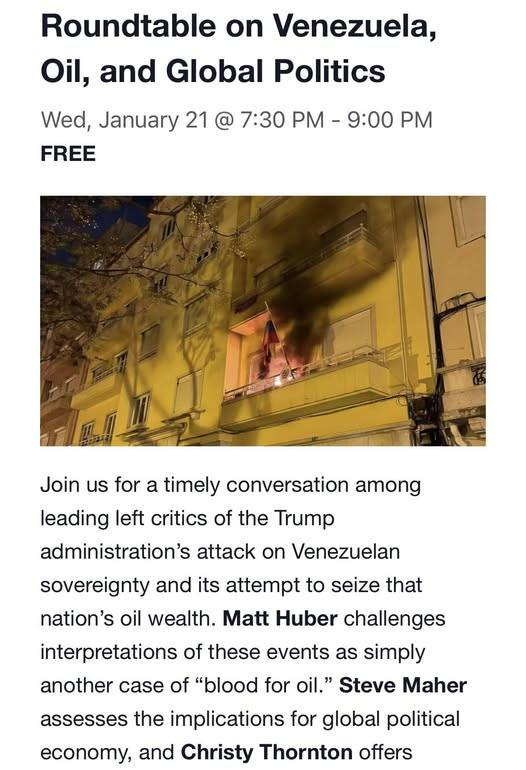
I'll be doing this online event on Venezuela with @SteveMaher18 and @llchristyll next Wed January 21st at 7:30pm. Thanks to @frmurph1 and the for organizing! (RSVP link in reply).
📚ONLINE EVENT📚
Join this free online event with @project_marx to learn about Mitch Abidor’s new book, Victor Serge: Unruly Revolutionary
🗓️Sat, Nov 1
⏰2 pm EST
https://t.co/t5qCVlOC31
Over the past few months, BlackRock and other major investment firms have abandoned their commitments to green investments, saying explicitly that it's not profitable enough. Yes, renewables are cheap... but they are not nearly as profitable as fossil fuels.
We need to understand that this puts us in an extremely dangerous situation.
Keep in mind that these investment firms control the surplus that *we* collectively produce. And yet, we have zero say over how it is invested. Instead, our ruling classes invest it in whatever is most profitable to them.
So they continue to invest in fossil fuels and other damaging activities, knowingly sabotaging our future, even while the world burns around us.
All of us should be outraged by the madness of this arrangement. We can solve the climate crisis quite easily - we know what to do and we have the capacity to do it. And yet we are prevented from investing in the necessary changes.
I cannot emphasize this enough: the correct response is to bring these firms under public control so that we can mobilize investment — of *our* surplus, remember — toward achieving democratically ratified social and ecological objectives.
Register for "Fake Work"; Register for "Free Gifts"; I bet @alybatt or I get a surprise visit from NYC mayor Eric Adams at our upcoming @project_marx events. Whether you're Eric Adams or not, link to register in comments.
What could a world after capitalism look like? This two-part article in the @NewLeftReview is the result of five years of research. I’ll be turning it into a book later this year, so I’d love to hear your comments and critiques. https://t.co/zxsJkqEfJi