🌍 Welcome to Project Locate! 🚀
Help me find amazing places—from ancient ruins to hidden wonders! Got a cool spot? Drop it below! 🏛️✨
🎯 Goals
✅ Reach 100 followers
✅ Share daily (or as often as possible)
✅ Post bookmark-worthy locations 🗺️
✅ Build a community and do good
This mud-brick pyramid has survived 1,500 years of Peruvian earthquakes, and the secret is visible in the walls. The bricks are standing up, with gaps between them.
The Lima culture built Huaca Pucllana around 500 AD using the bookshelf technique, millions of hand-shaped adobe bricks set vertically like books on a shelf, each row separated by deliberate spaces.
Those gaps are the engineering. When seismic waves roll through, the bricks shift within their spaces instead of cracking, and the soft adobe itself soaks up the energy that shatters rigid stone. The pyramid's trapezoid profile, wide base tapering upward, anchors the rest.
No lost technology required. Five centuries of living on the most violent coast in the seismic world, watching what fell and what stood, wrote this design one collapse at a time.
The earthquakes that later flattened colonial Lima kept arriving. The bookshelf kept standing.
While the exterior of the fortress is melted, the interior is in almost perfect condition.
We will never know what disaster befell it.
Shanxi, China
https://t.co/E7WZWC6eg6
ALIAGA GEOPARK is located in El Maeztrazgo, Teruel, Aragon, Spain.
An ancient city that was turned sideways after the cataclysmic shaking and MELTING event?
See images in comments of what it could've been. Just throwing ideas/theories out there! 🤷♀️
Research: Meltology 🫠
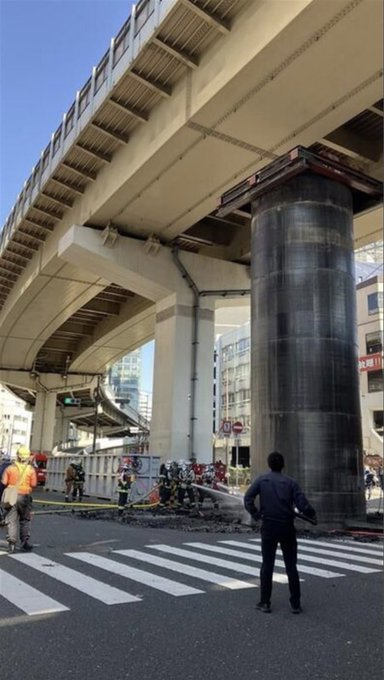
A strange incident occurred yesterday in Osaka, Japan. Near the Umeda Center Building on the west side of Shin-Midosuji, a huge unidentified object resembling a bridge pier suddenly emerged from underground. The entire area was closed to traffic, and the scene was chaotic.