I’m definitely not saying this based on just one test. Elon hyped it up to be Opus 5-level and promised the leap from Grok 4.6 to 4.7 would blow the 4.5-to-4.6 upgrade out of the water, but that couldn't be further from reality. Token usage is way higher, 3D modeling feels like a step backward with a noticeable drop in aesthetics and taste, and there's plenty more to unpack. So no, this isn't just one flawed prompt; it's a pattern. I get that a single chat doesn't tell the whole story, but in my experience, Grok 4.7 just didn't live up to the hype even after all the delays. It's a huge flop.
I’m definitely not saying this based on just one test. Elon hyped it up to be Opus 5-level and promised the leap from Grok 4.6 to 4.7 would blow the 4.5-to-4.6 upgrade out of the water, but that couldn't be further from reality. Token usage is way higher, 3D modeling feels like a step backward with a noticeable drop in aesthetics and taste, and there's plenty more to unpack. So no, this isn't just one flawed prompt; it's a pattern. I get that a single chat doesn't tell the whole story, but in my experience, Grok 4.7 just didn't live up to the hype even after all the delays. It's a huge flop.
Xiaomi just cooked HARD with MiMo 2.6 😭
This might be another K3 moment.
Just look at this game output… absolutely insane.
Testing it properly in the morning
Finally, an OpenRouter for agent harnesses!
(including System One by Jev)
Devs just open-sourced a plug-and-play infrastructure layer that lets you run any harness under a single interface, like:
- Codex
- Hermes
- Claude code
- DeepSeek Harness
- System One, powered by Jev
- And 9 more agent harnesses
This means you can bring Jev into the same product that already uses Codex, Claude Code, or another supported harness, without writing another implementation for sessions, streaming, files, cancellation, and failure handling.
Here's the repo: https://t.co/scJwb2xUyM
(don't forget to star it ⭐ )
The harnesses run locally, and the Unified Harness Protocol (UHP) defines the common task interface with an OpenAI Responses-compatible API.
If you want to dive deeper, my recent article explains why model routing is not the same as harness routing, and what it takes to support multiple harnesses.
It also covers UHP, the full local setup, a working API call, and how sessions and files work.
Read it below.
From Vibe Coding to Vibe World. 🌍
MiMo-V2.6 brings together 3D spatial reasoning, multimodal perception and computer use to build and interact with richer environments.
🔹 Turn text, images or video into playable 3D worlds, coordinating agents to build scenes, write interaction logic and refine the results
🔹 Create Blender objects and scenes for animation, 3D printing and games
🔹 Control a Franka Panda arm in simulation through visual feedback
🔹 Use desktop tools to search, edit and process data — then inspect the results and adjust its next actions
Build. Observe. Refine.
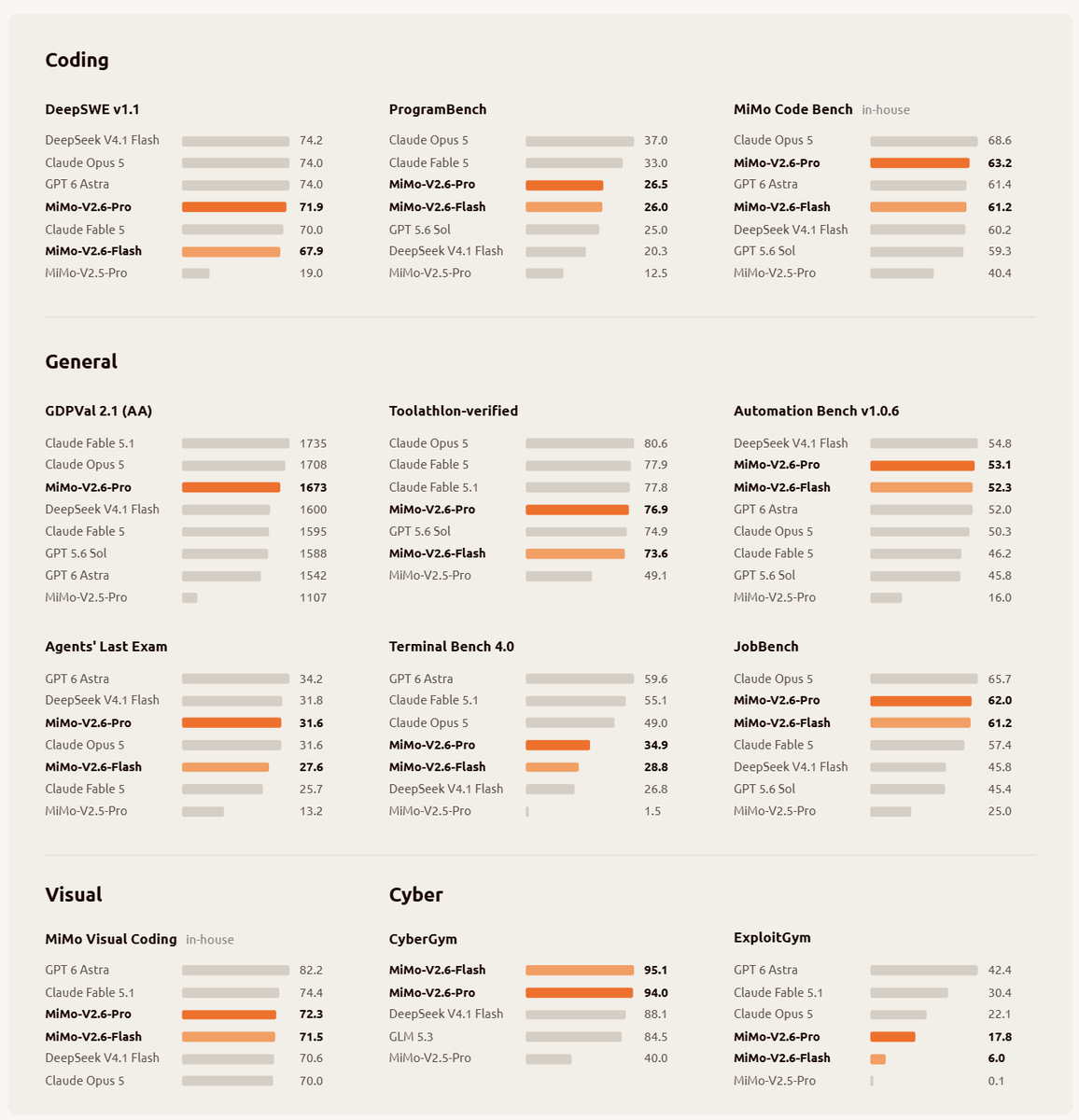
MiMo-V2.6-Pro debuts as the top open weights model on the Artificial Analysis Intelligence Index (46). At $0.13 per Intelligence Index task, it lands on the Intelligence vs. Cost per Task Pareto frontier
@Xiaomi has just released MiMo-V2.6-Pro, an open weights model with major advances in intelligence over its predecessor, MiMo-V2.5-Pro (Intelligence Index: 26). Despite the improvement, it retains the same attractive pricing at $0.435 per 1M input tokens (with a 99% cache-hit discount) and $0.87 per 1M output tokens. This makes MiMo-V2.6-Pro one of the most cost-efficient models to deploy.
MiMo-V2.6-Pro is an MoE model with 1.02T total parameters and 42B active parameters. Stay tuned for additional analysis of the model.
Check out MiMo-V2.6-Pro full benchmarking breakdown here: https://t.co/czBJhQKuWJ