Fun couple of days connecting with #crypto industry, lawyers and academics at the @UChicagoLaw 2026 Digital Assets Symposium. Grateful to join friends @propelforward & @Andrea_Tosato on a panel with Jusge Lane and @Tony_J_Casey on the intersection of private law and regulation
@mcuban@eriktorenberg@pmarca Code can operate a legal entity already in many US jurisdictions - Prof's Shawn Bayern & Lynn LoPucki wrote about creating autonomous entities & algorithmic entities 5-10 years ago. No new/ special laws needed!
Not quite sure anybody needs this… But for those who want this, they may want to read LoPucki (https://t.co/yqKFio06Hr ) and Bayern (https://t.co/SxEzokTqhP ) who explained how to do this under existing law about 10 years ago.
SITUATION DETECTED: Delaware is drafting a proposal for a new form of corporate entity called an Artificial Intelligence Company (AIC). An AI managing an AIC would be able to provide services, sign contracts, hold property, and even file or defend lawsuits in the company’s name.
The new Congress may herald an era of oversight, investigations, and enforcement. The White House has argued that private-sector communications are protected by executive privilege. How does this new argument change the response playbook? Read more here...
https://t.co/RwOJbD7PN9
Aave Labs and its co-authors have submitted a legal framework for decentralized lending protocols and non-custodial vaults to the SEC’s Crypto Task Force and Division of Corporation Finance.
Today, we are releasing a public summary of our paper.
I’m launching “With All Due,” a Substack focused on the frontier of finance. I’ll be writing about the myriad products disrupting the current market structure, the rules for them & where this all goes next. Subscribe: https://t.co/HjDQXkZRfb.
Today, @veda_labs, @aave, and @kamino are publishing a new legal framework for applying U.S. securities laws to decentralized lending protocols and non-custodial vaults. It draws from a joint submission to the @SECGov last month. Here's why it matters for the future of onchain finance: 🧵
I share the sentiment. Not the generalization. Custody of digitals is a complex private law topic
🧵
1) Under its terms, @Binance holds customers' tokens on trust. Customers' have pro-rata property interest
2) @Binance's promise to make customers whole is entirely diff. matter
Encouraging to see the @SECGov staff recognize in today's updated guidance that decentralized governance can involve discretion without necessarily creating centralized control.
I think this is an important distinction. Immutability shouldn't be the dividing line for what gets regulated. The ability of protocols to adapt to changing conditions and emerging risks and respond to live security incidents is an important form of user protection. There is room for distributed governance while constraining the powers any one actor can exercise / avoiding single points of failure.
@veda_labs has been working with some of our industry peers on a broader legal framework for applying existing securities laws to onchain financial activity, including questions like these. Excited to share more tomorrow!
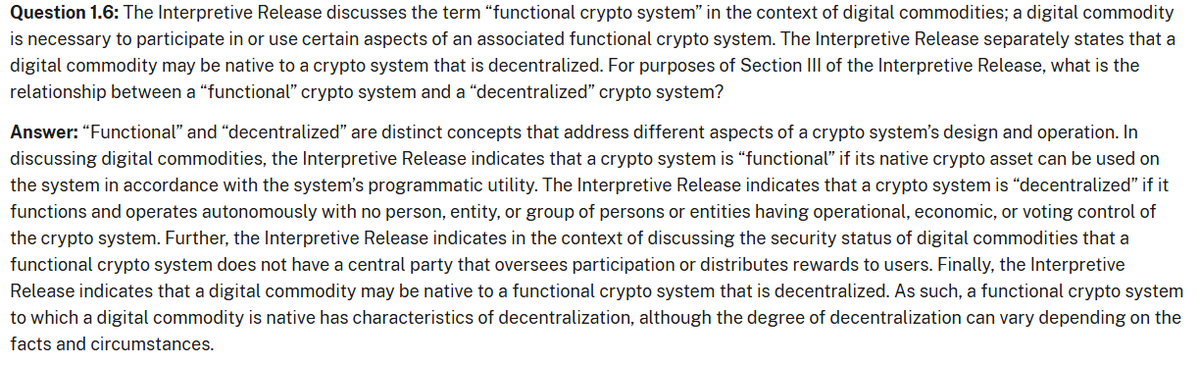
1.6 addresses the terms functional and decentralized and clarifies they are distinct concepts that address different aspects of a system's functionalities. TLDR- decentralization is not the same as functional, and each concept has diff. meanings/significance under the interps.
problem 2. "Modify the crypto system’s rules-based code" is "drive -a -mack -truck -thru -it" wide. As written, this basically means any governance that affects code, which is exceptionally broad.