Canadians are outraged on the wrong part of the US-Venezuela annoucement.
Canada oil production will continue to hit records.
This is not the risk.
At peak, when Venezuelan's fields will be developed to restore/new capacity, years down the road, it will equal roughly half of the imports from Canada (current + future).
The risk is that it can displace some Canadian barrels but not all of them. Still will be devastating if the US would want to go that way.
Here is what Canadians should be mad about:
> companies rather invest tens of billions elsewhere than next door. You can thank carbon capture and carbon tax for that.
> America will develop 17 fields on another continent and will increase oil imports by 1 million+ barrels of oil per day before Canada will even finish building its own pipeline to our own coast.
Canadian failure to build at speed and navigate our own red tape and added costs are no else's fault. The world is moving on.
@WhiteCollarExit The fourth is bottlenecks hardware, power, regulatory hurdles, slowing down the pace of buildout (can't buy chips if you can't turn on the data center).
Everyone keeps debating “affordability” like it’s some giant mystery...
It’s not. We printed nearly 40% more dollars in two years during COVID. Asset prices and everyday costs exploded as a direct result. Homes, food, insurance, and borrowing costs all reset higher. Mortgage rates that were once near historic lows are now stuck around 7%.
The affordability crisis is the direct aftershock of the largest peacetime money expansion in modern US history — future generations are absolutely cooked.
@hollyanndoan@BuildCanHomes@CMHC_ca Siddall previously stated Canadians should end the "glorification of homeownership," promoted renting as a valid long-term option, and supported research into taxing home equity gains on primary residences that CMHC dropped after Blacklock's Reporter revealed it.
FOR THE WILDFIRE CRAZY AND
CLIMATE MENTALLY DERANGED
The last 150 years is the greatest improvement in the human condition in the entire history of our species. It is not close.
Fire is down.
US burned area peaked at 52 million acres in 1930. It runs 5 to 10 million now. An 80 percent collapse. Global burned area, measured by satellite since the late 1990s, is down 25 percent.
Africa’s savannas, which used to dominate the global burn, have gone quiet as agriculture replaced fire-prone scrub.
The planet is greening.
Satellite data shows a leaf area increase equivalent to adding one entire Amazon rainforest to the Earth since 2000. Zhu et al. attributed 70 percent of the greening to CO2 fertilization. Deserts are shrinking at their edges. The Sahel is greener than it was 40 years ago.
Crops are exploding.
Global grain production has more than tripled since 1961 on roughly the same acreage. Yield per hectare on wheat, maize, and rice has quadrupled. Famine deaths per capita have fallen by roughly 99 percent since the 1870s.
People live twice as long.
Global life expectancy in 1875 was about 30 years. Today it is 73. More than doubled. In the developed world it went from 40 to over 80. Doubled again.
Children stop dying.
In 1800, 43 percent of children died before age 5. Today it is under 4 percent globally, under 1 percent in the developed world. A tenfold reduction. An order of magnitude.
Poverty collapsed.
In 1820, roughly 90 percent of humans lived in extreme poverty. Today it is under 9 percent, and falling. Another order of magnitude, while the global population grew from 1 billion to 8 billion. More people, vastly less poverty, per capita and in absolute terms.
Everyone can read.
Global literacy in 1875 was around 20 percent. Today it is 87 percent. Four times higher across a population that grew six times larger.
Everyone got rich.
Real GDP per capita globally (Maddison data, constant dollars) went from about $1,200 in 1870 to over $16,000 today. Roughly a fourteenfold increase. In the developed world, more like fiftyfold.
Weather stopped killing people.
Deaths from climate and weather related disasters peaked in the 1920s and 1930s at around 5 million per year, mostly drought and flood in Asia. Today, with five times the global population, it runs under 20,000 per year. A per capita reduction of over 99 percent. Two full orders of magnitude.
Work got easier.
Average annual working hours in developed economies fell from around 3,000 in 1870 to about 1,700 today. Roughly half. Child labor collapsed. Leisure exploded.
The cause is not a mystery.
Fossil fuels. Coal, oil, and natural gas turned muscle labor into machine labor. They powered fertilizer production (Haber-Bosch alone feeds roughly half the humans alive). They powered refrigeration, sanitation, hospitals, tractors, transport, and every step of the industrial food chain. Cheap dense energy is what dragged our species out of the Malthusian trap where it had lived for 10,000 years.
And the byproduct of that cheap dense energy, CO2, is the same molecule that is regreening the Earth and boosting crop yields on top of the mechanical gains.
Every actual measurement of the human condition and the biosphere shows the same thing.
Fires down. Green up. Lifespans up. Child deaths down. Poverty down. Hunger down. Wealth up. Literacy up. Weather deaths down. All by factors of 2 to 100 in a century and a half.
The industrial civilization the alarmists want to dismantle is the single largest engine of human and ecological improvement ever recorded. The data are not ambiguous. They are not close.
They are not debatable.
They are simply denied.
By the mentally ill.
I downloaded and reviewed NYC's grocery store RFP... as someone who has built biz's and bought a lot of food... wow.
Forget for a moment whether or not the govt should own a grocery store. Let's review the doc instead.
Here you go... /1
People think wealth inequality is due to capitalism, but it is actually due to over regulation making it so only major corporations can compete. They pay lobbyists billions to ensure their competition is crushed by government.
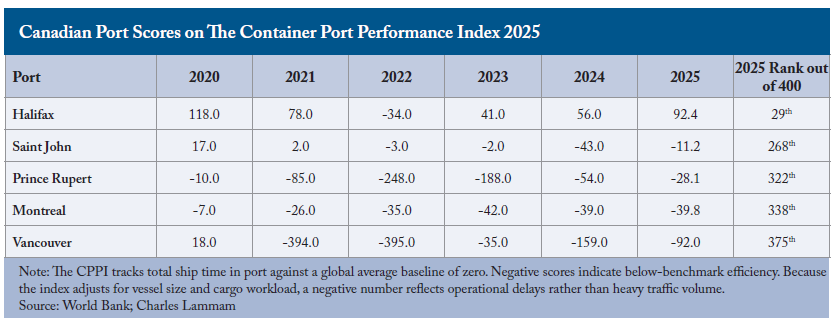
Vancouver, Canada's biggest container port, ranks 375th out of 400 ports worldwide.
That's not a typo.
Ottawa wants to double non-U.S. exports by 2035 but most of our container ports are among the worst performing on earth.
Vancouver: 375th
Montreal: 338th
Prince Rupert: 322nd
Saint John: 268th
Halifax (our star): 29th
Even federal Transport Minister @stevenmackinnon isn't spinning this. He says our port performance needs to be world-class but right now, it isn't.
Good to see Vancouver's Roberts Bank expansion potentially fast-tracked but there's MUCH more work to be done.
Bottom line: that 2035 target stays out of reach without a clear-eyed look at where Canada's ports actually stand.
My @CDHoweInstitute piece:
https://t.co/TFa0T9EX0k