According to 1 Kings 6:7, Solomon’s temple, the house of the Lord, was built using stones that had already been cut, shaped and finished at the quarry. No sound of a hammer, chisel, axe or any iron tool was heard at the building site during construction.
The stones were dressed offsite and brought to the temple to be put neatly in place.
It was an anomaly to hear chiselling or hammering and any kind of noise inside the temple. The stones used were already treated in the quarry.
A lot of stones have never experienced the quarry. They arrive at the temple expecting to be accommodated in their raw state. This is why there is so much noise in the temple. Some work should have been completed before arrival.
Also, the sympathy and advice of an undiscerning Christian can be as dangerous as the voice of the devil. Remember Peter ?
@ImKingGinger https://t.co/AXUYAMAYla
Couldn't find a Bible app that lets me study the Bible and take notes in markdown format while recognizing Bible references among other standard features.
@razrwit@Row_Haastrup I believe this is the verse he was making a reference to:
As it is written, "Jacob I have loved, but Esau I have hated."
— Romans 9:13 (NKJV)
The way this guy uses AI to create scenes like this is just too good. An angel came to deliver a man’s blessings, but the devil appeared, claiming he had legal grounds to stop them. Then Jesus showed up and declared that His mercy covers the man. 🔥❤
There is something inconsistent about saying we trust God with our soul for eternity while living as though He cannot be trusted with tomorrow.
We say Christ is sufficient to carry us through death, judgment, resurrection, and everlasting life, yet a financial problem comes, a door closes, health changes, someone leaves, the future becomes uncertain, and suddenly we begin living as though everything depends upon our ability to keep life from falling apart.
Jesus addressed this very directly. He told His disciples not to be consumed with anxiety over food, clothing, and tomorrow because their heavenly Father already knows what they need (Matthew 6:25–34). He did not say those needs were imaginary. He taught them to measure those needs against the character of the Father who feeds birds, clothes grass, and knows His children completely.
Paul gives us an even stronger argument: “He who did not spare His own Son, but delivered Him over for us all, how will He not also with Him freely give us all things?” (Romans 8:32). If God has already given Christ for us, then His providential care cannot suddenly become uncertain when we enter ordinary trouble. The cross is the greatest evidence that His hands can be trusted.
This does not mean Christians never become afraid. David could say, “When I am afraid, I will put my trust in You” (Psalm 56:3). Notice that faith did not mean the absence of fear. Faith meant that fear drove him toward God rather than away from Him. Trust is often learned while our hands are still shaking.
And this is where our theology has to leave the page and enter life. We confess that God is sovereign, wise, good, and Father to His people. Then the bills arrive, the diagnosis changes, the answer to prayer is delayed, or something precious is taken from us. Those moments expose whether sovereignty is merely a doctrine we defend or a God we actually rest in.
Peter says, “casting all your anxiety on Him, because He cares for you” (1 Peter 5:7). That is not sentimental language. It is an invitation to place the weight of temporal life upon the same God to whom we have entrusted eternity.
If we can trust Christ to raise us from the grave, we can learn to trust Him with the days that come before it. And when that trust is weak, the answer is not pretending to be stronger than we are. It is bringing the weakness itself to the God who has already proved His faithfulness at the cross.
Once a young woman came to see Charles Haddon Spurgeon and asked him if she could date a young man who was an unbeliever.
She said her aim was to lead him to Christ and so she had decided to be engaged to him soon.
Spurgeon asked the lady to climb up onto a high table.
She could not but obey.
Spurgeon already quite advanced in age, told the girl to grasp his hand and try her best to pull him up onto the table.
She tried but of course, she could not do it.
Then Spurgeon said he would pull her down. And with just one pull, she came down.
He said ''It is easy to be pulled down, but hard to pull up.''
That sister gained clarity that day.
I hope you have, as well.
I watched as my dad slip away for two years until his end, from dementia, he was 92.
Dad was a cruel and hateful "Atheist" of a man, who heaped some terrible things upon his family and my sisters, of which I vowed at 12 to ki-ll him.
He stayed with us those last two years of his life.
Wheeling around the house, making demands and leering at my wife, which I put a stop to.
It was exhausting.
I watched as he started forgetting names and even where he was at.
One time he thought my family was a different family masquerading as mine.
Those two years, I read the bible nightly, mostly Psalms
and explained God's love for us and His hatred of sin.
I talked to dad one night recounting what he had done to my one sister and some of the other terrible things he had done.
I did that, as he was never told he was a sinner and it needed to be told.
I did actually tell him the gospel message and the sin of mankind because he came to me one day and asked me what changed me after I got saved.
Dad was genuinely curious.
The last two weeks of his life he started seeing things that he would reach out for.
Strangely, dad was still coherent and we would talk, though his voice sounded like he was coming from a different dimension or was in a tunnel.
One night I came to make sure dad was comfortable and to add some glycerin to his dried lips as he was taking in little water, and had stopped eating.
When dad exclaimed loudly "I'm so sorry for the bad things I've done."
I barely breathed and thought what is this?
I decided after some brief silent prayer, to share the gospel yet again with a man who never apologized in his life.
I asked dad do you want Jesus to forgive you of your sin?
Do you believe now as you lay dying, Jesus is truly the Son of God.
He said yes.
I led him in prayer and we talked some more and I left the room.
The following day as I entered His room he spoke first telling me "Jesus was the truth, He spoke truth."
Two days later dad passed on into the hands of Jesus.
I remember I cried like never before at the salvation of my dad, and the wonder of the salvation process.
I remembered the story of King Nebuchadnezzar and how in his insanity gave praise to God and God restored him to his former place.
My point?
Never give up praying for anyone for any reason.
God's grace extends to everyone.
Titus 2:11 “For the grace of God has appeared, bringing salvation for all people.
The reason I am doing what I am doing now is because of *this* sermon.
It might be the most impactful 2 minutes of preaching I've ever seen — and it changed my entire life.
When a boy wrote to C.S. Lewis, worried that he loved Aslan the lion more than he loved Jesus, Lewis told him something you would never expect...
Instead of saying the lion was just a character in a book, he told the boy he could not possibly love Aslan more than Jesus. Because Aslan is not a symbol for Christ: according to Lewis himself, Aslan IS Christ.
This is the thing most readers get wrong about Narnia. People call it an allegory, a tale where a lion stands in for Jesus the way a character might stand in for an idea.
Lewis rejected that completely...
In a letter he wrote: "If Aslan represented the immaterial Deity, he would be an allegorical figure." Instead, he explained, Aslan is the answer to a question: "What might Christ become like if there really were a world like Narnia, and He chose to be incarnate and die and rise again in that world as He actually has done in ours?"
The answer Lewis gave was a lion. And he explained exactly why: "Since Narnia is a world of Talking Beasts, I thought He would become a Talking Beast there, as He became a man here. I pictured Him becoming a lion," Lewis wrote, partly because the lion is the king of beasts, and partly because "Christ is called The Lion of Judah in the Bible."
Once you know this, the story of Narnia changes: the moment Aslan lays down his life on the Stone Table for a traitor, and rises again at dawn, is not like the story of Christ. To Lewis, it is that story, happening in another world. And it is why, in the final chapter of The Voyage of the Dawn Treader, Aslan tells the children this:
"I am in your world too. But there I have another name. You must learn to know me by that name. This was the very reason why you were brought to Narnia, that by knowing me here for a little, you may know me better there."
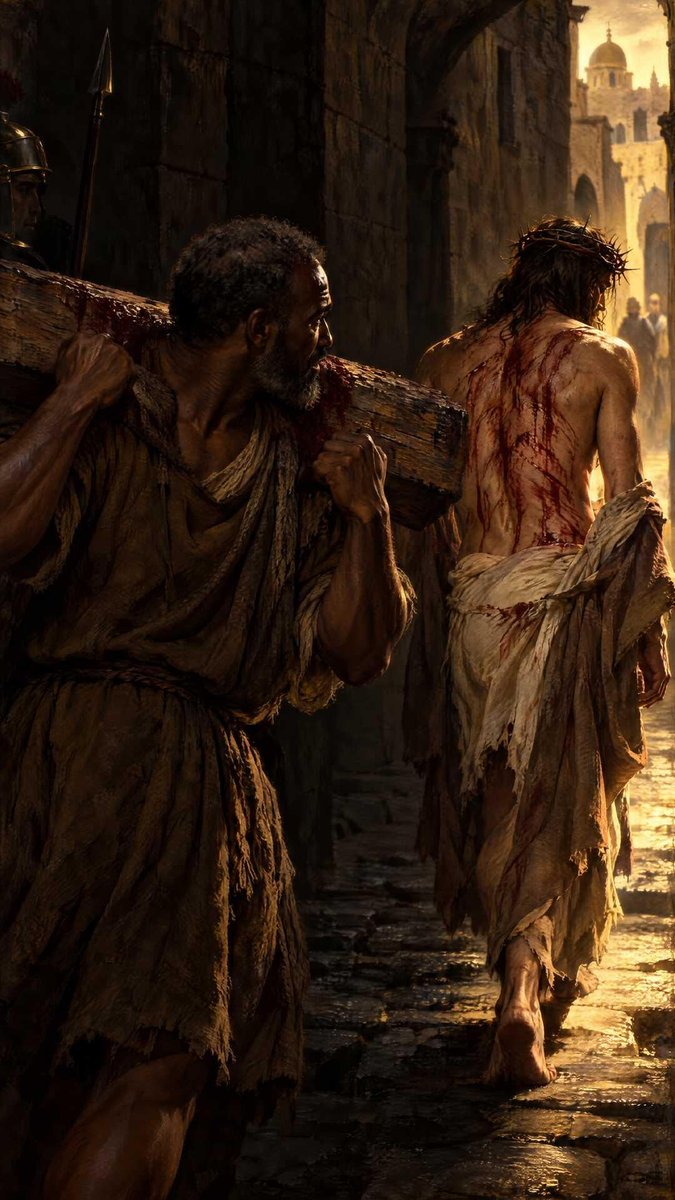
The man who carried the cross for Jesus didn't volunteer.
He was grabbed.
Mark 15:21. And they compelled one Simon the Cyrenian, who passed by, coming out of the country, the father of Alexander and Rufus, to bear his cross.
Picture it. A man walking into Jerusalem from the fields, minding his own business, and a Roman soldier's hand lands on his shoulder. You. The beam. Now.
Cyrene was in North Africa, modern Libya. Over a thousand kilometers from Jerusalem. Simon had made that journey for Passover, the holiest week of the year, and on the biggest morning of the feast he took the wrong street.
Now look at the word Mark uses. Compel.
In Greek it's angareuō. It comes from the old Persian courier system: a royal messenger could stop any civilian and requisition his horse, his cart, his back. Rome kept the custom. A legionary could grab any man on the road and make him carry the army's load, no questions asked. It was the most hated power the occupier had.
You've heard that word before. Jesus used it.
Matthew 5:41. And whosoever shall compel thee to go a mile, go with him twain.
Same verb. Angareuō.
Jesus stood on a hillside and told a crowd: when the soldier grabs you and makes you carry his load, don't just go the one mile the law requires. Go two.
Two years later, a soldier grabbed a man who had never heard that sermon and made him carry the Preacher's own cross.
Then Luke adds his detail.
Luke 23:26. On him they laid the cross, that he might bear it after Jesus.
After Jesus. Behind Him. Following.
Now flip back fourteen chapters in the same book. Luke 9:23. If any man will come after me, let him deny himself, and take up his cross daily, and follow me.
Luke wrote both sentences. He knew exactly what he was doing. Jesus preached take up your cross and follow me and the first human being in history to do it literally was a stranger from Libya who was forced.
Think about what Simon actually carried.
By the time the soldiers grabbed him, Jesus had already been scourged. Roman whips had lead and bone in the tips. His back was open. He'd been carrying the beam on it. The wood was wet.
Simon put that wood on his own shoulders. And walked behind Jesus, close enough to watch His back, the back Isaiah had written about seven hundred years earlier. I gave my back to the smiters.
He went to Golgotha with the blood of Christ soaked into his clothes.
Not a disciple. Not a believer. Not a volunteer. Just the man closest to the wrong soldier at the wrong moment.
And then Mark does something strange.
He names Simon's sons. Alexander and Rufus.
Why? Mark doesn't name the thieves on the cross. He doesn't name the centurion. He doesn't name the servant girl who broke Peter. But he stops the crucifixion narrative to tell you who Simon's kids were.
There's only one reason a writer does that.
His readers knew them.
The early church was unanimous that Mark wrote his gospel in Rome. And Paul, writing to the church in Rome, ends his letter with a list of greetings.
Romans 16:13. Salute Rufus, chosen in the Lord, and his mother and mine.
Rufus. In Rome. A man Paul singles out as chosen. And a mother Paul says had mothered him too.
Many scholars think that's Simon's son and Simon's wife.
If they're right, and it is the simplest explanation for Mark's detail, then here is what happened to the man who was grabbed on the road.
He went home to a wife and two boys, with another man's blood on his coat, and something he saw on that hill went through the whole household. Thirty years later his sons are known by name in the church in the capital of the empire. His wife is looking after the apostle Paul like a son.
Simon never says a word in the Bible. We have no record of his conversion, no sermon, no prayer. We only have the fruit. Two boys the church knew. A mother Paul loved.
He was forced to carry the cross one mile.
His family carried it for the rest of their lives.
Now you.
You didn't volunteer for the thing on your back either. Nobody does. You were walking in from the country, minding your own life, and a hand landed on your shoulder. The diagnosis. The child who needs more than you have. The grief you're still standing in. The debt. The parent who can't remember your name.
Ask Simon how it felt on Friday morning. Worst luck of his life. Ruined his Passover. A stranger's blood on his shoulders.
Ask him by Sunday.
The thing you were forced to carry is the only reason his name is in the Bible.
And notice where he was standing while he carried it.
Luke told you. After Jesus.
The forced cross is never carried alone. You're behind Him. He's already walked that road with a worse version of the same beam, and He's in front of you right now, close enough to see His back.
You didn't choose it.
Pick it up anyway.
He's in front of you.