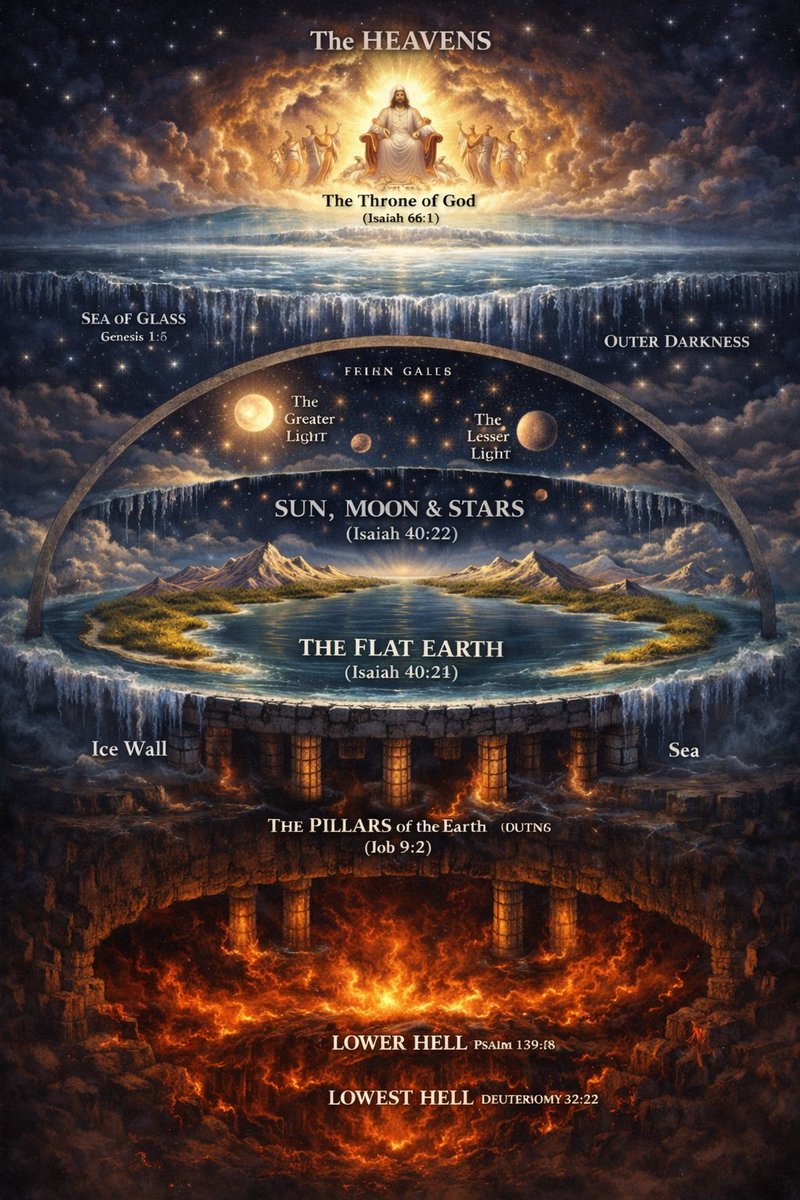
🚨‼️If you take the Bible literally, and I do, then your view of reality will not look like a NASA press release or a Hollywood planetarium show. It will look far more ancient, far more ordered, and far more terrifying. This image is not meant to satisfy modern science. It is meant to reflect the language of Scripture as God gave it, without smoothing the edges or spiritualizing the hard parts away. The Bible does not speak in abstractions when it describes creation. It speaks in structure, layers, boundaries, foundations, and realms.
At the top of this image is the third heaven, beyond the firmament, where Scripture says God’s throne is established. Paul said he was “caught up to the third heaven” (2 Corinthians 12:2), not floating through galaxies. John saw a throne, not a vacuum. Above the firmament is a sea of glass mingled with fire, clear as crystal (Revelation 4:6). When the sky is rolled back like a scroll (Revelation 6:14), it isn’t poetry. It is a curtain being drawn back. And when men finally see the God of glory, they don’t clap. They fall on their faces like Ezekiel did, because the fear of the Lord suddenly becomes very real.
Below that throne is the firmament itself, the “vault of heaven” God made on Day Two, dividing waters above from waters below (Genesis 1:6–7). The Bible places the sun, moon, and stars in this firmament, not beyond it. Two great lights, one to rule the day and one to rule the night, fixed for signs, seasons, days, and years (Genesis 1:14–16). The stars are not wandering suns billions of miles away. Jude calls the fallen angels “wandering stars,” which tells you the real stars are fixed. David said God “stretcheth out the heavens as a curtain,” not as an infinite void.
The earth itself is described as set, founded, established, and immovable. Isaiah said God “sitteth upon the circle of the earth” (Isaiah 40:22), not spinning inside it. Job said the earth has pillars. Samuel said it has foundations. The Psalms say it has corners. Those aren’t metaphors invented by poets who didn’t know better. They are descriptions from God’s point of view. Even the mountains are called the “ends” and “bottoms” of the earth. And yes, Scripture repeatedly speaks of boundaries, seas, and ends, which is why the idea of an ice wall and lands beyond is at least biblically discussable, even if not fully revealed.
Below the surface is where modern Christianity gets uncomfortable, because hell ruins the mood. But the Bible is clear. Hell is beneath, not abstract. It has depth, levels, and degrees. Moses said the fire burns “unto the lowest hell” (Deuteronomy 32:22). David spoke of Sheol beneath him (Psalm 139:8). Jonah said he cried from the belly of hell, from the depths. The Bible places hell below the foundations, under the pillars, in the lower parts of the earth. That is not Dante. That is Scripture.
You don’t have to accept this image as perfect. It isn’t inspired. But if you take the Bible literally, you should be willing to question the modern cosmology that openly mocks Scripture. This image is simply a visual thought experiment built from the King James Bible’s own words. And if the heavens really are a curtain, one day that curtain will be pulled back. When that happens, no one will be arguing cosmology. Every knee will bow, and every mouth will shut, because the God of the Bible will no longer be filtered through screens, theories, or institutions. He will be seen.