Some melodies aren’t just meant to be heard, they can be experienced visually, too. Pachelbel’s “Canon in D” offers a captivating blend of music and visual beauty.
🏈 Ever wondered why the Bears didn’t repeat in 1986? Here’s the hit that effectively ended their Super Bowl hopes.
👉 Do you think the Bears would have won another ring with a healthy McMahon?
🎥 credit: Depressed Bears Fan
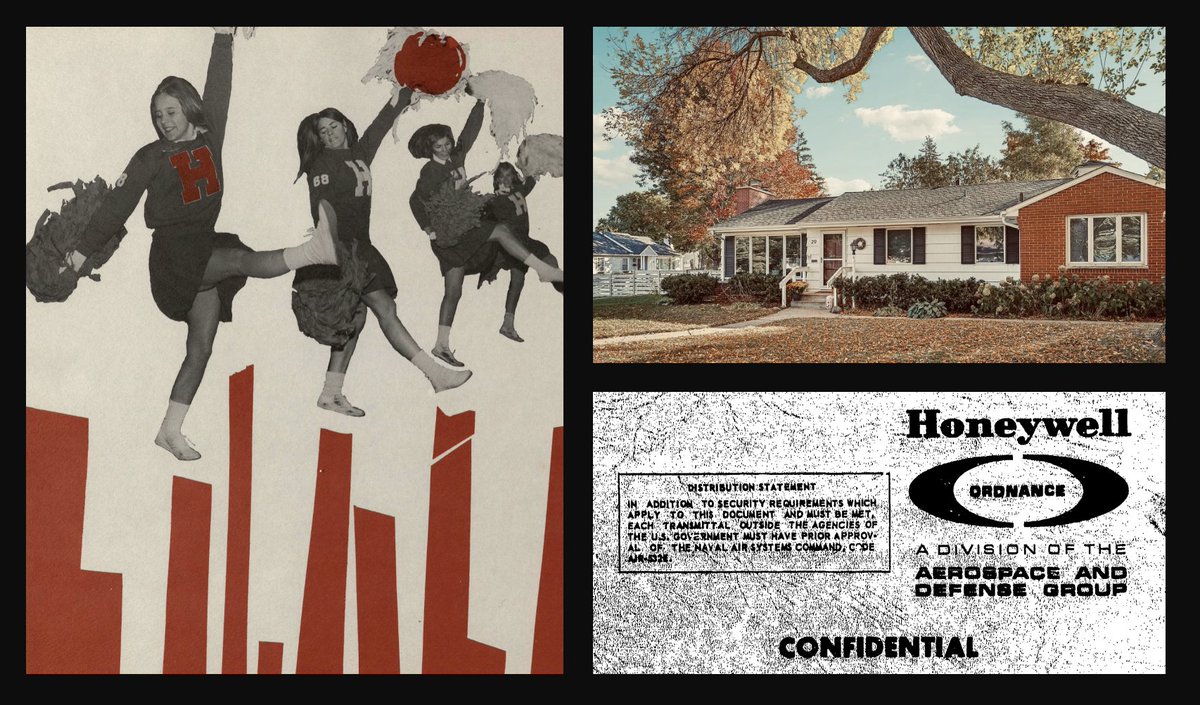
Back around 1968 you could live in Hopkins Minnesota, in the suburbs of Minneapolis.
You work at the Honeywell plant making cluster bombs. Your wife shops at the Country Club market. Your kids go to school at Hopkins High.
The air now in early autumn is cool and clear, and when you stand on your back porch after work, drinking a Hamms, it smells strongly of woodsmoke.
This would have been a pretty good life.
So many views on bearish/bullish oil/gold. Just take a step back and think about if it make sense to own energy producers during the greatest supply disruption ever? Does it make sense to own gold producers during a period with huge government deficit spending and China CB buying
From Stock Picker, Chapter 10 - Discovery
https://t.co/SxPFqb5B0P
In 1990, Pierre Lassonde formulated what is now called the Lassonde Curve. Lassonde realized that share prices of most junior mining companies followed a similar pattern.
In the Lassonde Curve, most of the price appreciation occurs through speculators bidding up the stock price leading up to the discovery of the resource deposit, and then the price languishes as speculators leave.
After discovery, investors realize it’s now up to management to figure out how to finance, permit, and construct a mine to get the resource out of the ground. A task that even experienced mining veterans would have a hard time completing.
There is an old saying among mining investors: “You never want to ruin a great discovery by mining it.”
The Lassonde Curve is relevant for all story stocks, not just mining stocks. It is really a map of perception versus proof: Early-stage story stocks with no revenue/earnings can levitate on narrative and optionality, then sag when dilution, delays, and “now prove it” reality sets in.
The next re-rate only comes when milestones turn the story into measurable fundamentals and economics, but only if the path to it is de-risked without dilution and debt that destroys the upside.
In 1776 Benjamin Franklin had propaganda leaflets disguised as packets of tobacco, so they would reach the enemy's soldiers. The offer inside was a farm.
Britain had hired 30,000 German troops to put down the rebellion. They were peasants' sons, mostly from Hesse-Kassel, conscripted by their prince and rented to George III at a price per head. If one was killed, the prince was paid extra.
At home they owned nothing. The game in the woods belonged to the prince. The wild boar that rooted up a family's crop could not be touched.
Congress read the situation at once. In August 1776 it offered any German who walked away 50 acres and full citizenship. In 1778 it raised the bid, to land and livestock, scaled by rank, up to 1,000 acres for an officer who brought his men with him.
The leaflets went into the camps wrapped as tobacco.
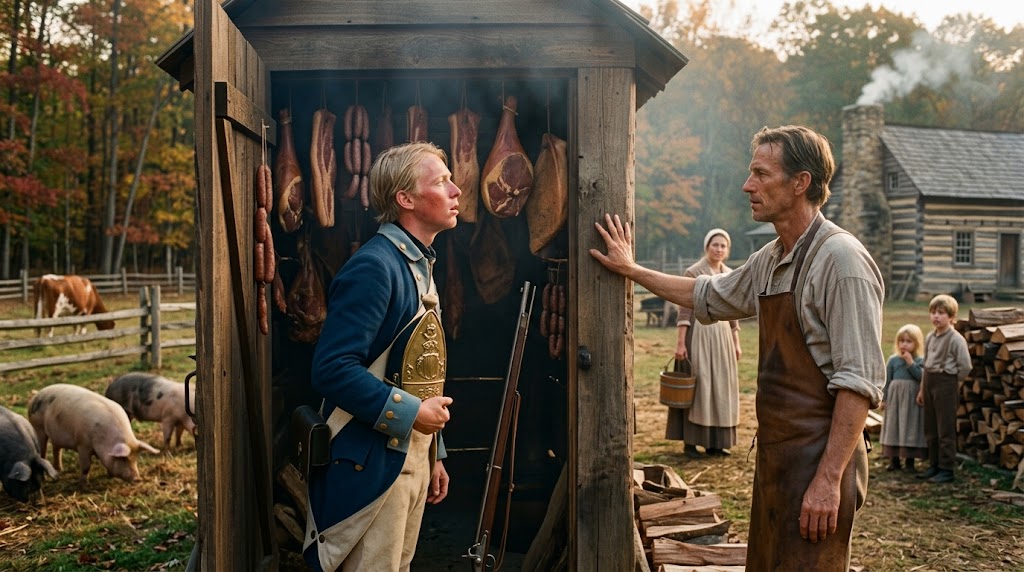
The Germans could also use their eyes. They were marching through a country where an ordinary farmer owned his land, kept a smokehouse full of pork, and answered to no lord, prince or gamekeeper.
Around 5,000 of them never went home. One in six.
The British Crown had paid a German prince for the use of the man. The Americans won a good many of them over by offering him livestock.
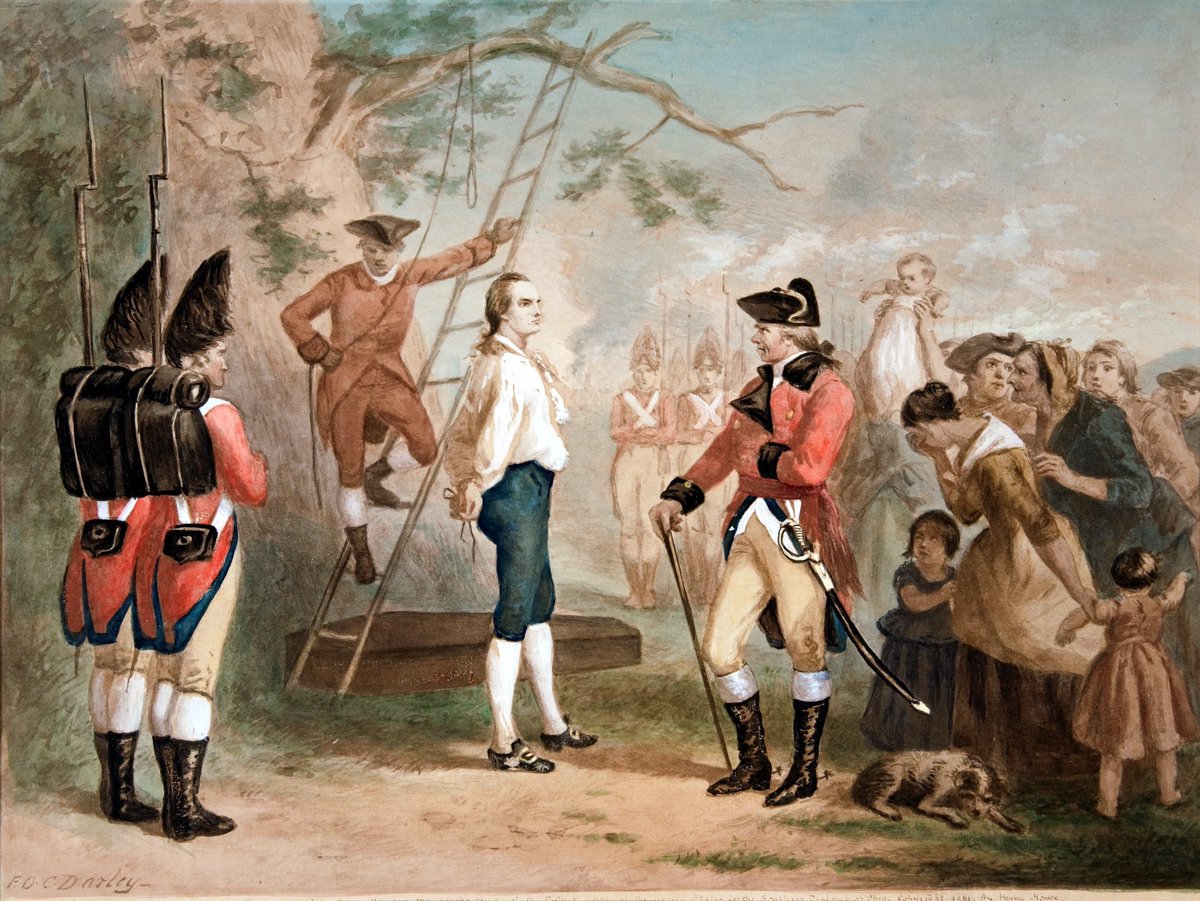
On this morning 250 years ago, the British hanged a 21-year-old American schoolteacher as a spy, and in trying to make him disappear quietly, they accidentally made him immortal. His name was Nathan Hale, and it is worth sitting with just the last few hours of his life.
He had been caught the night before, behind British lines on Long Island, carrying notes on enemy positions hidden in his shoes. There was no real trial. A man out of uniform with military intelligence on him was a spy by the rules of war, and the sentence for spying was death by hanging, no ceremony, no honor. General Howe ordered it done in the morning.
What we know of that morning comes mostly from the enemy, from British officers who were there, and it is the small human cruelties that stay with you. Hale asked for a clergyman to attend him in his final hours. The request was refused. He asked for a Bible. That too was denied. He was a devout young man about to die, and they would not give him even that comfort. A British officer named Montresor, watching, was troubled enough by the young man's composure to later make sure his story was told.
In his last moments Hale was allowed to write a couple of letters, one to his mother, one to a fellow officer. He wrote them, and then the British provost marshal, a notoriously brutal man named Cunningham, took those letters and destroyed them in front of him. The reason given was chilling in its pettiness: so that the rebels should not know they had a man in their ranks who could die with such firmness. They did not just want to kill him. They wanted to erase him.
Then they marched him to the gallows, and there, according to the accounts that survived, this young schoolteacher who had failed at the one dangerous mission he ever attempted, stood calmly and spoke about duty and country with a steadiness that unnerved the men sent to kill him. The famous words attributed to him, that he only regretted having but one life to lose for his country, may be polished or borrowed from a play he loved. But everyone who was there agreed on the essential truth beneath the wording: he met his death without flinching, and he made even his executioners remember him.
And that is the irony that redeems the whole sad morning. Cunningham burned the letters so no one would know how bravely Hale died. It did not work. The story got out anyway, carried by the very enemies who watched it, and a young man the British tried to erase became one of the most enduring symbols of the Revolution, honored two and a half centuries later, on this exact day, as the first American to die spying for his country. They denied him a Bible and a chaplain and burned his last words, and still they could not make him small.
I think about this quote a lot recently. There are no longer any good organizations or groups. Not the UN not your Government not your company's HR department not your HOA not your Church not local high school not the local Boy Scout Chapter: "In a very real sense all is evil" and at best you are the lone woodsman forging a path towards a clearing, only in the hope that somewhere on the other side, someone else is doing the same thing (to paraphrase Jünger).
Most people, seeing this chart for the first time, notice the triumph:
two centuries of compounding, punctuated but never stopped.
Look longer, and you notice something far more useful.
The great valleys — the stretches where investors lost a decade or more of real wealth — do not line up with the famous crashes.
They line up with inflations.
The Napoleonic-era bear ran twelve years.
The post-World-War-I inflation devoured eleven.
The Vietnam-and-oil-shock era took thirteen.
Each time, the killer was not a single bad day on the tape. It was a sustained rise in the price level that ate the purchasing power of financial assets, year after year, while the nominal index looked deceptively alive.
Here is the same history as three numbers
1⃣From 1906 to 1921, the US stock market fell 26% in nominal terms — and lost 63% in real terms.
2⃣From 1929 to 1949: down 22% nominal, down 44% real.
3⃣And from 1968 to 1982: up 35% nominal — down 51% real. Fifty-one percent. Half a generation’s wealth, gone, in a market that never printed a headline crash across the whole stretch. No single day for the history books. No panic to point to. Just a rising index and a dying currency.
That is the entire thesis of the trilogy I will publish over the coming weeks.
Nothing has to crash for everything to change.
Teaching daughter tennis. Another parent made an off hand comment about Florida weather. Had to tell them about the greatest dynasty in high school sports… my high school’s women on the tennis court:
@JoshuaTCharles Here are a couple of playlists for 15min meditations on a mystery of the Holy Rosary also requested be done on First Saturdays by Our Lady.
Meditations on the Joyful Mysteries
https://t.co/tsiEJANsUS
Meditations on the Sorrowful Mysteries
https://t.co/qHj23k8tAv
September 1st, 1983, it was a Thursday.
Congressman Larry P. McDonald boards Korean Air Lines flight 007 and is shot down over Moneran Island. The Soviets seize the wreckage and Congressman McDonald's body is not recovered.
Why did this happen?