An Iraqi platform for knowledge exchange & dialogue that seeks to bridge the gap between youth and state. Our flagship project is the Iraq Policy Program.
Experience levels among Second Cohort qualifiers, PSDIraq Economic Media Program: 38% (1-5 yrs), 28% (6-10), 12% (11-15), 22% (16+) — deepening the link between economic policy and media discourse. #PSDIraq#EconomicMediaProgram
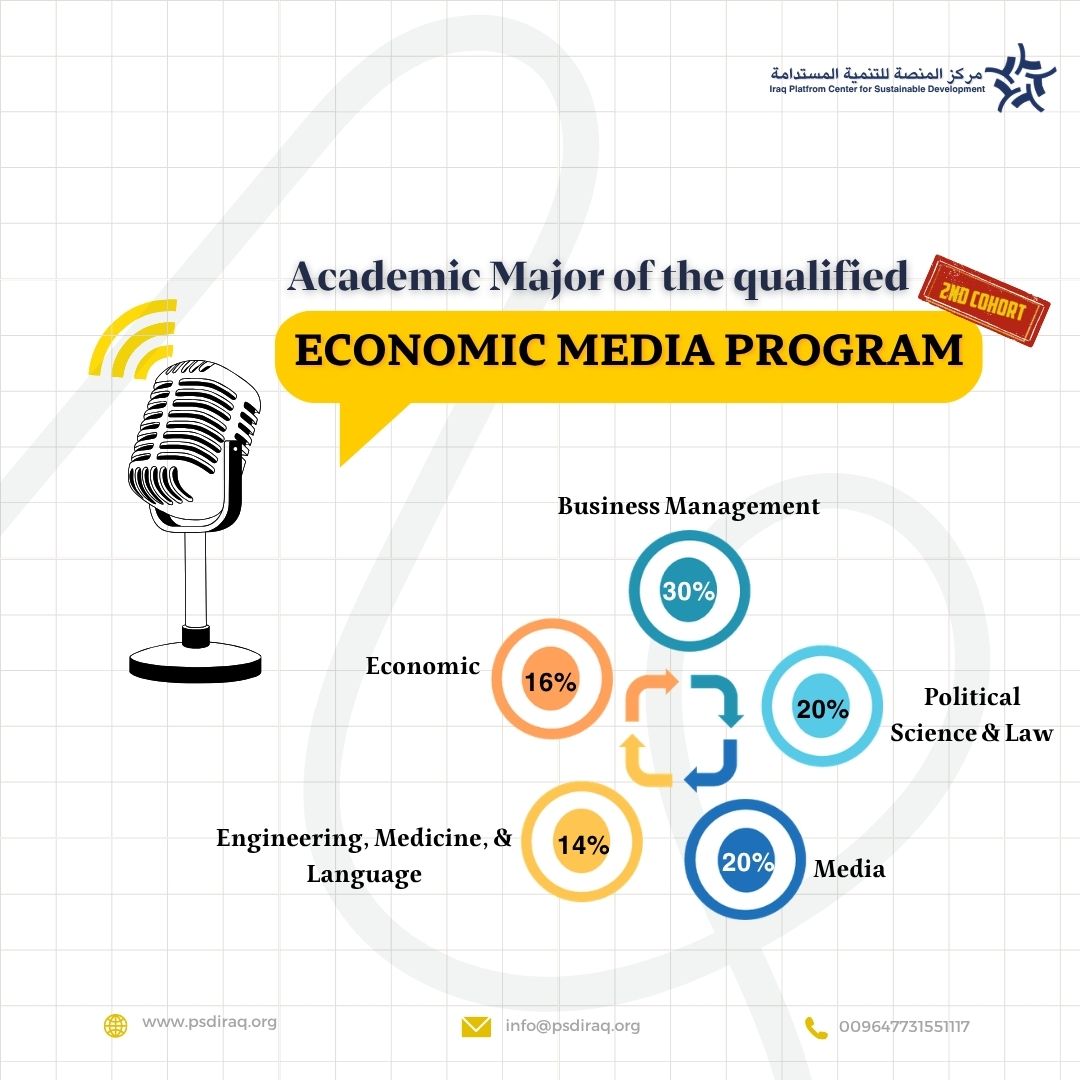
Academic specializations among Second Cohort qualifiers of the PSDIraq Economic Media Program: business (30%), journalism/political science/law (20% each), economics (16%), engineering/medicine/languages (14%). #PSDIraq#EconomicMediaProgram
Academic qualifications of Second Cohort qualifiers, PSDIraq Economic Media Program: 54% hold a postgraduate degree (28% master's, 26% doctorate), 46% a bachelor's. #PSDIraq#EconomicMediaProgram
Sector of employment among Second Cohort qualifiers, PSDIraq Economic Media Program: 68% public, 28% private, 4% mixed — reflecting rising interest in government transparency and private-sector analytical capacity. #PSDIraq#EconomicMediaProgram
Age distribution of Second Cohort, PSDIraq Economic Media Program: 56% aged 26-35, with balanced representation across other groups — demonstrating a generation seeking to strengthen economic analysis and public engagement. #PSDIraq#EconomicMediaProgram
PSDIraq Economic Media Program: 110 applicants, 80 advanced to interviews, 50 qualified for the Second Cohort. This series offers an analytical reading of the qualifiers' profile and what it reveals about economic media in Iraq. #PSDIraq#EconomicMediaProgram
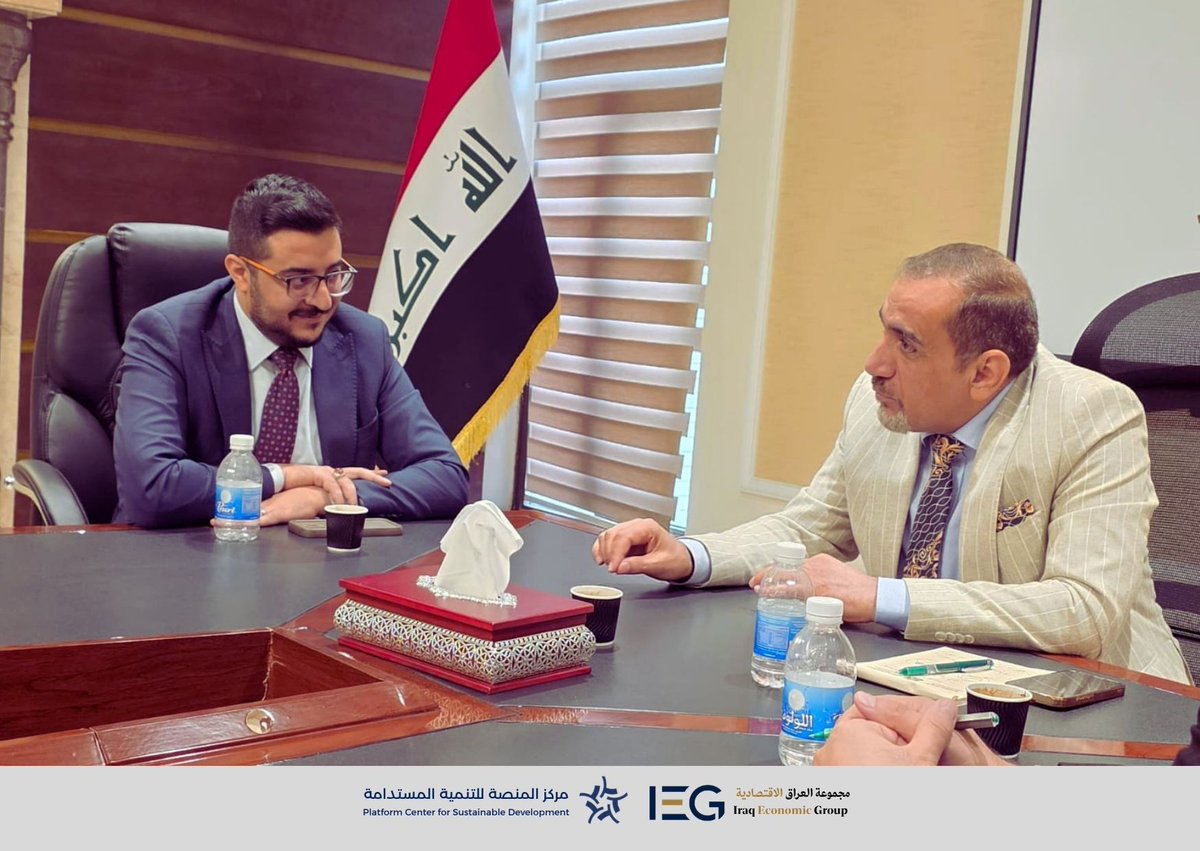
As part of supporting economic reform, a Platform Center delegation met Prime Minister's Tax Reform Advisor Dr. Abdul Hussein Al-Anbaki to discuss tax reform, sustainable economy, and think tanks' role in strengthening research-executive collaboration.
#TaxReform#Iraq
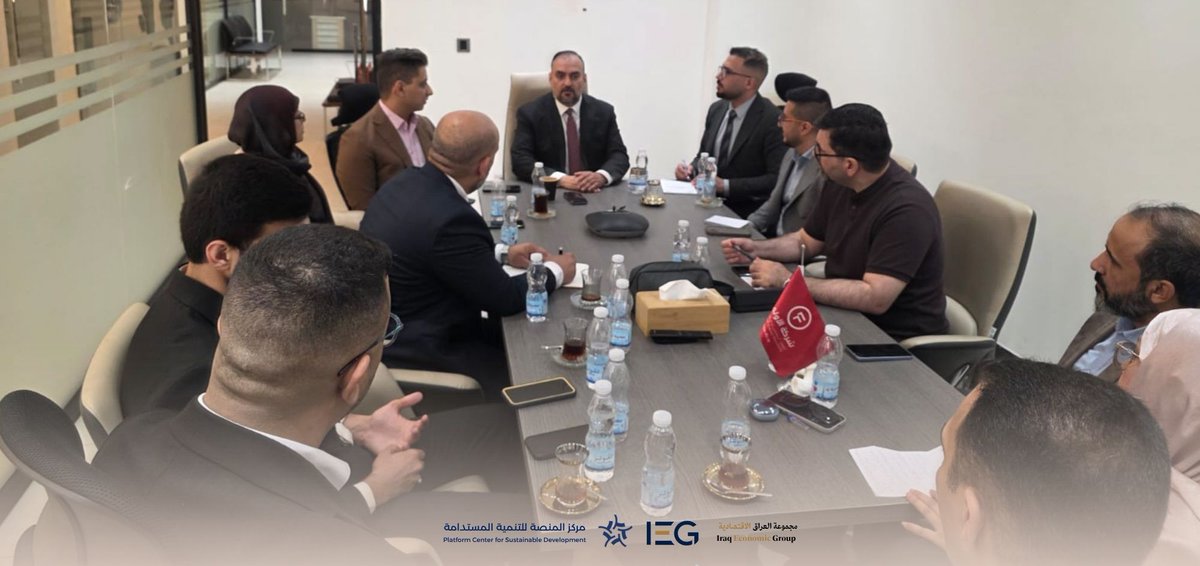
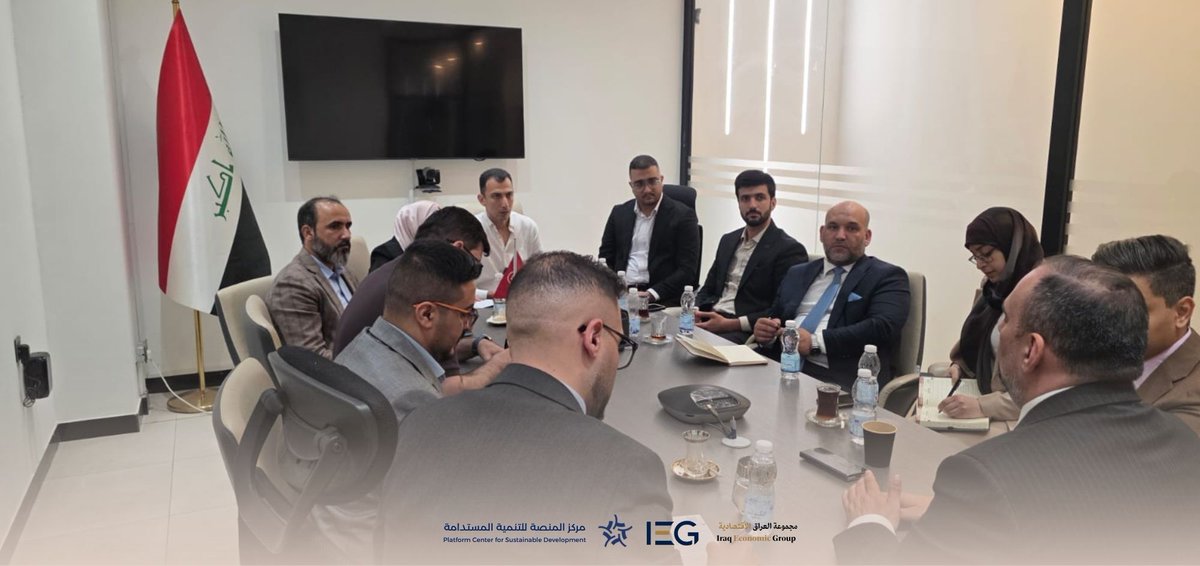
Hashem Al-Husseini: Financing should flow in times of abundance, not scarcity, or it burdens government. No successful economic transformation without parallel political and social change. Corruption remains the root cause. #PSDIraq#IraqEconomicGroup
Ali Al-Mayahi: Cutting production costs matters more than financing alone. Real diversification requires a genuine supply-side approach, not rentier dependency. #PSDIraq#IraqEconomicGroup
@azad7assan : The demonization of the private sector is the core problem — automatically linked to corruption and quota-sharing instead of seen as a partner. The fix requires a strong, bold, swift political decision. #PSDIraq#IraqEconomicGroup
Dr. Omar Al-Anbari presented a precise diagnostic tool to measure the Iraqi private sector's actual dependence on the state — essential for any reform strategy seeking a truly independent, competitive private sector. #PSDIraq#IraqEconomicGroup
Dr. Ahmad Hathal: Iraq's economic struggle stems from a distributive state reliant on volatile oil prices, draining trillions on subsidies and loss-making state enterprises, worsening the balance of payments and undermining investment. #PSDIraq#IraqEconomicGroup
How can economic reforms outlast changes in government?
At PSD Iraq’s Iraq Economic Group roundtable, Jameel Amar, Founder of Tajarib and a member of the Iraq Economic Group, highlighted the above question that is often overlooked in reform discussions.
Good policies are not enough if implementation creates obstacles.
At PSDIraq’s Iraq Economic Group, Faisal Al-Saffar highlighted how regulatory inconsistencies and administrative procedures can raise costs and reduce the competitiveness of Iraqi businesses.
Economic reform is not only about policy—it is also about institutions.
@PSDIraq , Rahma Shaker, Member of the Private Sector Development Council, stressed efforts to empower private sector by addressing legislative & administrative bottlenecks.
"The challenge is not a lack of money—it is how the money is managed."
@PSDIraq , economist Dr. Hamed Rahim Al-Janabi argued that financing must be tied to measurable outcomes, strong governance, and strategic investment priorities to deliver real economic development.
"A larger private sector does not automatically mean a stronger economy."
@psdiraq Iraq Economic Group, Prof. Ahmed Subaih Atiyah argued that Iraq should prioritize productive, value-adding enterprises—not simply expand private sector financing across the board.
Private sector development is a process—not a single reform.
@PSDIraq , Prof. Falah Hassan Thuwaini drew lessons from Rwanda and Georgia, arguing that successful reform for private sector starts with government leadership and evolves into public-private partnership.
@PSDIraq met with the CEO of Iraq's first finance company @Manar_iraqi licensed for SME and microfinance.
→ AI-driven screening of 1,000+ loan applications
→ Loan processing completed within two weeks
→ Underwriting based on cash-flow analysis
Link:https://t.co/hpO94DeWJ2