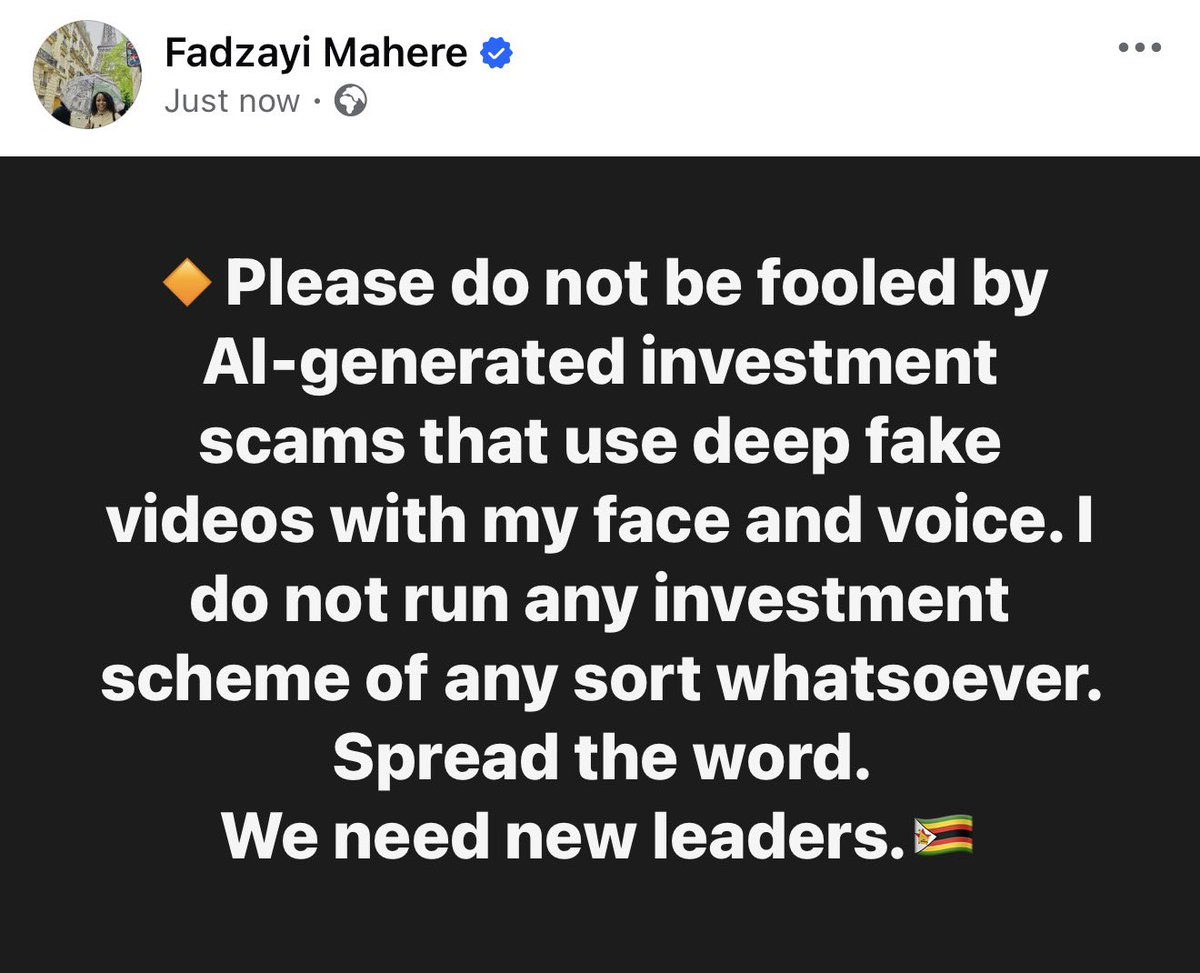
Breaking News.
Prof Ncube remembers he is President of the CCC after a fake statement misrepresents his position.
We look forward to hearing from him again next year.
@DavidColtart Odd - 3 days ago in Beitbridge, I met a man who had been deported from SA after some months in detention. He had no money, was hungry, and trying to go home to Gokwe. He said he got no assistance at all except being admitted back into Zim, to find his own way back home...
Don’t forget those who cheered him on - those who held spaces to tell us he was a champion of democracy. That he was fighting a dictator called @nelsonchamisa. Those who stood up to say they know him. They are part of this.
@Techzim 90 days in a long time in ZiG years - and anything can happen to it in that period - like a 100% devaluation or something - just like it once suddenly did despite kushambadzwa as 'pegged to and backed by real Gold' even as the price of Gold went UP!
We Are Living in the Dumbest Timeline
Donald Trump just posted a photo of a wind turbine next to birds and captioned it “Killing birds by the millions!”
He posted this without irony.
For every single bird killed by a wind turbine, nuclear and fossil fuel plants kill 2,118 birds. Coal alone kills roughly 7.9 million birds a year in the United States. Wind turbines? Between 140,000 and 328,000. That is not a defence of wind turbines.
We are living in genuinely, historically stupid times. Only rivalled, frankly, by the medieval peasants who blamed the Black Death on cats and promptly killed all the cats, which meant the rats multiplied, which meant more plague.
At least the peasants had the excuse of having no access to information whatsoever.
Trump has the internet. He chose this.
A guy walks into a bar carrying a briefcase and an old brass lamp.
He sits down and sets both on the bar.
The bartender pours him a drink and asks, “What’s in the briefcase?”
The man opens it to reveal a tiny man sitting at a piano, playing beautifully.
“Where on earth did you get that?” the bartender asks.
The man points to the lamp. “A genie. He granted me a wish.”
“No way,” says the bartender. “Can I try?”
“Be my guest.”
The bartender rubs the lamp, and out pops a genie.
“What is your wish?” asks the genie.
The bartender thinks for a moment and says, “I want a million bucks!”
The genie claps his hands.
Instantly, the bar is filled with a million ducks.
Ducks are everywhere. On the tables, behind the bar, hanging from the light fixtures.
The bartender stares in disbelief.
“What’s wrong with this genie?” he shouts. “He must be hard of hearing!”
The man takes a sip of his drink and says, “You think? Do you really believe I wished for a 12-inch pianist?”
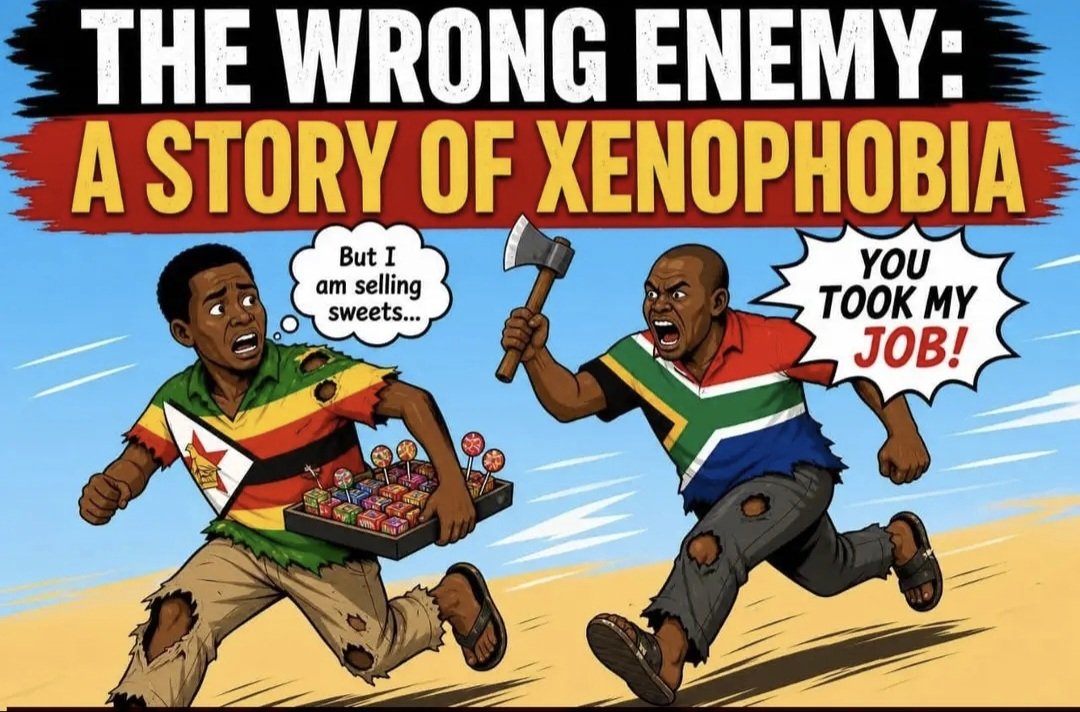
“Amashangani awaphume,” she shouts in KwaZulu-Natal. The hate in her voice is frightening and disgusting at the same time. They started off by saying they were going after illegal foreign nationals, then they began looting shops owned by legal foreign nationals.
Now they are turning on other tribes and ethnic groups within South Africa itself. You can hear her saying that the Shangaan should go. The Shangaan are an ethnic group indigenous to South Africa, found mostly in Limpopo and Mpumalanga provinces. This is also used interchangeably to refer to foreigners, those that don’t belong to that ethnic group.
Yesterday, they claimed they were targeting Amashangani, only to end up looting shops in KwaZulu-Natal owned by their own Zulu kith and kin. As events unfolded, it became clear that many of the businesses they were attacking belonged to the very people they claimed to be defending.
This is exactly what many warned would happen, that once hatred and lawlessness are normalised, they do not stop with the original target. They eventually consume everyone physically and economically.
The main question being asked quietly in international diplomatic circles and by foreign leaders is this; where is the South African state while all this is happening? How can such acts of intimidation, vigilantism, violence, economic vandalism and looting continue in broad daylight without decisive intervention from law enforcement and the authorities?
Imagine a country with an unemployment rate of between 30% and 35%, yet businesses that employ people are being shut down while the authorities simply watch.
At a time when every job matters, productive businesses should be protected, not allowed to become targets of looting, intimidation, mob violence and lawlessness.
The economic damage of such actions extends far beyond the businesses themselves, affecting workers, their families, investor confidence, and the country’s reputation.
The longer this continues, the greater the damage to South Africa’s reputation, social cohesion, investor confidence and standing in the world.
“Amashangani awaphume” is being used to mean “foreigners must go.”
What makes this chant particularly troubling is that it shows how language associated with a specific ethnic group has been transformed into a broader and hostile label for people perceived to be outsiders.
The term Shangaan traditionally refers to an ethnic group found mainly in parts of South Africa, Mozambique, Zimbabwe and Eswatini. However, in this case, the word amashangani has been used loosely and derogatorily to describe foreigners in general, regardless of their actual ethnicity or nationality. Foreigners to the province and country.
When crowds chant “amashangani awaphume” (“the Shangaan must leave”), the slogan therefore takes on a xenophobic meaning, targeting people viewed as outsiders rather than members of a particular ethnic group.
This kind of rhetoric is dangerous because it blurs the line between ethnic identity and nationality, fuels prejudice, and can encourage hostility against both foreign nationals and fellow South Africans who are wrongly perceived as belonging to the targeted group. South Africa can do better than this.
Meanwhile, the real owners of South Africa’s economy are enjoying the weekend playing polo and drinking expensive red wine with caviar. The black man continues to be a curse not only to himself, but also cannot understand why he is poor and living in abject poverty. However, his actions explain why he continues to be poor. Shame.