After 14 and a half years, having met incredible people, landed multiple jobs, created nationwide campaigns in education, business and politics, I have concluded Twitter died a long time ago. I’m now deleting the app. Love to all of you who made this place incredible.
@anandMenon1 In a Twitter chat, you once helped me get my head around Brexit. Quantum computing probably needs a coffee — DM me and I’d happily answer all your questions in person (my day job is communicating quantum computing)
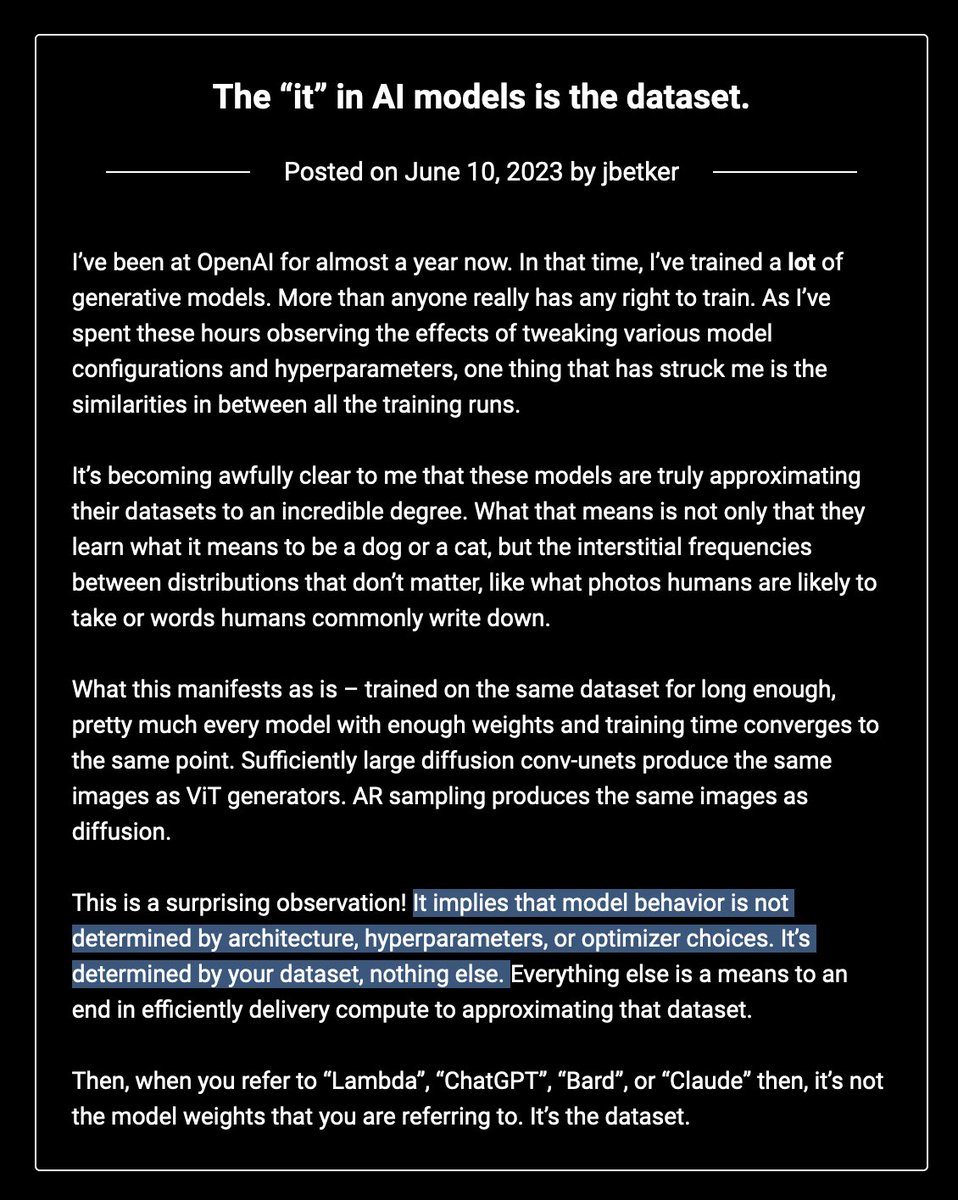
Large language models strongly reflect their training data, outweighing any choices in the algorithms’ structure or biases.
They truly are gargantuan averaging machines, no more, no less
interesting post from an OpenAI employee claiming that all large language models reach the same endpoint regardless of training strategy or clever tricks
this is of course what the bitter lesson teaches us but useful to get an up to date confirmation that it still holds true
@OriginalBored@C_Hendrick Without wishing to speculate too much, it seems likely to me that for people with reading difficulties, it may well be the case that voice interfaces provide faster and better access to knowledge and to store information for later use
If you’re following quantum computing developments, I strongly recommend Earl’s observations from QEC. Despite talk of quantum winter, we’re at the start of a golden age for error-correction and fault tolerance. Now is the best time to be in QC that has ever been.
There’s a situation in chess known as a “zugzwang”: when one player finds themselves facing a state of play where every possible move will weaken their position.
This is where Rishi Sunak finds himself in regard to Suella Braverman, writes @RMCunliffe. https://t.co/QrPZb5xuWV
Quantinuum and its industry partners are working to accelerate the advent of useful quantum computational chemistry, which has the potential to revolutionize areas such as drug discovery and next-generation material design.
Learn more in this webinar: https://t.co/9NWxLKEvgQ
Altman, Hassabis, and Amodei are the ones doing massive corporate lobbying at the moment.
They are the ones who are attempting to perform a regulatory capture of the AI industry.
You, Geoff, and Yoshua are giving ammunition to those who are lobbying for a ban on open AI R&D.
If your fear-mongering campaigns succeed, they will *inevitably* result in what you and I would identify as a catastrophe: a small number of companies will control AI.
The vast majority of our academic colleagues are massively in favor of open AI R&D. Very few believe in the doomsday scenarios you have promoted.
You, Yoshua, Geoff, and Stuart are the singular-but-vocal exceptions.
like many, I very much support open AI platforms because I believe in a combination of forces: people's creativity, democracy, market forces, and product regulations.
I also know that producing AI systems that are safe and under our control is possible. I've made concrete proposals to that effect.
This will all drive people to do the Right Thing.
You write as if AI is just happening, as if it were some natural phenomenon beyond our control.
But it's not. It's making progress because of individual people that you and I know. We, and they, have agency in building the Right Things.
Asking for regulation of R&D (as opposed to product deployment) implicitly assumes that these people and the organization they work for are incompetent, reckless, self-destructive, or evil. They are not.
I have made lots of arguments that the doomsday scenarios you are so afraid of are preposterous. I'm not going to repeat them here. But the main point is that if powerful AI systems are driven by objectives (which include guardrails) they will be safe and controllable because *e* set those guardrails and objectives.
(Current Auto-Regressive LLMs are not driven by objectives, so let's not extrapolate from their current weaknesses).
Now about open source: your campaign is going to have the exact opposite effect of what you seek.
In a future where AI systems are poised to constitute the repository of all human knowledge and culture, we *need* the platforms to be open source and freely available so that everyone can contribute to them.
Openness is the only way to make AI platforms reflect the entirety of human knowledge and culture.
This requires that contributions to those platforms be crowd-sourced, a bit like Wikipedia.
That won't work unless the platforms are open.
The alternative, which will *inevitably* happen if open source AI is regulated out of existence, is that a small number of companies from the West Coast of the US and China will control AI platform and hence control people's entire digital diet.
What does that mean for democracy?
What does that mean for cultural diversity?
*THIS* is what keeps me up at night.
After 35 years, Black Tish finally released their first album and their second album to boot. Now @coecke is working on the first post-metal industrial album including compositions by quantum computers. Cannot wait!! https://t.co/4Lbehl2mUj
Can hardly believe this is real. Beautiful modern design. The tapered pylons and hanging carriages are awesome — compare this to streets full of traffic jams
A short film from 1902 of a German suspended railway called the Wuppertal Schwebebahn, shot in 68 mm, colorized and upscaled in 4K.
It shows an unusual drone-like view of a German city at the beginning of the 20th century.
[📹 MoMA]
With the promising results of Quantum Signal Processing on @QuantinuumQC 's H1-1 trapped-ion QPU, we continue to work on the challenges of scaling up this protocol for NISQ-era computers.
Go #QuantumComputing 🚀
During a solar eclipse, the gaps between leaves on trees act as multiple pinhole cameras,
and each gap projects its own crescent-shaped image of the eclipsed sun onto the ground.
📹gottigreen
A little over 3 years ago, I wrote that generative AI would threaten the agency model.
Has any comms agency started to tackle this yet?
https://t.co/n8njXwoYyS #pr#communications