I'm super proud to announce the release of Pedalboard, a new Python library my team just open-sourced. Use VST and Audio Unit effects from Python in just a couple lines of code!
What if you could add studio-quality effects to your audio purely through #code?
Welcome to Pedalboard, a new, #opensource library from the @Spotify Audio Intelligence Lab.🔊🧪
https://t.co/3C1saMsNAZ
wild to me that people vibe-generate slides for conference talks
they are ugly (for now). they are low info densiry (thanks rlhf)
but worse, they don't represent your thoughts, so your presentation of them will be terrible, unless you put in a ton of work (so just write them!)
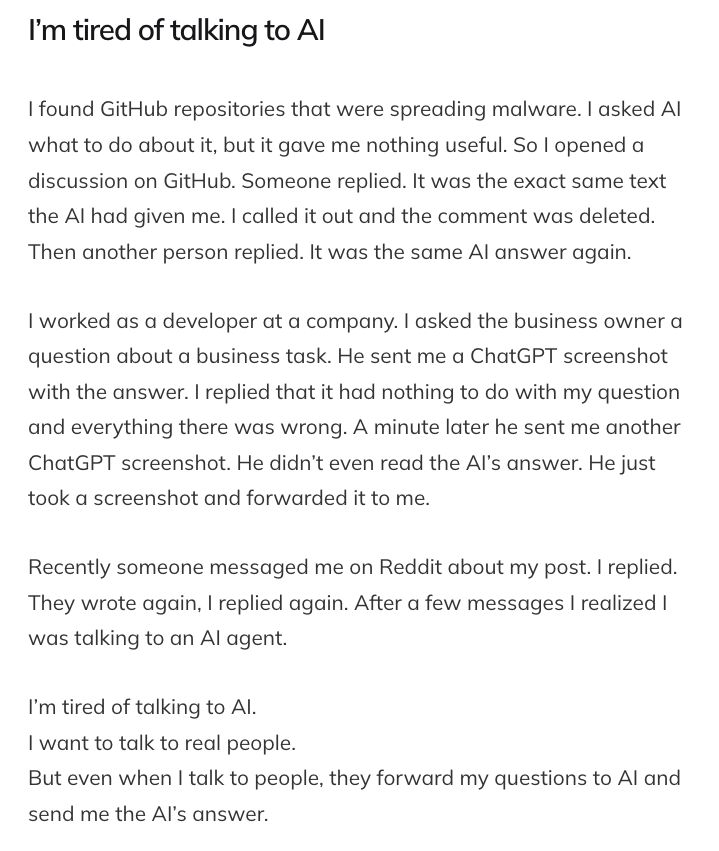
I’m starting to repeat a new mantra all the time: “Use your words, not AI’s.”
Every time someone tries to argue against this, I’m even more convinced.
AI is great! Just don’t put your name on its output without attribution, or I can’t trust that you even read what you “wrote.”
There is so much value to concise, simple, writing.
Really tired of seeing 20 page monologues that are half wrong.
Here's a challenge: Make it 1 page and use your own voice.
There is a premium right now for thoughtful writing.
As is tradition, I did something impromptu and dumb for @pycon this year: FlopPyPi, a floppy-disk-based PyPI mirror.
A handful of popular packages are now being distributed throughout the conference by hand, like this one.
my friends back in canada: "why do you use amazon so much in the states? doesn't it suck?"
here are the top two results for the same exact search query on .com and .ca
@cursor_ai is my favourite AI coding tool, full stop. Huge fan. But I have never seen a product play so fast and loose with remapping commonly-used keyboard shortcuts.
After 15 years, I just got rid of my last Drobo product. I saved up for a used original Drobo in 2011, and just today retired my Drobo 5N and gave it to a friend.
I still think about Drobo regularly - it was innovative technology deployed really well, and with style. Disks were expensive back then ($150/TB adjusted for inflation!) and people wanted to buy an extra terabyte at a time instead of having to do a big migration every time they needed more storage.
It was perfect for consumers who were price-sensitive enough that buying bigger and bigger drives was not an option, but buying an elastic NAS was still within their price range.
If you had less money, you couldn't afford one. But if you had *more* money, you had no need for a Drobo. Why spend $500 on an elastic NAS that could scale to 40TB when a single 20TB drive only cost $600 in 2020? Not to mention the rise of cloud storage and its plummet in price, the rise of high-efficiency media compression, etc.
Every time I think about building a new product, I remember Drobo. Technically solid, elegantly built, impressively designed, but useful for only a tiny subset of users for about a decade.
Reminds me of Peter Naur's classic 1985 essay "Programming as Theory Building" which argues that a program is not its source code. A program is a shared mental construct (he uses the word theory) that lives in the minds of the people who work on it.
If you lose the people, you lose the program. The code is merely a written representation of the program, and it's lossy, so you can't reconstruct a program from its code.
If you think of total software debt as technical debt + cognitive debt, then previously, we mostly had technical debt. Now with AI we have both.
Previously, when you built something, you accumulated technical debt but relatively little cognitive debt because you had to understand what you were building in order to build it.
In other words: the theory came for free as a byproduct of the work.
AI breaks that coupling. Now you can produce code without building the theory.
So you're now able to accumulate both kinds of debt simultaneously - technical debt in the code and cognitive debt in yourself. And cognitive debt is arguably worse because you can fool yourself into believing it doesn't exist.
Technical debt tends to show up in semi-obvious ways that we understand well as an industry.
Cognitive debt is more insidious - it means you're unable to even reason about the program (because you possess no theory of it) - which is what Naur describes as the "death" of a program.
As an ML practitioner, this is extremely exciting for the promise of - finally! - statically typed tensor shapes. Nice work @1st1!
https://t.co/4iDrjIL9xv
Please welcome PEP 827 -- the result of a year-long research into what would it take to uplift Python's type checking to match its dynamism.
https://t.co/nLzVDS0kfB
One of the biggest dangers of using AI agents to "just write this quick tool for me" is that it'll get you 90% of the way there after a couple of hours; when you could have instead spent those hours using a much better tool that someone else has already created.
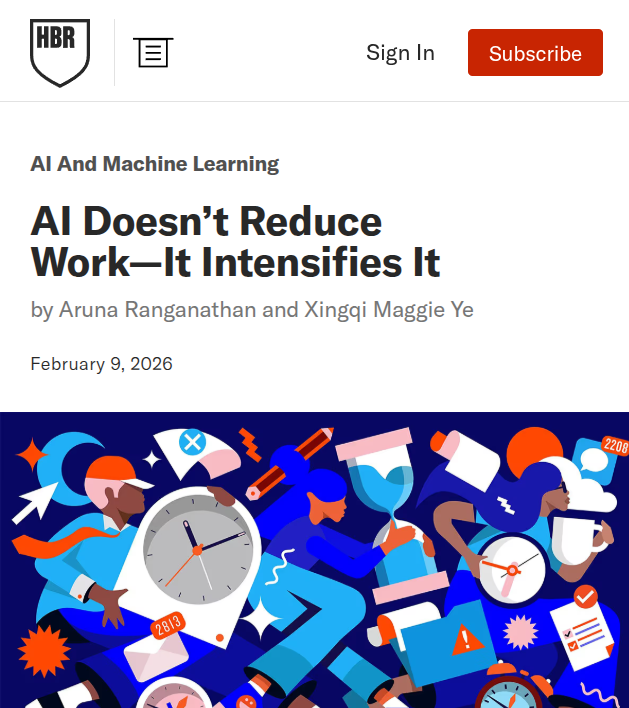
Powerful new Harvard Business Review study.
"AI does not reduce work. It intensifies it. "
A 8-month field study at a US tech company with about 200 employees found that AI use did not shrink work, it intensified it, and made employees busier.
Task expansion happened because AI filled in gaps in knowledge, so people started doing work that used to belong to other roles or would have been outsourced or deferred.
That shift created extra coordination and review work for specialists, including fixing AI-assisted drafts and coaching colleagues whose work was only partly correct or complete.
Boundaries blurred because starting became as easy as writing a prompt, so work slipped into lunch, meetings, and the minutes right before stepping away.
Multitasking rose because people ran multiple AI threads at once and kept checking outputs, which increased attention switching and mental load.
Over time, this faster rhythm raised expectations for speed through what became visible and normal, even without explicit pressure from managers.