New paper with @paolo_agnolin and Italo Colantone: in a way, I wish we didn’t have to write it --it's just another primer on post-treatment bias. But it’s a fun paper...We show how one can break some of Colantone and Stanig's earlier results (i.e., ours!) https://t.co/pwbzFjBFyv
https://t.co/YuvikvPiVN Come work with me! Bocconi is a potential host of the Marie Skłodowska-Curie Actions postdoctoral fellowships, and I am one of the available supervisors, considering projects related in general to the politics of technological change.
"Copiare (in modo asimmetrico) senza davvero imparare. La lezione dalla pandemia e i rischi per le prossime crisi" assieme a @PStanig e @Giammacco abbiamo pubblicato un articolo scientifico a riguardo. Qua un mio riassunto divulgativo @24infodata. https://t.co/FBnsrLcjr6
In 2021, @PStanig and I wrote a critical book on lockdowns.
In a follow-up paper (with @Curini) we study how governments copied each other and why few rolled measures back: restrictions remained also for political, not only health reasons
https://t.co/mnSyKpemiS
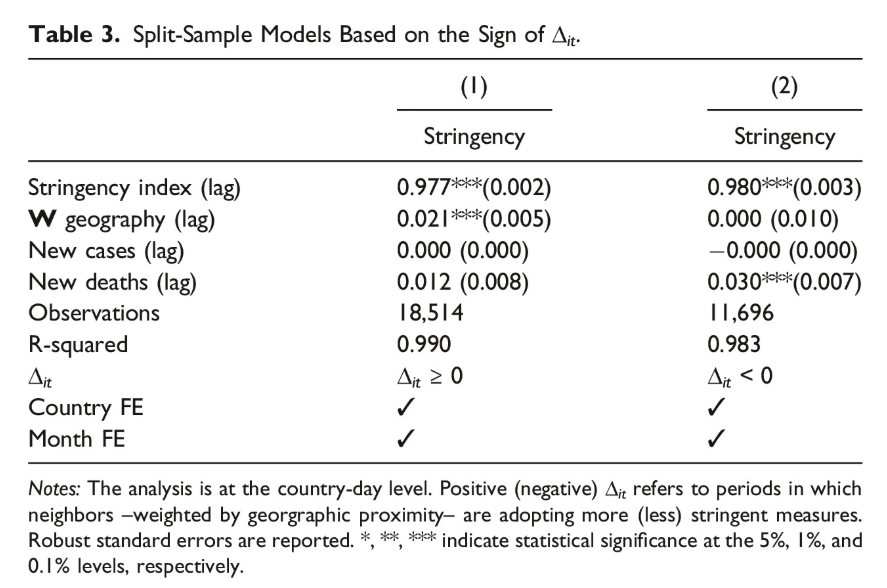
"The Asymmetric Spread of COVID-19 Policies" just published in Comparative Political Studies together with @PStanig and @Giammacco. We empirically document a systematic link between a country’s stringency index and the measures adopted by its neighbors in the preceding days (1/3)
@edenhofer_jacob@jonmummolo@Giammacco 5) the intrusive policies we were subjected to created a dangerous precedent in terms of the powers of the state and individual rights.
@edenhofer_jacob@jonmummolo@Giammacco 4)there is no evidence that Italian lockdowns worked particularly well in terms of saving lives; but the economic consequences (and the broader consequences of school closures) were enormous.
@edenhofer_jacob@jonmummolo@Giammacco I wish. I had (and still have) no idea regarding how to approach a US or UK publisher to translate it as a trade book, and going through the whole process to get a contract for an academic book on this topic was not my professional priority…
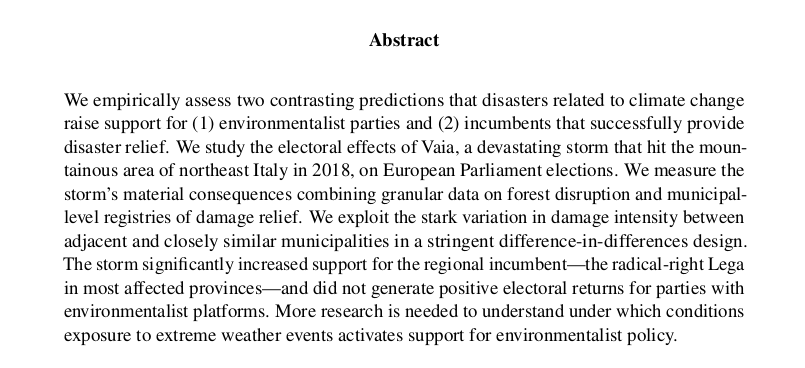
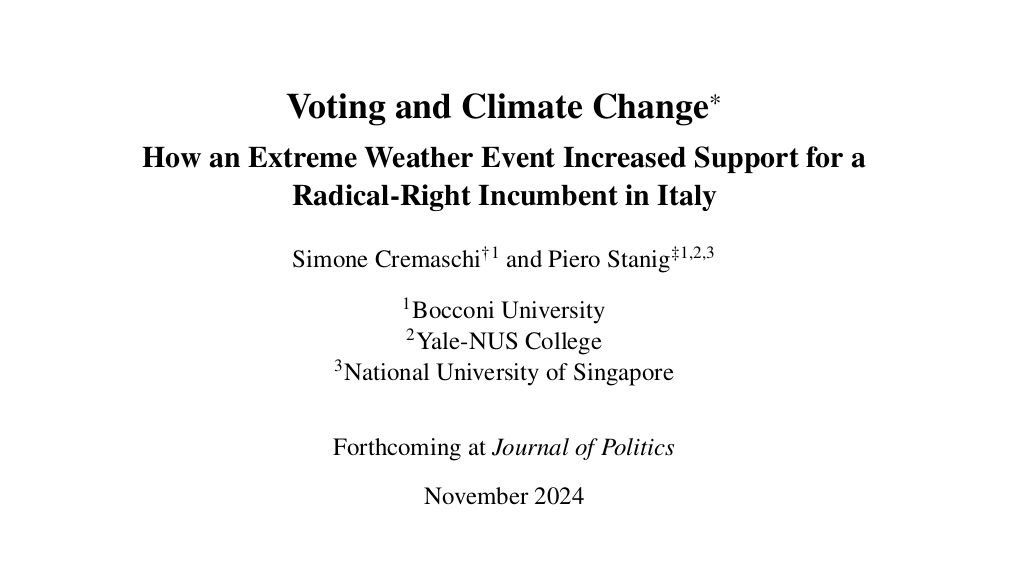
🚨 New paper 🚨 with @PStanig forthcoming at @The_JOP 🎉 about the political consequences of climate-related disasters 🌲⛈️⚠️
Pre-print 👉 https://t.co/N1PczfrBDk
Summary 🧵👇
Quick reminder that, yes, “PhD admission email season” is indeed here but you should not share emails on here that potential students send to you in good faith and in confidence. Doesn’t matter if they have a typo, or are annoying or anything else. Just not cool.
Is it possible to separate the effects of economic shocks from cultural concerns in voting behavior?
🚨New paper at @cps_journal🚨Italo @PStanig & I address the methodological difficulties in making such distinctions and provides new evidence on the globalization backlash
1/5
Does mediation analysis help in this setting, you might ask? Maybe. But using principal stratification following Forastiere et al., we clarify what the ignorability assumptions for causal mediation imply: these are not just technical assumptions, they are loaded with substance.
New paper with @paolo_agnolin and Italo Colantone: in a way, I wish we didn’t have to write it --it's just another primer on post-treatment bias. But it’s a fun paper...We show how one can break some of Colantone and Stanig's earlier results (i.e., ours!) https://t.co/pwbzFjBFyv
We also argue --quite forcefully-- that simpler models (without bad controls) may offer more relevant policy insights than complex models that aim at testing many different stories at once, but can ultimately mislead on each one of them.