Neuro-Linguistic Programmer.
Enneagrammarian.
Coach.
Integrating Neuro-Linguistic Programming with Virtue Ethics to become who you want to be.
#NLP#Enneagram
Attention is a tiny altar. Only one thing can be placed on it at a time. The trick is not “how do I focus harder”the trick is asking, again and again:
• What am I currently worshipping?
• Did I choose it?
• Is it worthy of the hour I’m giving it?
The window of attention is never empty.
If you don’t put something precious inside it, something loud will climb in and sit there wearing a crown.
A reminder from Atomic Habits by James Clear:
“It doesn't make sense to continue wanting something if you're not willing to do what it takes to get it. If you don't want to live the lifestyle, then release yourself from the desire. To crave the result but not the process is to guarantee disappointment.”
A Russian psychologist spent 10 years proving that the act of talking to yourself out loud is one of the most powerful cognitive tools the human brain has, and almost nobody outside his field has read the work.
His name was Lev Vygotsky.
He worked in Moscow in the 1920s and died of tuberculosis in 1934 at the age of 37. He had no laboratory, no funding, almost no English readers, and a body of work that the Soviet government suppressed for two decades after he died.
He produced the foundational theory of how human cognition actually develops, and the central piece of that theory was a behavior almost every adult is faintly embarrassed about.
Vygotsky noticed that young children talk to themselves constantly. They narrate their own actions, they argue with imaginary opponents, they instruct themselves through tasks out loud.
The dominant theory at the time, from the Swiss psychologist Jean Piaget, said this was a sign of cognitive immaturity that children would eventually grow out of as they learned to think properly.
Vygotsky said the exact opposite.
He argued that this self-directed speech was the most important cognitive event in the entire developmental window, because it was the moment a child first started to use language as a tool to control their own mind. The child was not failing to think. The child was learning how to think by externalizing the process and listening to themselves do it.
He predicted that as children matured, this out-loud self-talk would not disappear. It would go underground. It would become silent inner speech, which is the running monologue every adult has inside their own head for the rest of their life.
The voice you hear when you read this sentence is the direct descendant of a four-year-old narrating their own block tower.
For 50 years almost nobody outside Russia had access to his work, and the few researchers who did pick it up could not get funding to test it. Then in the early 2000s the experiments finally started to pile up, and what they found was that Vygotsky had been right about something even more important than he knew.
The first major study came from Gary Lupyan at the University of Wisconsin and Daniel Swingley at the University of Pennsylvania in 2012. They ran a simple visual search experiment. Participants were shown 20 images at once and asked to find a specific object, like a banana or a chair. In one condition they searched silently. In the other condition they were told to say the name of the object out loud to themselves while looking for it.
The participants who spoke the target name out loud found the object significantly faster, with higher accuracy, than the participants who searched in silence. The effect was strongest when the spoken word matched a familiar object the brain already had a strong category for.
Saying the word out loud literally tuned the visual system to detect that thing better. The researchers called it the label feedback effect, and the implication was that the act of vocalizing a goal physically changes how the brain processes the world while pursuing it.
The second major study came out of the University of Michigan and Michigan State in 2017. The lead researchers were Ethan Kross and Jason Moser, and they used both EEG and fMRI to record what happens inside the brain when people talk to themselves while emotionally upset.
They asked participants to recall painful autobiographical memories and reflect on them in two different ways. Some used the first person, saying things like "why am I feeling this way." Others used the third person, referring to themselves by their own name, saying things like "why is John feeling this way."
The brain scans showed that the simple act of switching from first person to third person, even silently, decreased activity in the medial prefrontal cortex, the region responsible for rumination and self-referential pain. Within a single second of using their own name instead of the word I, participants showed measurably lower emotional reactivity. The shift required no extra cognitive effort. It cost the brain nothing. And it worked.
Kross described the mechanism in his interviews. Talking to yourself by name creates a small amount of psychological distance from your own experience. Your brain processes the situation more like a problem belonging to someone else, which means it can analyze it instead of drowning in it.
What Vygotsky had intuited in 1934 turned out to be even more powerful than the developmental theory he built it into. The voice you use to talk to yourself is not background noise. It is one of the most precise cognitive tools the brain has, and you can change how it works just by changing the pronoun you use.
People who talk through problems out loud are not anxious or unstable. They are running an externalized version of a process the rest of us are running silently and worse. The kindergartener narrating their block tower, the surgeon muttering through a procedure, the engineer pacing a hallway describing a bug to nobody, the athlete repeating a cue to themselves before a free throw, they are all using the same ancient mechanism that builds and steers human thought.
You can run the experiment yourself the next time you are stuck on something hard. Stop trying to solve it silently in your head. Say it out loud. Describe what you are seeing. Walk yourself through the steps as if you were explaining it to a colleague who is not in the room.
And when something genuinely upsets you, switch to your own name. Ask why this person is feeling this way, instead of why I am feeling this way.
The voice you have been told to keep quiet your entire life is one of the oldest pieces of cognitive technology you own.
Most people are still embarrassed to use it.
Spend around 10–30 minutes a day visualizing a version of yourself that you are deliberately trying to build. Do it when your mind is already calm, especially in the evening or just before sleep, because the mind accepts imagery more easily when it is not being pulled in different directions.
The basic idea is simple. The brain treats repeated internal experience as something important. When a certain kind of situation is lived again and again in imagination, with enough detail and emotional weight, it starts to lose its “imagined” quality and becomes something your mind recognizes as familiar territory.
And what becomes familiar stops feeling impossible.
Old patterns weaken in this process not because you fight them directly, but because you stop feeding them the same mental rehearsal. At the same time, new patterns begin to stabilize because they are being repeatedly experienced internally before they ever exist externally.
Start by settling your body. Slow breathing. Less tension in the face, shoulders, stomach. You are not trying to force anything, you are just lowering internal noise.
Then choose one specific scene. Not an abstract goal. A moment. Something you can step into mentally.
If it is health, do not think “I want to be healthy,” instead see yourself moving through a normal day with physical ease, walking without effort, breathing clearly, feeling your body light and responsive.
If it is confidence or success, see yourself in a real situation where you would normally hesitate, but now you speak without that hesitation, you are steady, direct, and things unfold without internal resistance.
If it is discipline, see yourself already inside the routine, doing the work without negotiation, as if it is simply what you do.
Always stay in first person. Through your own eyes.
What is directly in front of you. What is under your feet. The texture of the environment. The light in the space. The small details your attention would normally skip.
Then sound. The way voices actually enter the space. The rhythm of your breathing. Any background noise that belongs to that environment.
Then physical sensation. The weight of your body. Temperature on the skin. The sense of movement. The way you occupy space when you are not resisting yourself.
Emotionally, you are not trying to force excitement. You are allowing a quieter set of states to appear. Relief that things are simple. A sense of “this is already how I operate.” A quiet internal stability that does not need justification.
You are not building a fantasy. You are rehearsing familiarity.
At the end, stop adding detail and just remain in the general felt sense of it for a short moment, as if your mind has already accepted it as normal.
Let that feeling continue lightly as you move into the rest of your day.
Repeat it often enough that the scene stops feeling like something you are trying to reach, and starts feeling like something your mind already knows how to do.
Andrew Huberman gave the simplest anxiety reset I’ve heard in a while on the Nine Club.
When you’re stressed, your lungs’ tiny air sacs collapse and CO2 builds up. The fix? The physiological sigh: two quick inhales through your nose (second one shorter), then a long exhale through your mouth. One or two of these and you offload the CO2 and calm down fast.
I’ve tried it a few times when my mind was racing and damn — it actually works in seconds. No apps, no meditation marathons, just basic physiology.
We’re all dealing with more stress than ever, and having a tool this quick and free that actually changes your nervous system is huge.
Tried the double inhale + long exhale trick yet? Does something this simple work for you when you’re spiraling?
Tony Robbins hit hard on Theo Von’s podcast:
Major meta-analyses (including the 2022 Newsweek cover story) show SSRIs barely beat placebo for most people. A 2023 JAMA Psychiatry review found only modest effects overall (SMD 0.42).
Yet when Robbins asks big audiences “Who knows someone on antidepressants who’s still depressed?” 95% raise their hands.
Compare that to a Johns Hopkins psilocybin study (54% full remission) and Robbins’ drug-free 6-day seminar that got 100% of participants symptom-free after just six days.
The default treatment isn’t delivering for most people. We need to talk about better options.
This made me rethink how quickly we default to medication instead of fixing root causes.
Do you think we’re over-relying on SSRIs?
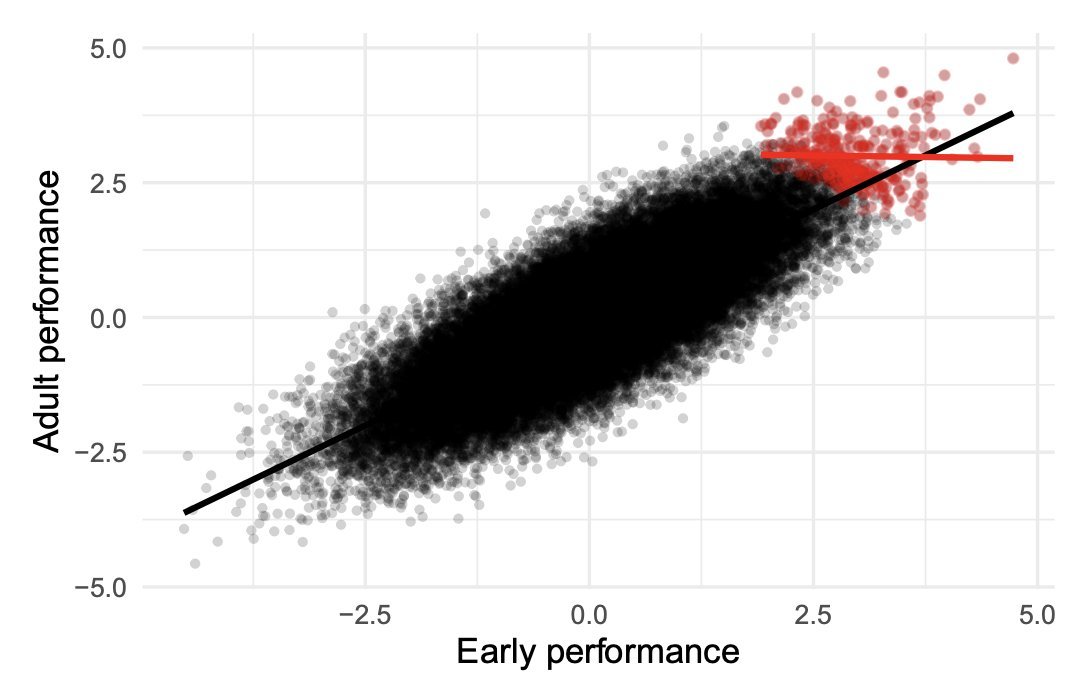
Among elite chess players, those with the lowest IQ are the best.
Among NBA players, the shortest ones are the best.
Among Hollywood actors, the least attractive are the most talented.
Among elite academics, those with poorer early academic performance are the best.
Among people with high LDL & high plaque burden, LDL is barely correlated with plaque burden.
Learn collider bias. Nice catch by @AlexTISYoung
Tolstoy believed most men die without ever truly living.
He explains in his novella, "The Death of Ivan Ilyich."
Protagonist Ivan spends his entire life doing what society told him was "proper":
Get a good career, model wife, follow aristocratic social practices.
To an outsider, he looks successful, but a closer look reveals that Ivan's soul is rotting from the inside out. He grows ill, and on his deathbed, becomes haunted by a horrifying realization:
"What if my entire life was a lie?"
Ivan's life of vanity and decadence led to emptiness and loneliness. Even his friends and family don't care for the dying man.
Tolstoy's insight is that the greatest human tragedy is not death itself, but reaching death only to discover that you never truly lived at all.
Modern people tend to think of death as a distant abstraction that applies to humanity in general, but somehow not to themselves personally. Tolstoy shatters this illusion:
He shows that most know intellectually they will die, yet they live as though they are immortal. They distract themselves with status, entertainment, careerism, and social approval, such that they never have to confront what mortality actually means. But the terrifying power of death is that it destroys one's illusions.
And in that moment, all the things society told you mattered suddenly reveal themselves to be hollow.
However, Tolstoy does not present this realization as nihilistic... in fact, quite the opposite.
He suggests that only by fully confronting death can man begin to live authentically. Only when you realize your time is finite do cowardice and conformity lose their grip over you.
The fear of death, then, is not something to suppress, but something capable of awakening the soul.
A man who learns how to *die* is finally capable of learning how to live.
Every time you recall a memory, it becomes plastic again, you can rewrite it. This is how therapy works.
But it’s also how false memories form. Every time you remember something, you’re not accessing a file, you’re rebuilding it. And you might rebuild it wrong.
Your brain is constantly rewriting your past. You’re not remembering your childhood, you’re remembering the last time you remembered your childhood.
Your history is neuroplastically unstable.
“Talking about your problems all the time makes them grow bigger.”
Joe Rogan had a genuine lightbulb moment when Abigail Shrier explained this on his podcast.
Constant rumination — obsessively thinking and talking about your pain — is the #1 symptom of depression. Science backs this up: longitudinal studies show ruminators are up to 4 times more likely to develop major depression, and it actively prolongs depressive episodes by strengthening negative neural pathways.
The best therapists (especially CBT and DBT) focus on breaking that cycle immediately, while many others just let you stay stuck rehearsing your suffering.
Sometimes the most radical (and effective) thing you can do for your mental health is to stop feeding the loop and take action instead — even if it’s just going for a walk or running an errand.