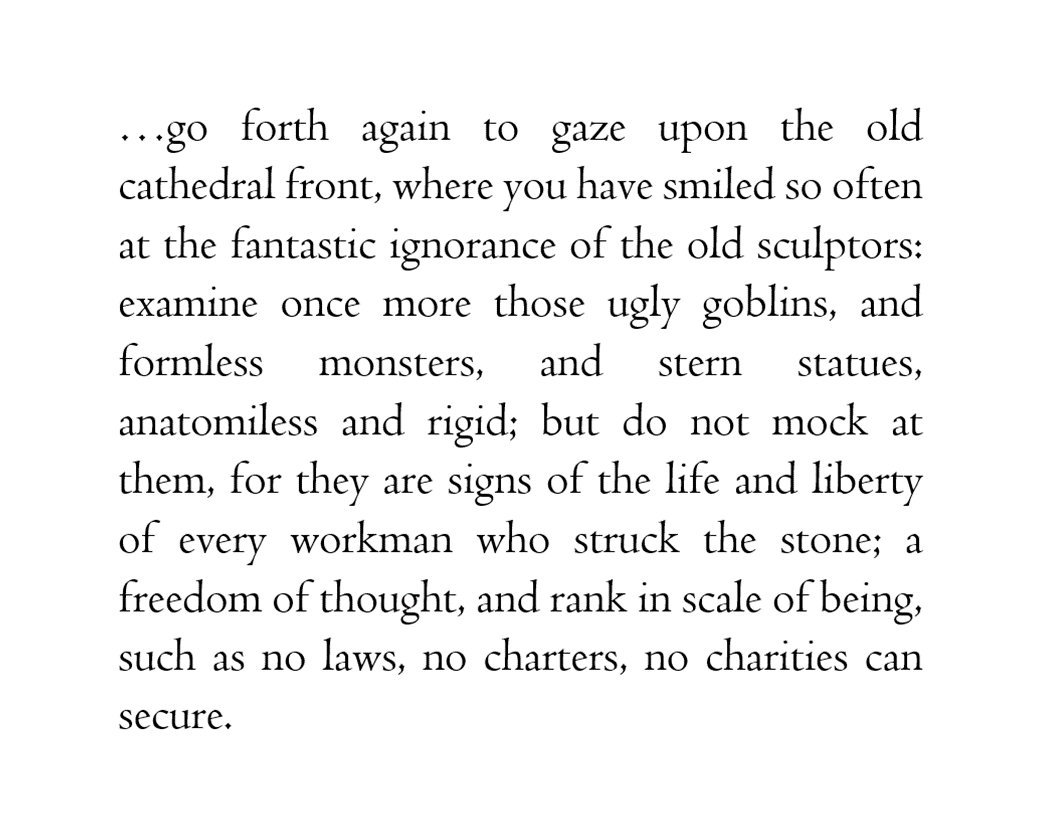
Ruskin’s romantic defence of Gothic from critics such as Vasari – who believed Gothic was “imperfect” because of its non-classical proportions – misses the mark because Gothic actually follows strict geometric principles. It isn’t “disorderly” OR “a symbol of liberty”. 🧵
And, even more importantly, Ruskin argued that the very imperfection of Gothic Architecture represented the creative freedom of the people who had made it — a freedom which workers in the 19th century did not have.
Gothic imperfection is a symbol of liberty.
I’m trying to build a series of memory palaces for the entire Bible, where each book is represented by a building containing loci that correspond to a chapter outline or key moment. I then test myself on them using Anki spaced repetition.
@luther_snell@giantgio Variety is about avoiding overuse and, if you care about aesthetics, targeting muscles that compounds don’t hit well (e.g. triceps long head) or are lagging
@giantgio Not necessarily – I’d like the stack for overhead cable extensions and especially rowing variations for back – but there are many tricep extension variations for long and short heads with those, especially if you have an adjustable bench.
@LandsharkRides In a world of pole climbing treachery, fake CVs, fake achievements, the one thing you can’t fake is looking like a menacing Chinese supervillain goon. So this makes sense.
@MilkAnd15244 The full quote is quite interesting. He talks about “the necessary step of faith” and of philosophers “worshiping the elements of this world.”
Augustine describes God’s enemies as “all who forbid belief in things unknown and promise certain knowledge” – today’s naive scientific realism in a nutshell
@MilkAnd15244 Augustine didn���t say ALL things unknown. But it is in theory possible to defend the position that Christian theism is our best scientific theory – this I think is essentially what @InspiringPhilos does. But it isn’t the route I’d take.
I’m also experimenting with AI to help draft 50-word chapter outlines. I’m mostly doing this on my phone, so I read the chapter on Catena, get the summary from ChatGPT, paste into Notes to edit, add the image/loci, and paste into Anki. I can do about 5 chapters in 30 minutes.
Update: I have now completed Genesis–Judges. I am hoping to finish by Christmas. The major difficulty isn’t remembering the information encoded by each loci/image, it’s getting to the right place in the memory palace – especially larger ones.
I’m trying to build a series of memory palaces for the entire Bible, where each book is represented by a building containing loci that correspond to a chapter outline or key moment. I then test myself on them using Anki spaced repetition.
I may experiment with adding additional images using Major System every 5 chapters so that I can immediately access chapters furthest from the beginning, middle, and end of each book. But I haven’t mastered Major yet, and it may make the system unnecessarily complicated.