Today, @Stendr_tech announces a $5.4M pre-seed round. One of the largest in Nordic Defence Tech history.
When I stepped away from Sky Mavis, I had nearly eight years of hard lessons in my pocket. What it takes to survive near-bankruptcy. What it takes to find product-market fit. What it takes to scale something real under pressure.
Speed and focus. The startups that win move faster than anyone thinks is reasonable, and cut everything that does not serve the mission. Those lessons apply everywhere. Especially in defence, where the cost of moving slowly is measured in lives.
Stendr is building the foundational technology stack for a new Nordic defence prime: an AI-native platform for the rapid development and deployment of defence software and hardware. Built to perform today and adapt to the warfare of tomorrow.
The immediate problem we are pursuing is among the most urgent in modern warfare. Drones have changed what the battlefield looks like, and Europe's detection and response capability has not kept pace. We are building the sovereign technology to close that gap.
Norway is where we are building it. The engineering talent is world-class, the strategic context is clear, and the window to build something foundational is open.
I am building it alongside Robin Alexander Holm Pedersen, one of the most versatile engineers I have met, and Markus Leonhard Hansen, who built Gungnir of Norway from nothing into a globally recognized hardware brand. Together, we have the software, AI, and hardware depth to build something that lasts.
A big thank you to Rainfall Ventures, ACME, Skyfall Ventures, Sisyphus Ventures, Antler, Startuplab, Max Samuel, Magne Uppman, Thomas Falck, Tord Moe Laeskogen, BORGET Sebastien, Arthur Madrid, Joachim Haraldsen, Alex Svanevik, Kenneth King, Jeffrey Zirlin, Sandeep Nailwal, Stephen McKeon, Marcus Krylborn, Yat Siu, Michael Arnold, Einar H. Braathen, Sebastian Almnes, Thuc Hoang and Andreas Helbig for backing me to build again, and from Norway no less. It truly means everything.
We are hiring a software architect, senior electronics and cybernetics engineer, and growth operations lead. The people who join now will help define what European defence looks like for the next generation.
Apply at https://t.co/Eu0DhUw2TL
There have been 9 European companies that have raised $1bn+ rounds so far in 2026.
15 years ago people doubted whether Europe could produce billion dollar tech companies.
Now there are tech companies here raising billion dollar ROUNDS, and so far in 2026 there have been 9 of them:
> Isomorphic Labs: $2.1bn
> Nscale: $2.0bn
> Stegra: €1.4bn
> NEURA Robotics: $1.4bn
> Helsing: Raising $1.2bn
> Wayve: $1.2bn
> Ineffable Intelligence: $1.1bn
> Quantum Systems: €1.0bn
> Amilabs: $1bn
Europe is cooking.
Norwegians are hard working, have high intergrity and like to win
Im glad this World Cup is waking up the national pride
Politically the winds are shifting and I expect us to have more favourable terms for startups very soon
Norway szn 🇳🇴
As I’m getting back to building from scratch I see many founders surprised at VCs and their incentives
VCs want a 100x+ to return the fund that’s it.
If you don’t fit that mold then don’t waste your time trying to raise.
Home run or bust.
The talent density, culture and educations levels are similar in Norway and Sweden but Sweden owns us when it comes to breakout startups
On the bright side, it means the few Norwegian startups with a great vision can recruit exceptional people without much competition locally
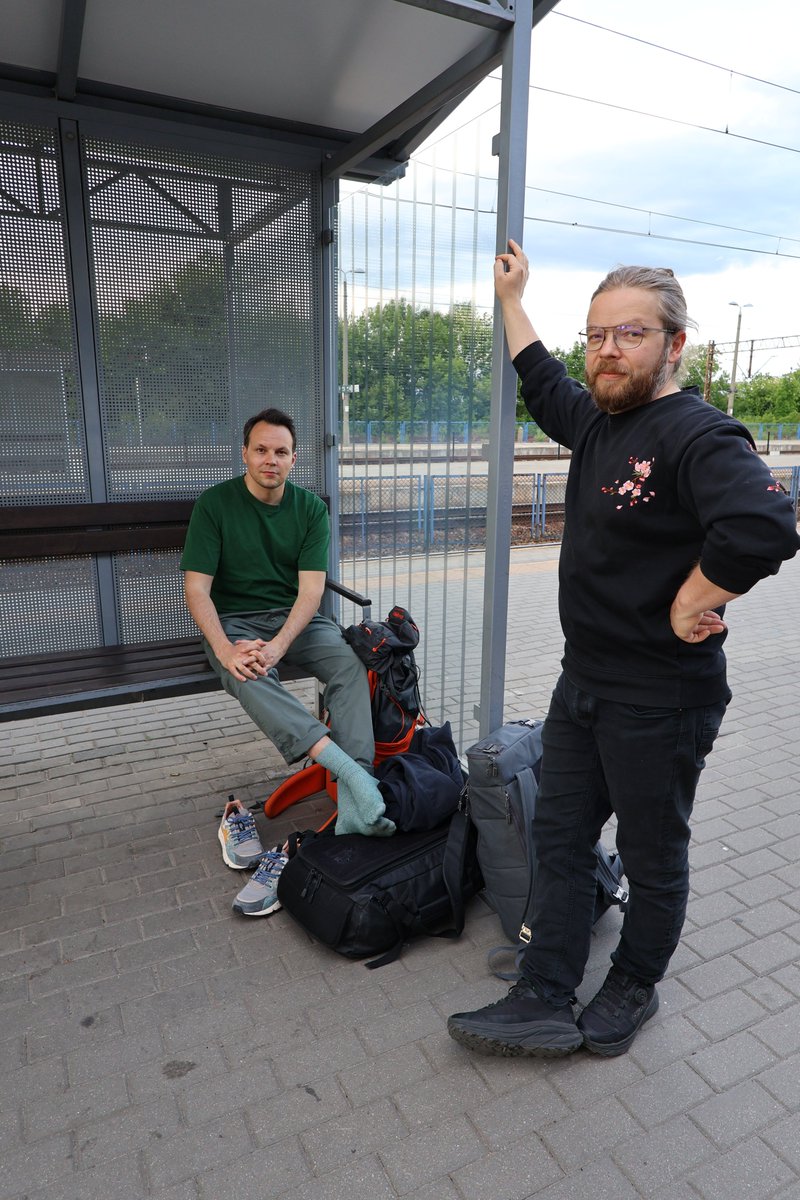
A 15-year-old on the train into Kyiv asked us why we were traveling to Ukraine now.
He was heading home to his father, who's fighting in the war. We told him we're building something to detect drones, so we can stop them in time.
As he broke into a smile and said "thats amazing" I started thinking about how I would have felt in his shoes. If it were Norway at war, and people were coming from their safe havens to chip in.
What's truly amazing is the Ukrainian people's force of will, determination, and grit, which the kid and many others embody.
Building Stendr never felt more important than it did during the 12-hour, bumpy train ride into Kyiv.
We travelled to Ukraine to validate that what we are building is something they need. We came back with confirmation that what we're building has real value, and that we need to deliver it fast and at scale. We met the people living this every day. People who want to keep testing it alongside us in Ukraine and in Norway.
A sincere thank you to @BRAVE1ua , Ukraine's defense-tech cluster, for taking the time to sit down with us and help validate what we're building. It mattered more than I can put in a post here.
Tomorrow we run our third field test. We came back from Kyiv knowing exactly why we are in a hurry, and now we get to prove it.
A cheap drone can take out equipment worth millions.
This is the problem we need to solve as soon as possible, and what I talked about in an interview with @Teknisk
Cheap drones have turned the economics of war on its head: attack is cheap, defence is expensive. At Stendr we are working on balancing the equation. Countering the enemy with resilient and cost-efficient solutions. Our a decentralised network of radar nodes detect, track and classify threats in the air.
As I told TU at Kongsberg Agenda :
"We must own more of our own defence capability in Norway and Europe. We can't rely on others to do it for us. We have to own it ourselves, and we have to do it ourselves. It's as simple as that."
Read the full article in the comments.
Massive news from @Stendr_tech today.
We just signed Major General (ret) Henning-Frantzen as an advisor.
Frantzen brings exactly the kind of senior policy experience Stendr is building around. He served as Head of the Department of Defence Policy and Long Term Planning in the Norwegian Ministry of Defence from 2021 to 2025, capping a career in the Norwegian Armed Forces that spanned more than three decades.
Across that career he held senior roles in defence policy, doctrine, and operations, and served as commander and rector of the Norwegian Defence University College. He holds a PhD in War Studies from King's College London.