What kind of regime is Trump trying to implement? Not Fascism, exactly, since it's not guided by an ideology. I agree with @FukuyamaFrancis and @jon_rauch that we're seeing a backsliding from a rational-legal mode of political organization, where rights & responsibilities are stipulated by a social contract, to a patrimonial state, governed by the three basic human relational models: kinship, dominance, and reciprocity. (This trichotomy comes from the anthropologist Alan Fiske, a big influence on my work.) https://t.co/e1PNSNy4k5
Except the things they want to indoctrinate are sicker and more delusional than under the Reds, who at least inherited parts of bourgeois worldview/anthropology.
The South German nobility was like the Swedish and Finnish nobility primarily involved in administration and court life. They were largely independent of the land. In contrast, the Junkers in the east were dependent on the land.
1/9
Restoration France was a golden age of political thoughts and literary developement, with its rapid expansion of printing industry. Quinet:" It was a blind impatience to live, a feverish waiting, a premature aspiration for things to come, a sort of intoxication of reawakened thought, an unappeased thirst of the soul after years in the desert of the Empire."
The paradox of USSR dissolution is the creation of potential rivals with connected critical infrastructures (energy, military, transportation etc.). Only recently the Baltic states switched to EU grids. Russia's strategic military assets were perilously dependent on heavy industries in the East and South of Ukraine, from shipbuilding capabilies, the maintanance of nuclear systems, the missile launchers and guidence systems, to engines and hydraulic system of fighter jets. Thus, the annexetion of Crimea and Donbass uprisings ameliorated the situation significantly. Popular discussions on Russian calculations and behaviors 2014-2022 often fail to take this into account, focusing more on surface rhetorics or domestic dynamics, at most changes to the balance of power in the Black Sea with the end of Sevastopol's disputed status are mentioned
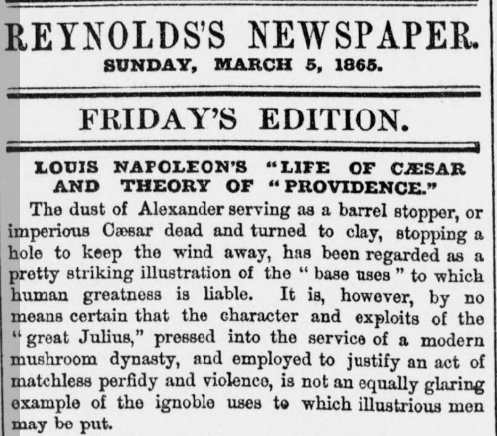
Napoleon III took time out from affairs of state (and affairs) to write a biography of Julius Caesar. When the first volume came out in 1865, it was a publishing sensation. Keen for feedback, the emperor relaxed censorship so it could be honestly reviewed, but most publications in France read the room and were effusive in their praise.
An obituary in La France, however, was taken as veiled criticism: 'On Thursday evening M. de Brotonne was engaged up to a late hour in reading the ‘History of Julius Caesar; next morning, at eight o’clock, he was found dead in his bed.'
In Britain, of course, there were no restrictions on what reviewers could write...
Fun fact: the word for parasites living in animal bodies (sarcophage) has the same root with stone coffins (sarcophagus): it comes from sarx "flesh", and phagein "to eat", flesh-eating, and sarcophagus comes from lithos sarkophagos, literally "flesh-eating stone".
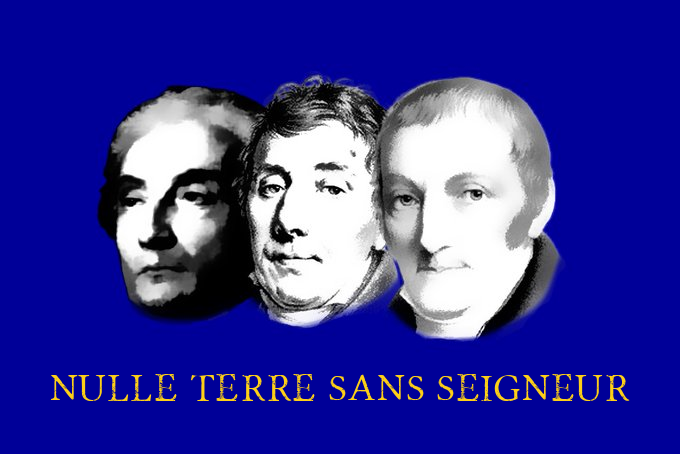
In the 16th C., Theodore Beza, Philippe Mornay and Francois Hotman were lucubrating literature justifying tyrannicide and the destruction of oppressive governments; in 2026, "Calvinists" are telling you you need to die for ZOG because of the 'G because Romans 13 or something
Blepp in his genius declares martyrdom null. Deutsche Christen at least were more coherent than their modern imitators in justifying their removal of certain biblical/religious principles as the removal of Jewishness.
This is a big dividing line between Christian teaching & judeo-secular values. Doing your duty to your secular authorities is an honour onto itself, there exists no good rebel alliance or virtuous resistance. The camp guards of Auschwitz are in heaven but their victims are not.
Excerpt from Soviet magazine article mentioned by Ray:
"Will the Earth Become a Planet of Giants?" by Kornei Arsenyev
But over thirty years the average height of children in Moscow increased by 10 centimeters, in Yaroslavl by 7, and in the villages of those regions by 4. Similar results have been obtained when comparing other towns and villages. Moreover, a direct dependence of the rate of growth on the size of the city stands out sharply. Perhaps acceleration may serve, in a certain sense, as an indicator determining the size of a city.
As a rule, the circumference of the chest in newborns is smaller than the circumference of the head. But, once born, the child naturally begins to breathe, and the chest begins to grow. According to data from 1900, the volume of the chest reached the volume of the head at one year of age; in 1937, at six months; and in 1967, two or three months after birth. The statistics given apply only to city children. Such rapid growth of the chest, of course, causes accelerated development of other organs as well. Apparently, some processes in the external environment have forced the child’s lungs to work more intensively. And specifically in the city.
The next link in our search suggests itself: air. I traced the change in the composition of urban air over the very period that was “suspected” in connection with the increase in the volume of the child’s chest. The main change consisted in this: the content of carbon dioxide in city had sharply increased. And this gas markedly intensifies the respiratory process. Rapid growth of the chest results, and correspondingly of the whole organism.
As is known CO₂ enters into the composition of lime. And when the concentration in the air rises, this not only stimulates intensified growth of the organism, but also brings growth more rapidly to an end, since lime accumulates more intensively in the bones of the skeleton.
Perhaps this double action of carbon dioxide is what explains the variability of the rates of acceleration depending on age. The average height of children and adolescents separated by decades differs several times more than that of adults: 10–12 centimeters in the first case, and 3–5 in the second. Acceleration slowed with the years, not so much increasing the average height of the human being in general as speeding up the growth process itself. In 1900 this process ended at about the age of 26; now it ends at 18 or 19.
In the distant past the abundance of plant food and the warm, humid climate favored the rapid multiplication of reptiles. Energetically devouring vegetation, they thereby disturbed the balance of oxygen and carbon dioxide in the air they breathed. And then the process assumed an avalanche-like character. The reduction of the green cover led to a slight predominance of CO₂, but this was enough to intensify the animals’ respiratory process. The volume of the lungs, and the whole organism grew. This required additional portions of oxygen, and consequently more CO₂ began to be released in respiration. At the same time the destruction of plants became more active: the giant lizards required more and more food. A moment arrived when the planet’s green cover could no longer regenerate the oxygen.
The organism responded with the forced increase of lung volume and, accordingly, of the whole body, and so on and so forth. I mentally picture these poor creatures, heavy to the point of absurdity, suffering from shortness of breath, dying of heart attacks and strokes. But they could no longer break the vicious circle. At some moment nature said: enough. And the wasteful, uneconomical, and, it seems to me, very unintelligent giants disappeared. The oxygen “curve" rushed rapidly upward. The planet breathed a sigh of relief, and not only in the figurative sense of the phrase. More perfect organisms appeared, harmoniously eating plants and one another, fitting by their whole way of life into the biochemical technology of nature.
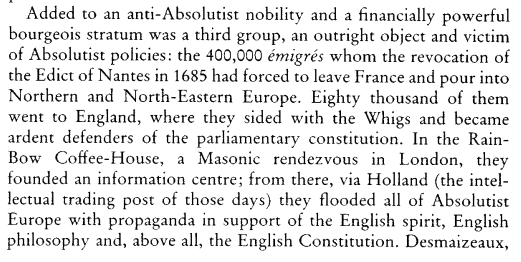
Koselleck points to French Protestant émigrés after 1685, how they created a transnational anti-Absolutist network across NW Europe, combining with local opposition to create a political "republic of letters."