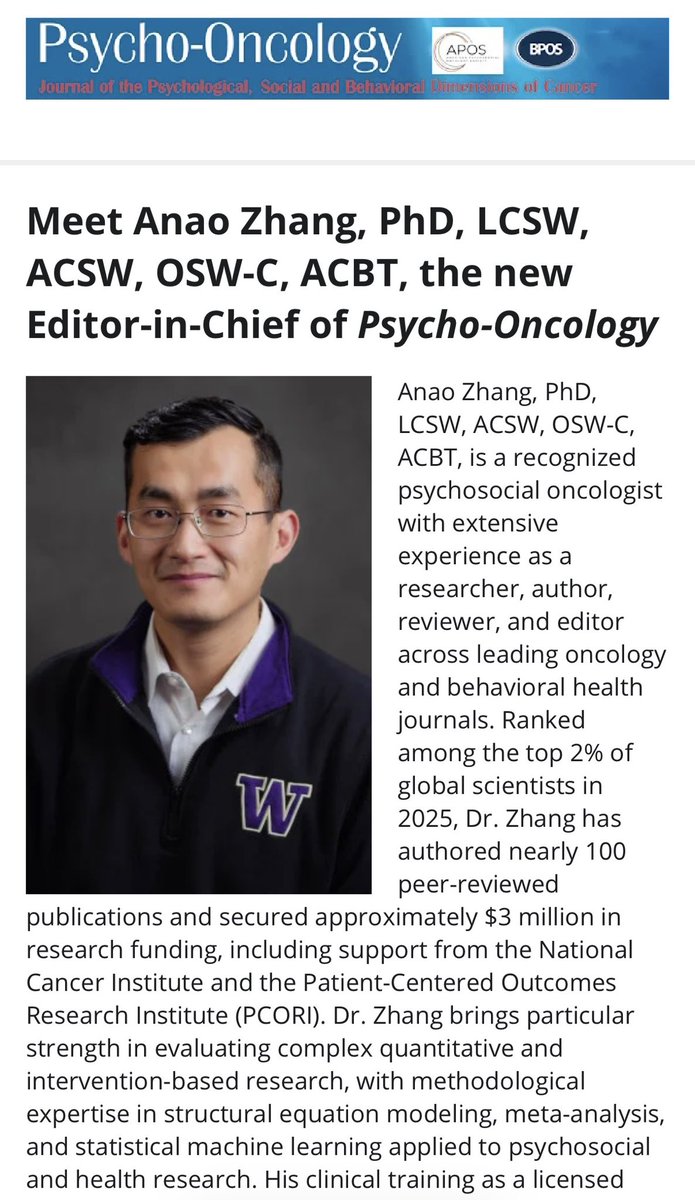
Congratulations to Dr. Anao Zhang on being named the new Editor-in-Chief of @PsyOnc ! 👏
A leading psychosocial oncology researcher, Dr. Zhang brings deep expertise in quantitative methods, intervention research, and patient-centered care
https://t.co/Qf5xmENjK8
A new @PsyOnc study of 191 patients identified 4 subgroups with distinct circadian rhythms, psychosocial profiles, and analgesic responses
Integrating biological and psychosocial assessments may help personalize cancer pain management
🔗 https://t.co/CisLKTWuMM
@crisbergerot@PauloBergerot@montypal discuss how to harmonize PROs across oncology trials —prioritizing common measures and validated score linking
🔗 Editorial https://t.co/k9Mcdz9xgD
🔗 Original study https://t.co/PzU6fdbzCN
Among 298 distressed #BreastCancer survivors, only 20% reported recent mental health service use @PsyOnc
Notably, greater fear of recurrence was linked to fewer visits
https://t.co/fsyv1Q8bgA
A qualitative study of 200 women with #BreastCancer found that financial hardship, transportation barriers, limited social support, and mental health challenges often intersect @PsyOnc
🔗 https://t.co/AfHY2reMmW
The #LEGACYCARE pilot found that proactive legal support for patients with colorectal cancer and their caregivers was feasible and acceptable @PsyOnc@guptaarjun90
🔗 https://t.co/Hl4Wjkf1Zt
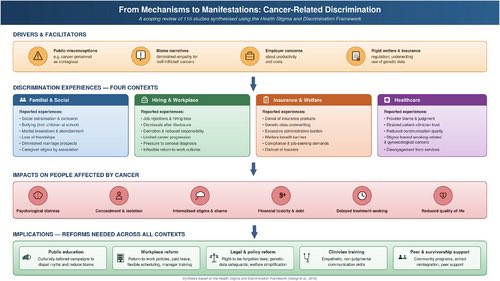
Cancer-related discrimination extends beyond interpersonal stigma @PsyOnc
This scoping review identifies discrimination across social, workplace, insurance/welfare & healthcare settings, w impacts on psychological health, finances, care-seeking & QoL
https://t.co/LGrK0Qn3gE
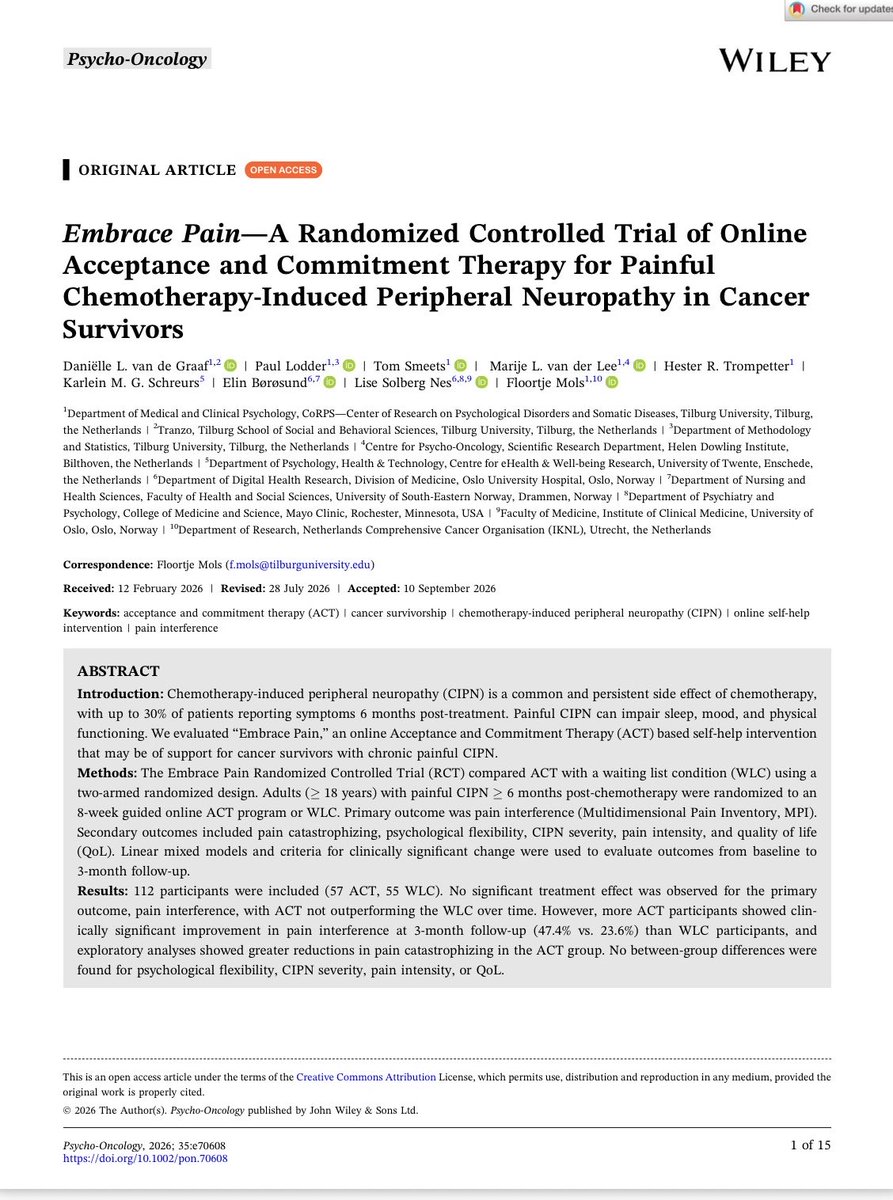
Online ACT may offer support 4 survivors living w painful chemotherapy-induced peripheral neuropathy @PsyOnc
While the primary endpoint was not sig, meaningful improvement in pain interference was seen in 47% vs 24%, w reductions in pain catastrophizing
https://t.co/i8zpIMdfJV
Psychosocial needs don’t end when treatment does @PsyOnc
Across the childhood cancer continuum, needs persist - but evolve from emotional shock & uncertainty to disrupted relationships, autonomy challenges, and fear of relapse
https://t.co/jkP43nNg14
What does “acceptable” cancer screening actually mean? @PsyOnc
Among 393 studies, only 4% defined acceptability and 14% used theory, with wide variation in how it was measured
https://t.co/uoAsUbWPuA
Different PROMs, comparable outcomes? @PsyOnc@EORTC_QLG
Crosswalks across commonly used psychosocial PROMs may help harmonize #PROs, enabling comparisons and data pooling across cancer studies
https://t.co/PzU6fdbzCN
Among men with low- to intermediate-risk #ProstateCancer, affect shaped how information was interpreted, options were weighed, and personal values and autonomy were prioritized @PsyOnc@DrFrankJPenedo@DrTracyECrane
https://t.co/CyEZChbuhx
Can digital tools help personalize PTSD care after HCT?
In a SMART trial of 477 survivors, stepped care, starting digitally & escalating non-responders to therapist-delivered CBT-PTSD, was associated w the greatest symptom reductions @PsyOnc@DocApplebaum
https://t.co/ZSPwVwfJiH
Better sleep support for AYA with cancer
The #CanSleep stepped-care intervention showed promising results, with significant reductions in insomnia symptoms following both self-managed and individual CBT-I @PsyOnc
https://t.co/pglG3s3zk7
Tailored psychosocial care matters.
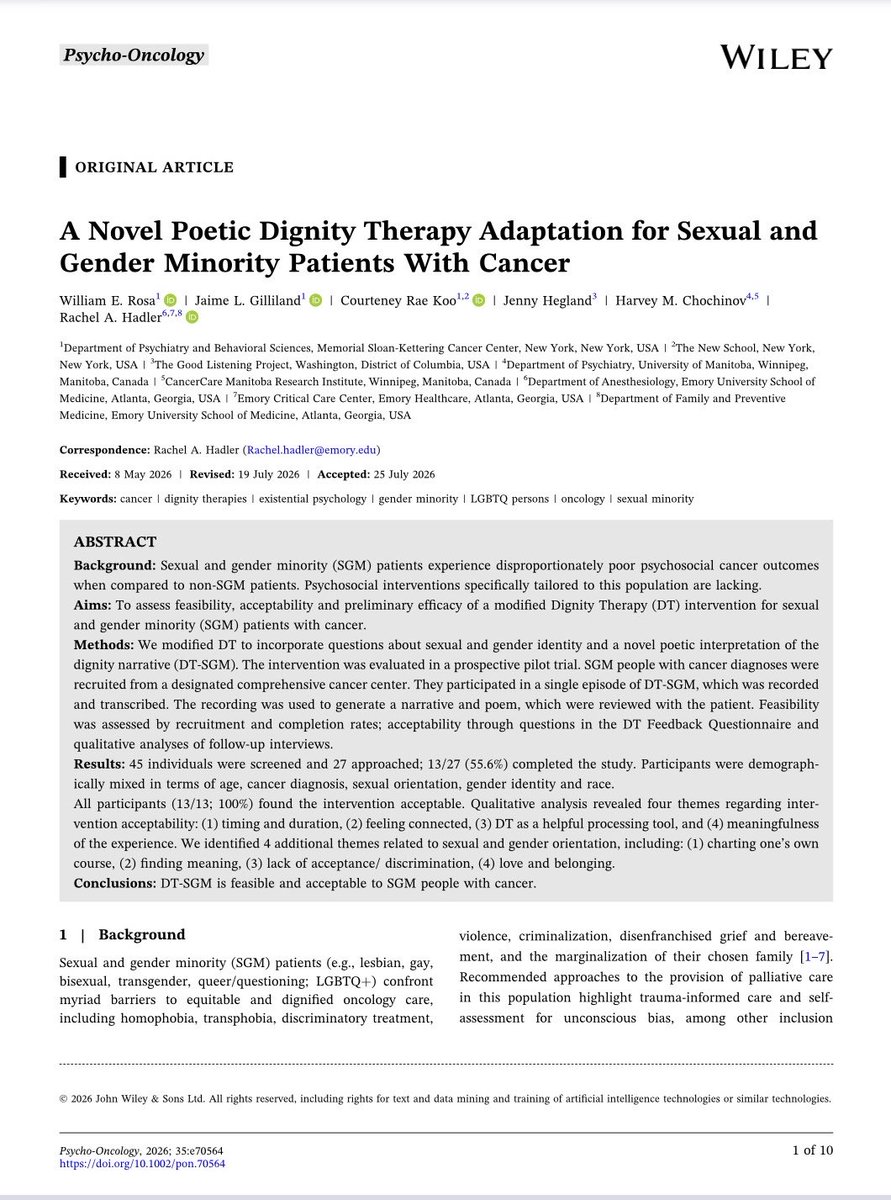
A pilot study found modified Dignity Therapy to be feasible & acceptable for sexual & gender minority people w cancer, providing space for connection, meaning, identity & belonging @PsyOnc@BillyRosaPhD@HMChochinov
https://t.co/mE40vm2FXg
This study identified 23 features specific to scan-associated anxiety, highlighting its emotional, cognitive, behavioral, physical & interpersonal dimensions
= Scanxiety as a distinct, time-bound experience surrounding scans & results @PsyOnc
https://t.co/9pFX74Zymv
Expanding the #PsyOnc workforce is essential to meet the growing needs of cancer survivors @PsyOnc
The @APOSHQ PSO Virtual Academy demonstrates that virtual training is a feasible, acceptable, & effective strategy to build capacity for evidence-based care
https://t.co/FvVGmqm9FY
Cancer survivors experience complex psychological symptoms that may not fit traditional diagnostic categories
This study shows the HiTOP framework is a reliable, valid approach to better characterize mental health in survivorship @PsyOnc
https://t.co/tKIihPzolm
A new tool for clinical practice and research!
The 7-item Ottawa Clinical Fear of Recurrence–Self-Report (OCFR-SR) provides a brief, reliable, and valid way to identify clinically significant fear of cancer recurrence among survivors @PsyOnc@cancer_K2A
https://t.co/phl3lPdPZh
Caring for someone with cancer can take a profound emotional toll
Through co-design with caregivers, researchers adapted an online CBT program to better address caregivers’ unique challenges and unmet psychological needs @PsyOnc@joshaw
https://t.co/qFk7KoPbGo