The broader point: intractable problems require metacognitive control over object-level strategies.
AI alignment may depend not just on optimizing outputs, but on building systems that can reflect on their own limits, alternatives, and uncertainty. #AIalignment#metacognition
Can LLMs know what they don’t know?
A paper by Steyvers & Peters offers a sharp empirical look at AI metacognition: how models track their own knowledge boundaries & communicate uncertainty, in the spirit of metacognitive sensitivity metrics.
https://t.co/PNvItOSgRD
It connects with the core thesis of our recent @TrendsCognSci paper on “machine wisdom”.
Our paper focuses more on the why: why AI systems need perspectival metacognition to become more robust, explainable, and safe.
https://t.co/9jq831uzP5
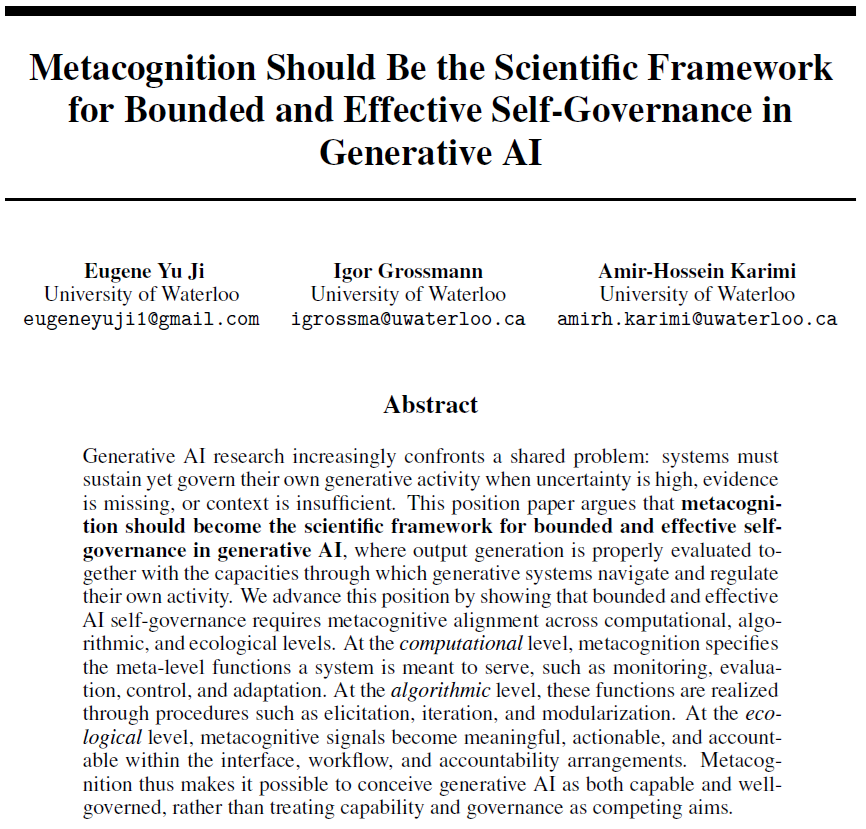
New paper with the amazing @aejj1228@amirhkarimi_ : "Metacognition Should Be the Scientific Framework
for Bounded and Effective Self-Governance in Generative AI"
LINK: https://t.co/issfTLQHB3
#metacognition#LLM#selfgovernance
A presto, Firenze. 🇮🇹 Spent May 2026 as a Visiting Fellow at the @EUI_EU Robert Schuman Centre @EUI_Schuman , during EUI's 50th anniversary. Fiesole's hills, Renaissance Florence, and conversations on science for policy. Still processing it all.
2/Grateful for visits with colleagues in Genoa, Milan & Lucca, connecting with the Italian Young Academy, and esp. @gaby_um's hospitality and our exchanges on strengthening the evidential value of science in policy foresight, & the role of social scientists in the AI age.
Why do we agree about the sky being blue but argue about politics and religion?
@BayesandBounds target article in Psych Inquiry 37:1 says: not because there are 2 kinds of belief; because evidence in the world has locality.
Plus commentaries + reply.
🔗 https://t.co/myEKKkgc1k
Thrilled this is out! https://t.co/cxZZsoqEFK
🧵
Do we have 2 kinds of beliefs? Some beliefs seem insensitive to evidence and rarely guide behavior, etc. To explain this, several theories divide belief into 2 types. I argue the explanation isn't in the *mind* but in the *world*
1/ We've been measuring intellectual humility wrong. Most scales ask "are you intellectually humble?" but the people least humble are the most miscalibrated about it. They overclaim. The #humilityparadox. Out today in Behavior Research Methods. Here's what we did instead. 🧵
7/ We propose four design principles for measuring metacognitive constructs, both for IH and others: Contextual specificity Event reconstruction (real, not hypothetical) Accessibility (binary chains over Likert) Model within-person variability
What might a "wise" AI look like? How would we build one?
Tomorrow 11:00–13:00 CEST Hybrid: EUI Florence + Zoom Free, I will be at @EUI_EU to talk on benchmarking wisdom and metacognitive AI architectures. With discussant Claire Boine. Register: https://t.co/FkncYb2Okz
1/ We're hiring a postdoc in the Wisdom & Culture Lab
@UWaterloo to lead a new SSHRC-funded project on cultural narratives & decision-making. Fall '26 / Winter '27 start. 🧵
4/ 🇨🇦 Global candidates: this is a strong fit for the new Canada Impact+ (CIRTA) award — $70K × 2 yrs, tri-agency funded, designed to recruit international talent. We will actively support competitive candidates for nomination.