This is *EXCELLENT.* Our inability to plan electricity infrastructure--especially ahead of demand--is a fundamental constraint on economic growth & decarbonization. (Minor quibble: permitting reform advantages public projects at least as much, if not more than, private ones).
"I was talking to the leader for infrastructure at one of the hyperscalers earlier in the week... there was nothing that was gonna move the needle for us at sufficient scale before 2030" @saranormous
In normal times, the rise in the real 10-year Treasury yield (blue line, inverted) would be bearish for gold (black line). But we're no longer in normal times. The rise in real yields raises the odds of another Treasury intervention. That's bullish gold...
https://t.co/g0dhPo6RFv
@GasBuddyGuy I’d guess half to 2/3 of Padd3 refining capacity could handle Venz heavy. There would be no need to go further north. Incremental Venz production only 0.5 to 1.0mmbd in next 5 years is my guess as well.
To all those telling younger people to stop complaining and work harder…piss off. Multiple rounds of QE following 2008 and turbo charged post 2020 robbed entire generations of their future.
An essay I've just written for @nytimes on why Big Tech is the 21st Century’s equivalent of the East India Company:
"What It Would Take to Dismantle the Most Powerful Companies in the World" https://t.co/E8mFY9tJkW
Small problem, it will take years to build the necessary infrastructure and upgrade the current one, including ports and logistics, to take that oil out of the ground and meaningfully increase shipments to the US
Philip Pilkington’s warning is simple: Scott Bessent is trying to command the bond market, the dollar, oil, and the yen at the same time. That is not policy. That is black magic.
➡️ Buybacks only calm things for a moment. Then selling resumes.
➡️ Trust is leaking out of Treasuries and into gold.
➡️ Europe is already scrambling for diesel.
➡️ Japan is a pillar of the dollar system, and it is wobbling.
Philip’s take: ZIRP was messy, but this is darker. You can fake a price for a week. You cannot fake energy, inflation, or confidence.
Full report: https://t.co/ULXWPbAI48
@philippilk
I think we may finally have our DeepSeek 2.0 moment Monday.
Mystery model Ox Alpha pretty clearly seems to be the next iteration of Chinese model GLM. With new Chinese models one upping each other weekly, why is this model DeepSeek 2.0?
Because it is a frontier level model that launched with 100 trillion free tokens per day. This is a massive narrative violation on compute scarcity. Initial speculation said it had to be one of the big US labs because nobody else could field this much compute. Now that it seems clearly to be the next GLM iteration, it likely marks a step change in frontier model token cost and availability. It’s pretty hard to get to trillions of $ in AI spend when token costs are falling to 0 far faster than abundantly available tokens can find use cases. Positive capex ROI Jevonistas in shambles.
Market doesn't give notice before it revolts against the debt. But so far this month, as debt crossed $40 trillion, the 30-year bond yield hit a 19-year high, gold rose 13%, silver +18%, GSCI commodity index +5%, BTC +19% and the dollar weakened. Markets are saying something.
1/3
Without getting into 'we're better than them type of debates' - around the whole world, at every level and in every sphere - education is the key. To health, to social cohesion, to economic well being, public safety etc. It really is the answer to most (if not all) problems.
Chart of the Day:
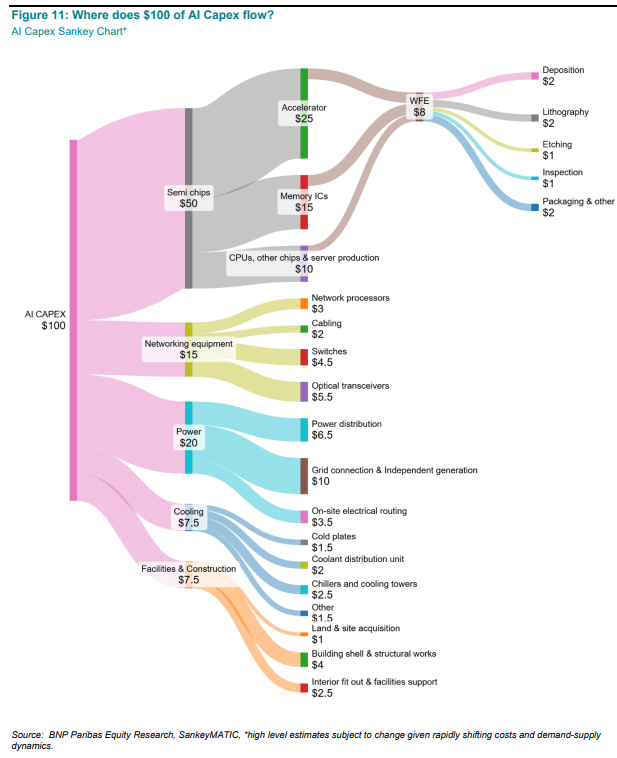
Four companies now spend at a staggering scale. Hyperscaler AI capex is on track for ~$733B in 2026, about 87% of the base US defense budget.
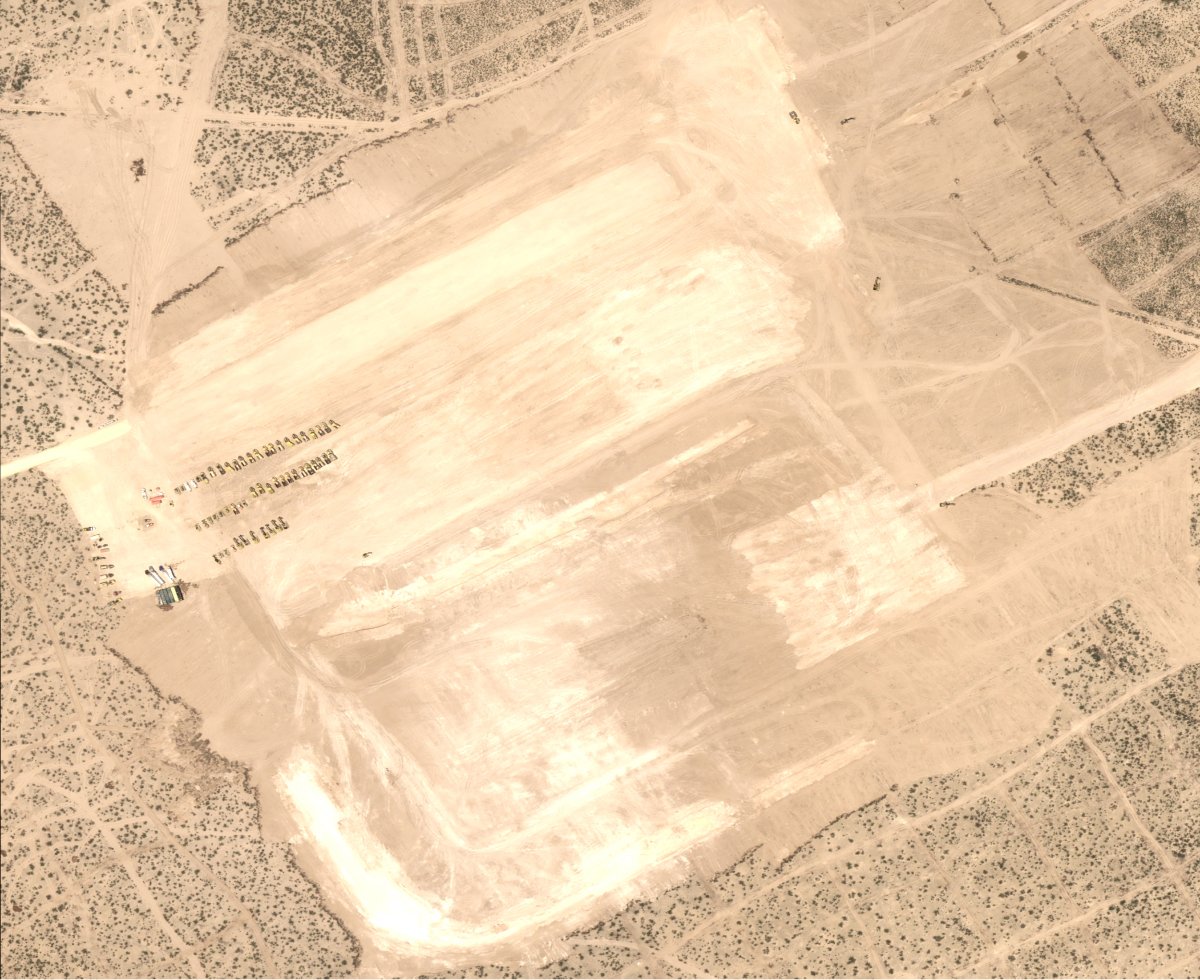
This week I found permits and satellite photos suggesting Amazon is backing what could be the largest gas power plant ever built in the US.
I just got off the phone with the company and confirmed they're behind it.
Amazon confirmed that it has acquired a site in Pecos County, Texas called GW Ranch, where it plans to build an AI data center campus powered by a 7.65 GW gas plant. It would initially be entirely disconnected from the Texas electric grid.
In January, GW Ranch received a permit from the state of Texas allowing the gas power plant to emit 33 million tons of carbon dioxide into the atmosphere.
If the project emitted that much CO2, it would be the largest single source of pollution in the United States—emitting more greenhouse gases than the country’s largest coal plant. It’s worth noting that companies rarely emit as much as their permits allow.
The paper trail linking Amazon to GW Ranch surfaced earlier this week when Amazon filed three construction permits with the state. The permits showed Amazon’s plans to build three data center buildings with construction beginning immediately.
Cleanview reviewed satellite imagery to look for the project and discovered that land clearing had begun at the site described in GW Ranch’s air permit records.
We reached out to Amazon and the company confirmed it had acquired the GW Ranch site and plans to buy power from the plant, which is being developed by Pacifico Energy.
Partnering with GW Ranch marks Amazon’s first major investment in an off-grid data center. In doing so, the company joins Microsoft, Google, and Meta who have all invested significantly in natural gas power this year.
Data center developers have announced nearly 60 behind-the-meter gas power projects since the beginning of 2025 with a combined capacity of 90 GW, according to Cleanview’s latest report.
Not all of these projects will be built, but in recent months a growing share of them have begun construction and signed key tenant deals.
Amazon’s project in West Texas is unlikely to be its last bet on large-scale natural gas power. Yesterday, the company confirmed that it is in talks with the developers of a 4.5 GW gas power plant in Homer City, Pennsylvania.
When the developers of the Homer City gas plant first announced their project, they said it would be the largest gas power plant in America.
Now it’s just one of many giga-scale power plants that have been proposed across the country.
Few seem to appreciate what this chart means, so let me simplify with an analogy
The companies on the right have been losing money drilling for oil at $500 per barrel
The companies on the left just discovered how to produce the same oil at $5 per barrel
Also, half of the US stock market depends on the companies on the right eventually making hundreds of billions of dollars in profit
The meltdown at @Leopold Aschenbrenner’s Situational Awareness hedge fund shows the difference between intelligence and wisdom.
I’ve never met Leo. But I know people who know him quite well. He is by all accounts very, very intelligent.
But …
1/5