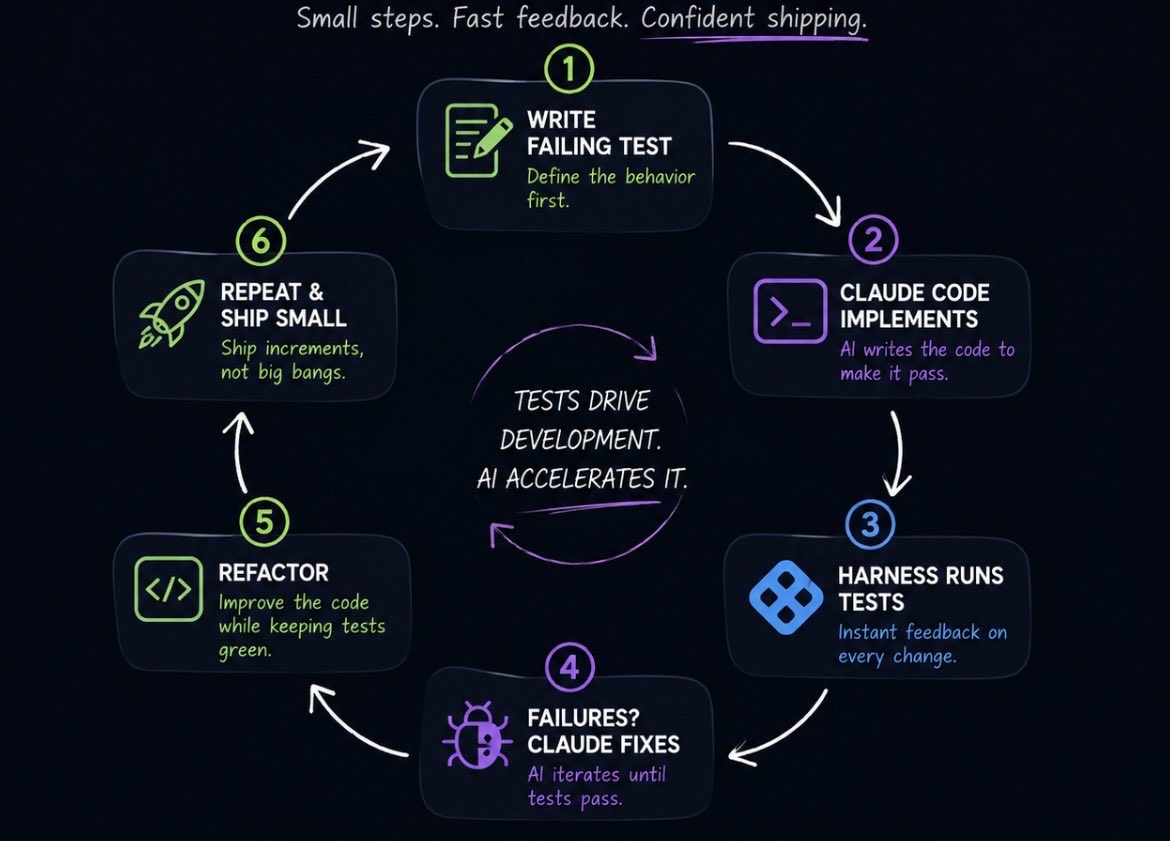
Building MVPs with AI feels completely different when you follow TDD.
My workflow:
1.Write a failing test.
2. Let Claude Code implement until it passes.
3. Harness runs the test suite.
4. Claude fixes failures.
5. Refactor.
6. Do this recursively .
Every change is validated before the next one.
Instead of prompting for features, you’re collaborating in a tight feedback loop where tests drive development and AI accelerates implementation.
That’s the closest I’ve felt to having a reliable AI pair programmer.
#TDD #ClaudeCode #Harness #BuildInPublic #IndieHackers #AIEngineering #MVP
Anthropic engineer:
"You're not supposed to prompt Claude. You're supposed to build a system that prompts itself."
In 45 minutes she breaks down how Anthropic builds agents that remember, learn from their mistakes, and get smarter with every run.
Worth more than any paid course you'll find on building agents.
Watch the session, then read the guide on building loops below.
I really love the moments when people who invest time in using your product and giving valuable feedback.
Working on the feedback Adam suggested.
#feedback#buildinpublic
@DanielSmidstrup The people who'll be paid best are the ones who can direct AI output at speed and have the taste to know instantly where to apply scrutiny
Storyy time :
A founder posted about their product on Reddit. I replied in the comments and we ended up chatting about building products, and I mentioned my security scanner. Then some third guy shows up. His agentic spam scanner had flagged both of us as the same person running a fake sockpuppet conversation.
I pointed out that these agents predict probabilistically and false positives are guaranteed. He flipped out and started throwing abuse 😂
The lesson vibecoders keep skipping: a flag is a hypothesis, not a conviction. Verify before you accuse.
The more I scope the output upfront, the better my AI coding results.
Before any code, I spell out:
→ the goal
→ the workflow
→ DB changes (or none)
→ schema changes (or none)
→ which UI files get touched
The tighter I define the boundaries, the fewer hallucinations I get. Vague prompts and No plan = vague (and wrong) code.
Constrain the system, get accurate output.
Quit my 6-figure job a month ago to build solo.
100+ users on a rough web security tool. Best part isn’t the number it’s the DMs telling me what’s broken and what’s real value
Hardest part of going solo isn’t building. It’s the silence between “I made a thing” and “people use the thing.”
Just a month after my last job, I get confused between…
Should I prepare for LLD rounds or just completely dive into building my product and distributing it
Indian telecom Reliance is sabotaging access to Telegram for millions of users OUTSIDE India (including the UAE) via a rogue method called BGP hijacking.
The sabotage seems intentional, as Reliance has ignored multiple reports.
This may be part of a competitive war, as Reliance is partially owned by Meta — the company behind WhatsApp.
Network operators are advised to reject unauthorized BGP announcements from Reliance (AS18101) to prevent route hijacks and ensure stable Internet access for their users.
Such abuse of global Internet routing is alarming. I wouldn’t be surprised if Reliance/WhatsApp were also behind the recent lobbying effort to ban Telegram in India.
As a result of a US government directive, we are suspending access to Claude Fable 5 for all users. You can continue to use all other Claude models.
Here’s what this means for you:
Across Claude products, new sessions will run on your selected default model or Opus 4.8, and existing Fable 5 sessions will end with an error.
On the Claude Platform, requests to Fable 5 will also return an error. Please update your integrations to other Claude models.
We know this is a disruption to your workflows; we appreciate your patience and support.