David Friedberg says if you want to bet on AI you should own Google ($GOOG)
"If you want to bet against Google’s deployment of capital into infrastructure because you’d rather have them give you cash for your shares today, you shouldn’t own the stock. Someone else will buy it."
"I think Google wins in a lot of different ways. There’s the consumer business, there’s also YouTube. There’s also GCP."
"I think there’s no better suited enterprise layer than GCP to take advantage of capturing value with AI for that enterprise setting. You can run any model you want and you can run any workflow you want, and you don’t have to be tied in."
"There’s also this portfolio of other bets, which includes 10% of SpaceX and a good chunk of Anthropic that they own, worth way more than $100 billion. They just went up $20 billion on Anthropic in the quarter."
"The worst, worst, worst case scenario is they have the lowest cost infrastructure in the world to run other people’s models as a service, like Elon did with Grok and the Colossus."
A TON OF THINGS HAPPENED IN THE STOCK MARKET TODAY.
Here's a full recap:
1. Rocket Lab $RKLB won a $266M U.S. Air Force contract, extending its momentum in defense. The launches are expected to take place in Alaska and be completed by the end of 2028. The award adds to Rocket Lab’s growing streak of defense contract wins as the company continues expanding its role in national security space missions.
2. BofA is staying bullish on the memory trade, arguing that Chinese open-source AI models strengthen the long-term demand case for $MU, $SKHY, $SNDK, $STX, and $WDC. The firm reiterated its Buy rating on Micron $MU with a $1,550 price target, saying cheaper Chinese model pricing does not mean lower hardware intensity. BofA notes Kimi K3 API pricing is reportedly 5x–350x below Western models, but says that reflects business-model choices rather than the true cost of compute infrastructure. The firm also highlights that Kimi K3 needs roughly 1.4TB of HBM per serving instance, while larger AI models should require the same or even more memory as weights and active parameters grow. BofA also sees CXMT focused on commodity DRAM rather than advanced HBM, and notes Micron’s CHIPS Act restrictions may expire around December 2026, potentially opening the door for $50B–$60B in annual buybacks.
3. Moonshot AI is reportedly targeting a valuation of up to $50B in a final pre-IPO funding round after launching Kimi K3. The company is expected to close its current round at a $31.5B valuation before starting another round of fundraising talks in August, ahead of a potential Hong Kong IPO that could come as soon as this year.
4. Tesla $TSLA detailed its 2026 Summer software update, with rollout expected soon. The biggest change is deeper Grok integration, letting drivers use voice commands to place calls, control music, change climate settings, and open the glovebox. Tesla is also bringing self-driving stats into the mobile app, making them viewable and shareable, while navigation will get smarter by surfacing routine destinations and favoring routes the driver has taken before. The update also adds the ability to set a preferred arrival battery level from the app, upload custom vehicle wraps without a USB drive, and lock rear-screen controls from the front display.
5. Nvidia $NVDA says it could eventually produce up to 1,000 Vera Rubin racks per day. If reached, that scale would imply more than $630B in quarterly revenue for Nvidia and its manufacturing partners, based on estimates cited in the post. Nvidia’s hardware engineering SVP Andrew Bell said the company’s manufacturing partners should be able to make up to 1,000 racks per day once production ramps, highlighting the massive revenue potential tied to Vera Rubin if AI data center demand continues scaling.
6. Sam Altman is expected to brief the Trump administration and members of Congress next week on OpenAI’s next family of models, including their capabilities and potential impact on jobs. A new release may be getting closer, though OpenAI has not officially named the models GPT-6 or announced a launch date.
7. Jefferies came away impressed after testing Meta’s $META AI glasses, highlighting the camera quality, seamless setup, and normal-glasses form factor. The firm says Meta has a first-mover advantage as the only player currently shipping AI glasses at scale. Jefferies estimates the category could become a $14B–$18B hardware revenue opportunity within the next few years, assuming Apple Watch-like adoption at an average selling price of $400, or roughly 35M–45M units. The firm also sees upside from AI subscriptions, advertising, and commerce over time. Jefferies noted Meta AI now has around 1B monthly active users, daily glasses users are tripling YoY, and more than 7M units were sold in 2025. Jefferies says the bigger opportunity is commerce, as AI glasses could capture user intent at the point of discovery if agentic AI shifts behavior from browsing to delegation. units in 2026.
8. Supermicro $SMCI gave a major preliminary update after hours. Fiscal Q4 revenue is expected to land near the low end of its $11B–$12.5B guidance range, but the bigger surprise is gross margin, now expected at 15%–17% versus the prior 8.2%–8.4% forecast. Last quarter, SMCI was guiding gross margins around 8.4%–8.7%, and its TTM gross margin is only 8.83%, making this a dramatic improvement in just 90 days. The company also said it received more than $60B in new orders during the quarter, pushing backlog to a record high, though some orders could still be delayed or canceled. Full results are due August 11
9. Google $GOOGL is rolling out Gemini 3.6 Flash, Gemini 3.5 Flash-Lite, and a new limited-access cybersecurity-focused model. Gemini 3.6 Flash is designed to be more efficient, using up to 17% fewer tokens while also lowering cost per token. Flash-Lite is aimed at faster, high-volume use cases where speed and scale matter most. Google is also introducing Gemini 3.5 Flash Cyber, a model built to find and help fix software vulnerabilities, though access will initially be restricted to governments and trusted partners.
10. The top 10 most active options today by contracts traded were $NVDA with 2.3M contracts, $AAPL with 1.1M contracts, $MU with 977K contracts, $TSLA with 887K contracts, $SPCX with 752K contracts, $INTC with 656K contracts, $AMZN with 511K contracts, $NFLX with 509K contracts, $AMD with 410K contracts, and $MSFT with 387K contracts.
11. CoreWeave $CRWV says near-term profitability is being weighed down by a timing mismatch in its AI infrastructure rollout. New capacity starts depreciating roughly six weeks before contracted customer revenue begins coming in, creating pressure on reported earnings. The company is carrying about $30B of debt to fund 49 operating data centers and future deployments, with depreciation and interest equal to 81% of Q1 revenue. CEO Michael Intrator expects that drag to lessen as more installed capacity converts into revenue. CoreWeave’s financing is supported by long-term customer contracts, where clients must pay for reserved capacity whether they use it or not.
12. Short interest across U.S. equities is climbing to extreme levels. In the S&P 500, short interest has risen to roughly 3.7% of free float, near the highest level in data going back to 2010. For the Russell 3000, short interest is around 6.1%, also close to an all-time high, with both measures steadily moving higher since the start of 2025. Across all NYSE-listed stocks, short interest reached a record 9.0% of shares outstanding in late June. For context, that same metric peaked near 5.0% during the 2008 Financial Crisis and around 6.0% during the 2020 pandemic.
WALL STREET IS THE GREATEST SHOW ON EARTH.
Exciting earnings week ahead!
• Wednesday: $GEV, $TSLA, $GOOGL, $NOW, $IBM
• Thursday: $NOK, $INTC
All eyes on $GOOGL for AI demand + capex guide and $NOW being the first big software name to report Q2 earnings.
25% of IBM - gone in one day. worst drop since 1910.
then Alex Karp, who sells AI for a living, went on CNBC and read his own customers' anger out loud:
paying for tokens that create nothing, while the model quietly walks off with their data and their edge.
that's not a skeptic talking. that's the buyer.
i wrote why AI doesn't make the money - it moves it.
THE MAN WHO TURNED $10,000 INTO $8 MILLION EXPLAINS IN 7 MINUTES WHY MOST PEOPLE NEVER GET RICH
his name is Joel Greenblatt, one of the best investors of the last 30 years. no motivation talk, no "believe in yourself". two facts, and you'll never think about money the same way
fact one. the best fund of the 2000s made 18% a year. the ordinary people who put their money in it LOST 11% a year. same fund. they panicked on every dip, came back after every rise. the fund was right. their nerves weren't
fact two. the S&P 500, the thing everyone calls the safest investment on earth, automatically buys more of what's already too expensive. the "safest" instrument in the world makes the same mistake scared people make. nobody at your bank will say this out loud
the market never took anyone's money. people hand it over themselves, at the worst possible moment
watch the 7 minutes before you invest a single dollar anywhere. it will save you more than any advisor ever will ↓
This is one of the most important moments ever aired on CNBC.
Billionaire investor Chamath Palihapitiya says the media lied to millions of Americans about President Trump, and that after going back to the original source material, he realized he had been completely misled about Trump’s character.
PALIHAPITIYA: “The reality is that most of us were lied to by the media about President Trump.”
“And if you just go back to the source material, you should take away two things.”
“One, he didn’t say half the things he said, and two, why did these other people just fabricate what they wanted to say so that they could essentially assassinate his character?”
“I think that that second thing is completely unacceptable in America, and there’s still been no repercussions, really.”
“I took the time to learn about it. I admitted where…you know, the way that I met him was, I admitted on the pod, which, you know, has millions of viewers.”
“And I said, I got it totally wrong because I went and I watched Charlottesville.”
“And, you know, the first person to call me? President Trump.”
“And I got to know him and I put the phone down, I called my wife, and I said, we got it TOTALLY, totally wrong. We were lied to.”
“And then I got to know him and he is fantastic!”
@chamath
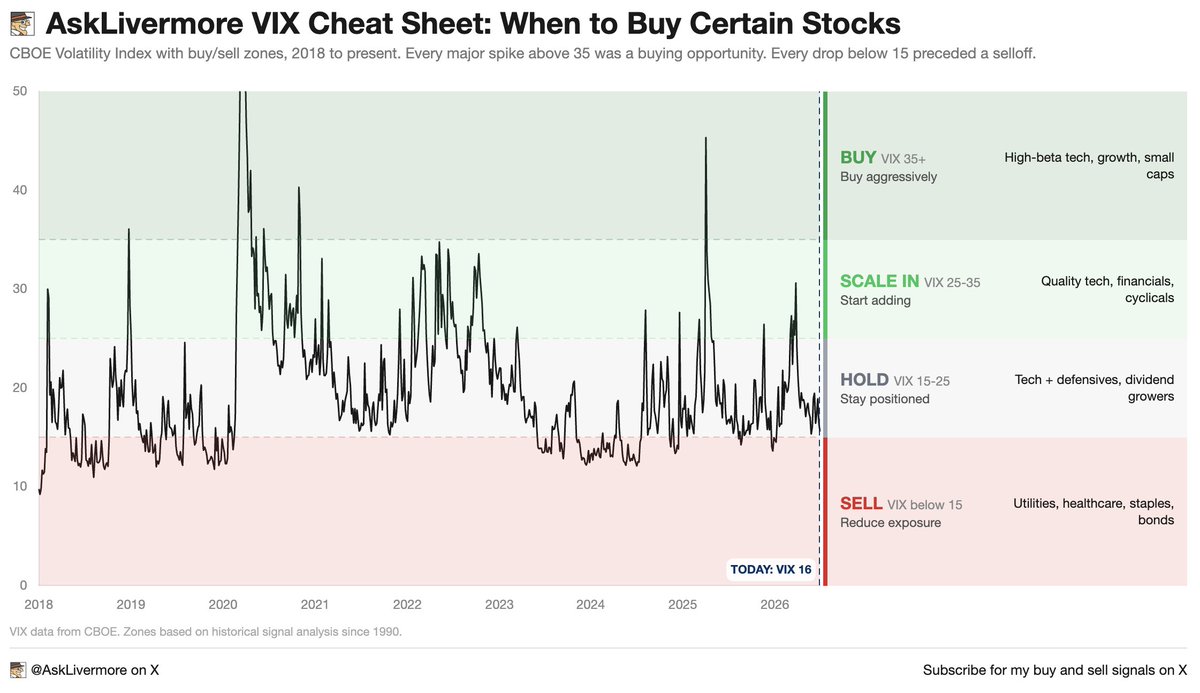
This is all you need to do to make millions in the stock market. Save this. Screenshot it. You will need it.
1. VIX above 35: buy aggressively
- High-beta tech, growth, small caps
- Every single time the VIX spiked above 35 since 2018 was a generational buying opportunity. COVID bottom. Oct 2022 bottom. Tariff crash. If you bought when everyone else was panicking, you made a fortune.
2. VIX 25 to 35: start scaling in
- Quality tech, financials, industrials, cyclicals
- This is where smart money starts building positions. Not all at once. Gradually. The fear is real but the opportunity is bigger.
3. VIX 15 to 25: hold
- Balanced: tech + defensives, dividend growers
- This is normal. Stay positioned. Don't chase, don't panic. Let your winners run.
4. VIX below 15: reduce exposure
- Rotate to: utilities, healthcare, staples, bonds
- This is when everyone is comfortable. Nobody is hedging. Nobody is worried. That's exactly when you should be.
- Every major crash in market history was preceded by the VIX sitting below 15 for weeks.
Right now the VIX is at 16. We're in the hold zone. Stay positioned but stay alert.
Bookmark this. The next time the VIX spikes above 35, don't freeze. Buy.
Palantir CEO: "most AI companies are going to die - Anthropic and OpenAI give no value and take your IP" - so he announced a deal with Nvidia to build a new AI
Alex Karp just revealed which AI companies will survive and showed his current strategy
His words:
"AI is real but somehow it's not working - and we're not allowed to say it publicly because we'll look stupid"
"I've been telling them for six months - we're going to be nationalized - they say it can't happen in America"
"if you say AI let you fire two-thirds of your workforce - you might as well sign up for the Bernie Sanders manifesto"
he built Palantir with Peter Thiel from zero to $500 billion - the Pentagon, CIA and NATO use his software - now he's coming for OpenAI and Anthropic
bookmark & watch today ↓
"…most AI companies are going to die - Anthropic and OpenAI give no value and take your IP"—Alex Karp
The OpenAI podcast host get nervous.
This is what happens when you are anti-open source.
Will Anthropic and OpenAI learn?
Stop scrolling:
This 55-minute lesson could improve your trading more than weeks of watching charts.
The Psychology of Successful Trading with Dr. Brett Steenbarger is 55 minutes better spent than watching Netflix.
Your mindset is your biggest edge: