I agree with you @arthur_spirling. Unfortunately the full essay was clipped and taken out of context. The X framing-- "Princeton professor thinks AI teaches better than him" but that is not what I argue. In fact I basically argue the opposite. Full essay here: https://t.co/rHo5NWbD5G
New Faces in Chinese Politics Conference
MIT, September 1-2, 2026
Application materials due by May 22, 2026
We invite advanced PhD students and post-doctoral fellows who study Chinese domestic and international politics to apply for the sixth New Faces in Chinese Politics Conference at MIT on September 1-2, 2026, just before the APSA annual meeting in Boston. The New Faces in Chinese Politics Conference is an opportunity to get feedback on job market papers and job talks with peers, conference co-organizers, and invited senior scholars.
The papers should be based on original, rigorous research, employing quantitative or qualitative methods. The in-person conference is open exclusively to job market candidates for the 2026 job market. Successful applicants are fully funded for travel, lodging, and food.
Applicants must submit a curriculum vitae, a full job market paper or dissertation chapter (for chapters, we would prefer an empirical chapter with a short summary of the theory), and a letter of support from the dissertation committee chair. Application materials are due by May 22 via email attachment to [email protected]. Applicants should put their full name in the subject heading of the email.
The letter of support should be emailed separately to that address and should endorse the applicant’s decision to be on the job market in 2026, with the subject heading including the full name of the applicant.
Fiona Cunningham, University of Pennsylvania
Iza Ding, Northwestern University
Taylor Fravel, Massachusetts Institute of Technology
Melanie Manion, Duke University
Yuhua Wang, Harvard University
Excited to share our new @AJPS_Editor paper! We analyze 5M+ Douyin videos from 18K+ regime-affiliated accounts and show how propaganda is now produced and spread through a decentralized model on social media. Four years of work with an incredible team: https://t.co/ku334vfkjC
After years of doubt, drafts, and disbelief, my first—and likely last—book is finally out. It’s about how entertainment media shapes American politics.
If you preorder (https://t.co/HNJ6t4nprG), I’d love to send a small token of thanks: https://t.co/Hz5BeJaRhk
Congratulations to Samantha Chapa (@SamanthaChapa7). Samantha was recently featured in an @APSAtweets member spotlight. Check it out here: https://t.co/nrgCScjpt4
#OpenAccess from our October 2024 issue -
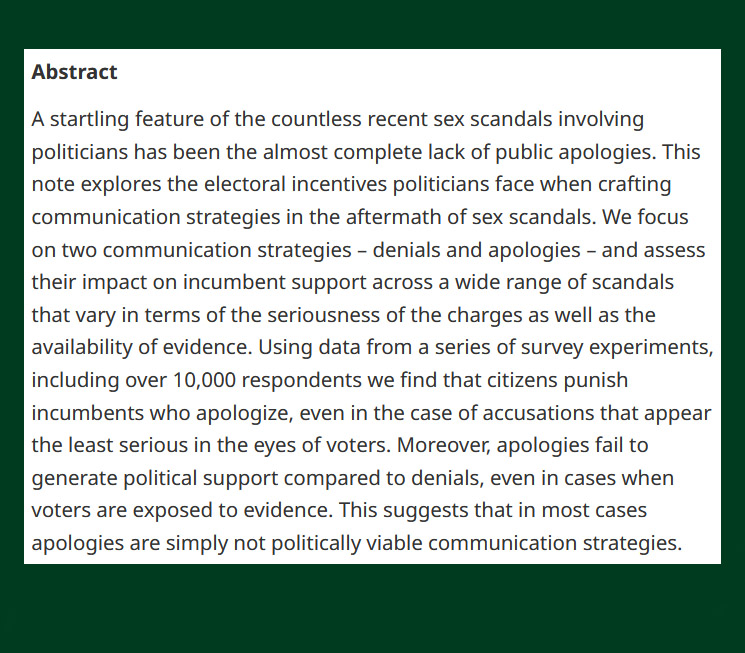
Why Politicians Won't Apologize: Communication Effects in the Aftermath of Sex Scandals - https://t.co/0TwWYrmAwc
- Bence Hamrak (@ceu), Gabor Simonovits (@ceu), Alex Rusnak (@ComeniusUni) & Ferenc Szucs (@Stockholm_Uni)
Survey Research in Authoritarian States: Research Group Workshop | Deadline: February 14, 2025
2025 APSA Virtual Research Meeting (VRM) | April 10th & 11th | Apply to a Virtual Research Group Workshop!
https://t.co/sTxkgV6ix0
#OpenAccess from our new issue -
In the Shadows of Great Men: Retired Leaders and Informal Power Constraints in Autocracies - https://t.co/3XVuYhtEYY
- Junyan Jiang (@Columbia), Tianyang Xi (@PKU1898) & Haojun Xie (@CUHKofficial)
Congrats to Aparajita Datta (@datta_aparajita)! Her paper "Policy Feedback, Energy Equity, and Climate Justice: Can Existing Policies Improve Solar Access for Low- and Moderate-Income Communities in the United States?" was just published in @ps_polisci.
https://t.co/PMgbPI0zj4